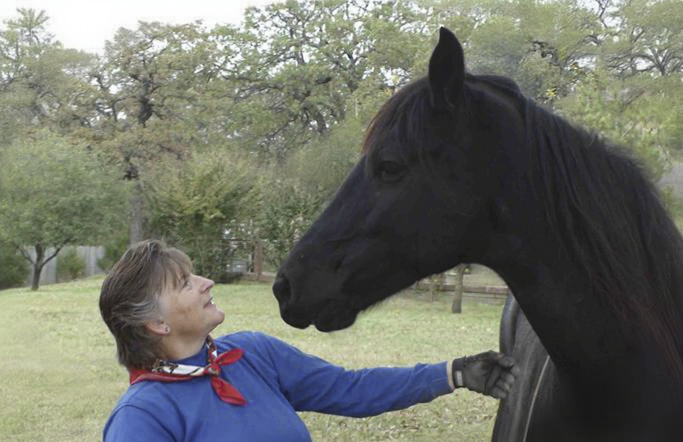
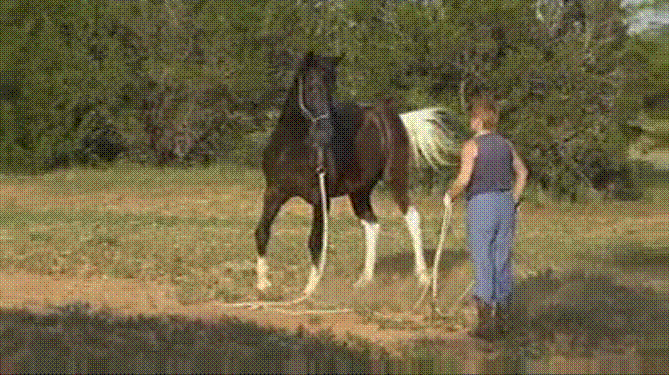
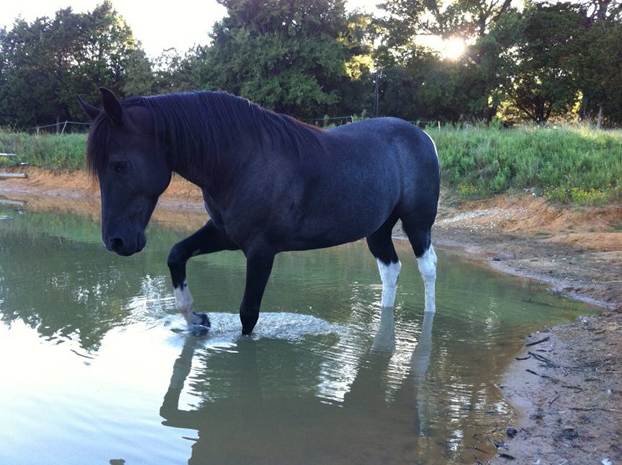
At the seasoned age of 48, I became the naïve owner of a
horse. I am one of those rare people
that had never dreamed of owning or riding horses. My daughter, Cody Anne, was eight years old
when we became horse owners. Cody Anne
was one of those little girls who continuously asked for a pony from the day
she learned to talk. She loved animals
and our routine outings usually included some sort of animal activity. Cody had to ride the pony at every petting
zoo and animal park we visited.
When Cody Anne was 7, we reluctantly let her take horseback
riding lessons at the local stable. We
quickly realized horse ownership was the only way for her to understand how to
care for and truly develop a relationship with a horse. Cody Anne also continuously expressed her
plans to be a veterinarian and help animals.
As parents, we realized that Cody Anne needed to know first-hand about
nurturing and caring for animals to make sure she really wanted to pursue a
career as a veterinarian. This is how Rio Bravo Rocky Road
(known as Rocky) joined our family.
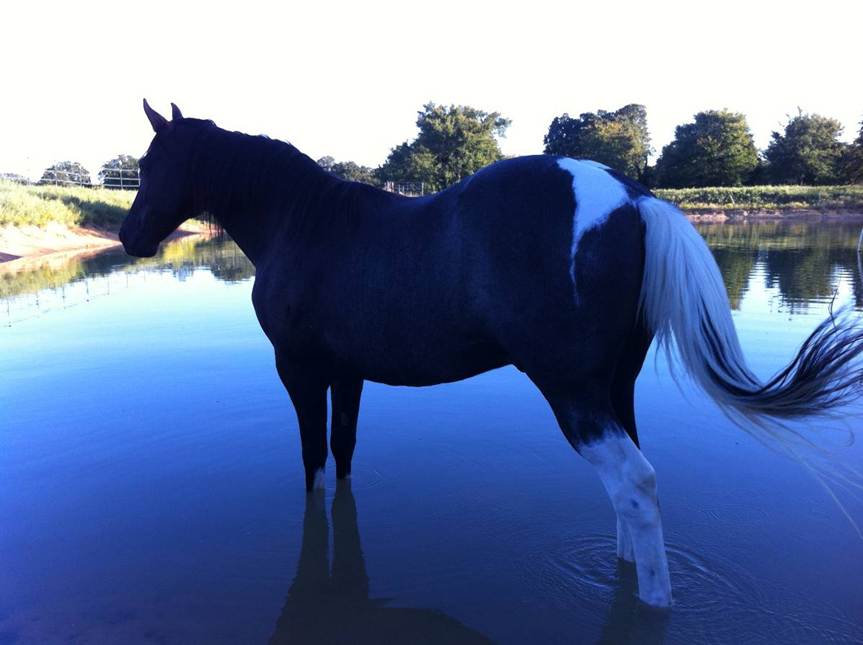
The decision to buy a horse is a life
changing decision. We had many
family discussions about the life long commitment
needed to care for a horse. These
commitments were not just monetary but also caring for the physical and
emotional needs of a living being.
Before buying a horse, we observed many of our stable
friends purchase the perfect horse and descend into a cruel cycle of
·
Buy the horse of your dreams.
·
Realize the horse has
problems and needs training.
·
Send the horse to a trainer.
·
Enjoy the newly trained horse for a few weeks.
·
Realize the horse is broken again and needs to
be fixed.
·
Sell the broken horse and buy a better one.
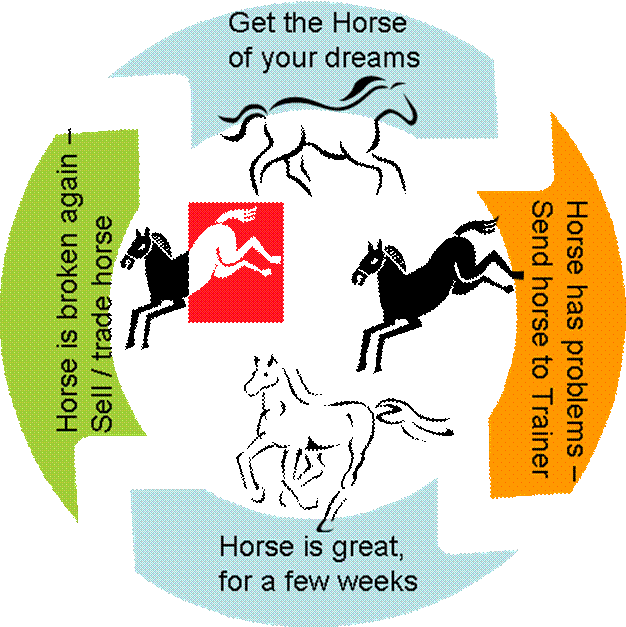
Figure 1 Horse Buying
Cycle
We were determined not to descend into this cruel spiral and
were committed to do whatever was necessary to make
sure Cody Anne and her horse had a long-term positive relationship.
We quickly learned why the term “horse trader” is a
justifiable insult. Unfortunately, our
personal experience is typical of many new horse owners. Here is the common sequence of events
associated with buying the first horse:
·
The horse owner has a difficult horse and needs
to find a naïve buyer.
·
The horse is boarded at a stable where children
take riding lessons.
·
The horse is perfectly happy and well-behaved
grazing in the stable pasture.
·
The horse owner reluctantly announces they must
sell the horse. In our case, the horse owner
developed severe back problems and would never be able to ride again. The owner seemed genuinely upset about her
situation.
·
Your child falls in love with the horse and begs
you to buy the horse.
·
You have the veterinarian check the horse.
·
There doesn’t seem to be any negative qualities
with the horse.
·
You buy the horse for your child and quickly
realize this is the most dangerous mistake you have ever made.
·
Your new horse’s prior owner miraculously
recovers and is riding a new horse.
·
You are in absolute shock about the level of
deceit exhibited by some people and their total lack of guilt about selling an
animal they couldn’t handle to a child.
I grew up on a family farm raising cattle and hogs so I am very familiar with handling large
livestock. I quickly realized Rocky was
creating dangerous situations for himself and the humans around him. You may wonder “what were the warning signs?” Here are some of the most troubling warning
signs:
·
Food aggression.
Rocky did not like people to be near him while he ate sweet feed or hay
in his stall area. I was standing near
Rocky while he was eating hay one day and he bit me in the stomach. I had a huge swollen hard hematoma bigger
than my fist for months. I was shocked
that he would bite me without any apparent provocation that I could recognize
on my part. I was afraid he would bite
someone else (especially my daughter) in the same manner.
·
Biting.
Fortunately, for everyone else, Rocky only bit me. Rocky did not nip – he would bite with the
full force of his teeth. When he did make contact, I would have hematomas and deep muscle
swellings that lasted for weeks. The
injuries from his bites were bigger than my fist. I know horses bite one another all the time,
but this s a dangerous situation for people.
I was especially concerned that Rocky would bite the children that loved
to pet him and give him treats.
·
Kicking.
When Rocky didn’t want me around, he would swing his hind quarters
toward me and kick. He would also jump
up and kick out with his hind legs when he galloped away from me. This is natural behavior with other horses,
but I was afraid he would actually make contact and
hurt someone.
·
Cowgirl at the rodeo. I thought it would help develop a
relationship with Rocky if I took some riding lessons with him. This had the opposite effect and made our
relationship far worse. Our rides would
begin calm and then explode. My extreme
experiences riding Rocky include runaway galloping rides, being bucked off, and
rides described by observers as the equivalent of rodeo quality bucking bronc
rides. There are photos of Rocky bucking
under saddle in Chapter 7. The bucking
section in Chapter 7 is called “The Storm” and shows how much energy Rocky has
when he bucks under saddle. I must give
Rocky credit for NEVER doing this with my daughter.
·
Kick butt to the death. Yes, kicking is a natural horse behavior but it was apparent that Rocky had the willpower to
fight this battle to the death. Every
morning, Rocky and a Belgian draft horse would fight for dominance. They would kick one another with their hind
legs until Rocky was knocked to the ground.
He usually got up and tried again until the Belgian got bored and left
him. I heard people say the Belgian
would eventually kill him if he did not give in. He never did.
We had to separate Rocky from the Belgian. One fence of separation was not enough; they
would kick one another through the fence.
Several times, I had to cut him out of the slick wire and have the vet
treat the wounds on his legs.
You may wonder how I did not see these signs prior to
purchasing Rocky and that is an excellent question. I have thought long and hard about it and
spent many sleepless nights devoted to that same question. You must remember that all
of these events occurred before I understood much about horse behavior
and before Pat Parelli starting introducing his
Horsenality concepts in 2006.
Rocky is great lawn art.
He is a beautiful horse and has obviously been around people most of his
life. He loved being fed treats by all
the kids. In general, Rocky had good
ground manners and was not difficult to catch, groom, bridle, saddle, or
wash.
Rocky never exhibited aggressive behavior toward my daughter
or the other children at the stable. I
am eternally grateful that Rocky never viewed my daughter as a threat to his
dominance. While he was grazing in the
pasture, he didn’t mind anything my daughter did. She could walk up to Rocky and crawl up this
mane to sit on him bareback without a halter in the pasture. My daughter rode Rocky in her horseback
riding lessons and didn’t have any behavior problems with him. Rocky was used for children’s riding lessons
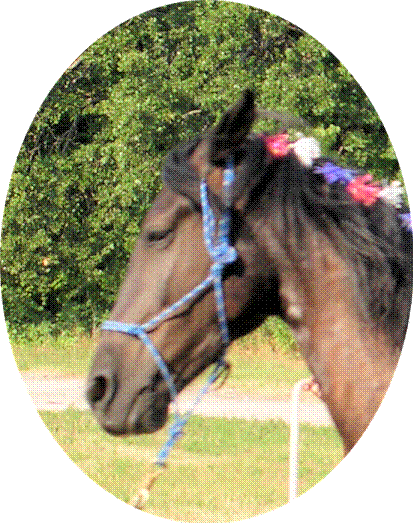
and the following photo shows Rocky after the children dressed him up during a
riding camp in the summer of 2004.
I realized that before we bought Rocky, he didn’t have any
reason to behave badly at the stable because very few people interacted with
him other than to feed him. He didn’t
have anyone that asked him to do anything that he didn’t want to do. His prior owner did not come to the stable to
visit him. The stable manager didn’t
present a challenge for him. She put him
in a stall at night, gave him food, and put him in the pasture in the morning. Kids taking riding lessons didn’t present a
challenge to Rocky’s dominance – they were happy to groom him, give him treats,
and let him pick the pace – he was in charge and getting treats too. He got to be with the other horses at the
stable and didn’t have any human challenges to his dominance. That is, until I came into his life and
unwittingly became his sparring partner in the dominance game.
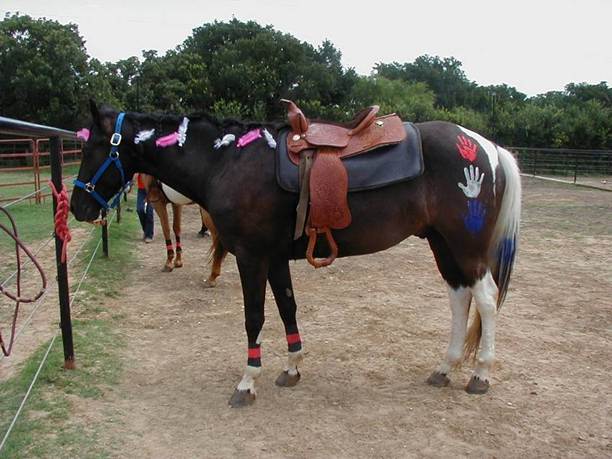
Figure 2 Rocky Dressed Up for Kids Camp
Have you ever heard the 30 second rule? Many people suggested there was a 30 second
rule with horse behavior. They said I
had 30 seconds to punish Rocky after a bad behavior or
he would never learn. Even at the time,
it seemed like such an arbitrary and odd rule.
That horse could remember which stall was his, where the food buckets
were located, which kids usually brought treats, which door of the truck had
the treat bag, and a whole list of other things for longer than 30
seconds. How could he possibly not
remember biting me for longer than 30 seconds?
Another idea presented to me was that he only bites because
he expects a treat so you shouldn’t give him treats anymore. Withholding treats did not change his
behavior so I was back to trying the 30 second rule.
Personally, I have a problem with physical punishment. I raised my daughter by rewarding good
behavior, removing privileges for poor behavior, and never resorting to
violence. Like many people, I am not
prone to violence and had never slapped another human
being or animal. Would slapping Rocky
when he bit me stop the behavior?
Absolutely NOT. I am ashamed to
say that I actually tried slapping him on the neck in
response to his attempts to bite and it only escalated the dominance games to a
totally new level! He grew more
aggressive.
Many horses don’t like being caught to be saddled and
ridden. The owner must play the
“catching game” to get close enough to the horse to halter them. Rocky was always easy to catch. He would look me
square in the eyes and wait when I approached him in the pasture. Initially, I thought this was a friendly
gesture on his part. I was so
wrong! He was plotting how to fight and
win the next round of the dominance game.
I never had any trouble putting the halter or bridle on
Rocky. I would walk up to him in the
pasture and put the halter on him without any problems. Most people lead their horse with the horse
trailing behind them. I quickly learned
to NOT do that unless I wanted to risk being bitten from behind.
In addition to biting, his aggressive behavior started to
include attempts to kick with those powerful hind
legs. It may sound like a cliché, but
both of our lives were at stake. Rocky
could easily kill me with one swift kick and his future
was bleak if he did not stop this behavior.
I noticed Rocky and other horses in the pasture biting one another on
the hind end all of the time. I developed the habit of picking up small
round rocks in the parking lot as I approached the horse pasture. If he tried to swing his hind legs around
toward me, I would toss a rock at his hind quarters. When I first started this, Rocky was startled
and seemed confused about what was happening but he
quickly got out of the kicking habit. Today,
he has a fantastic hind quarter yield.
People said it was easier to handle a horse from the
saddle. This advice didn’t sound right
to me but others had a lot more experience than I did
and must know more than I did. Please
remember that Rocky was our first horse and I had ZERO riding experience. I am only 5 foot tall
and Rocky is 15 ½ hands high so getting in the saddle is a challenge without a
mounting block. Rocky stood still while
I got on so I decided to try more riding with the mistaken idea that sitting in
the saddle would give me some advantage. I had a lot of wild, scary rides because of
this advice.
Why would a 48 year old woman play
the ultimate game with an 1100 pound master of the
dominance game?
I wanted my daughter to understand commitment. This may sound old fashioned
but we live in a disposable society where everything can be thrown away and
replaced with a newer model
– spouses, cars, cell phones, pets -- everything. Prior to purchasing Rocky, we as a family agreed
that owning a horse was a life long commitment. We had seen people churn horses because
something was always wrong with the horse. We agreed not to treat the horse as a
disposable toy but as a living being to be respected. What kind of commitment
lesson would I be teaching my daughter if I were to sell Rocky?
There were many days that it took every ounce of courage
that I could muster to go into the pasture with Rocky. But, I had nagging
doubts that maybe I somehow caused the horse behavior problems and if that was
true then it was my responsibility to correct the problem. I am life long
learner and was certainly willing to learn new skills.
The general pattern of Rocky’s biting behavior seemed to
be:
·
everything is fine
·
sudden quick bite or attempt to bite
·
retreat and wait for my response.
This behavior was dangerous, but
didn’t seem to signal that his intent was to actually kill
me. It seemed more like he was
attempting to get my attention or to set a boundary. I had two choices, avoid it by selling him or
deal with it.
As a mother, I had read a lot of literature about toddler behavior and
how to handle aggressive behavior (biting and hitting) with
talking about consequences, timeouts, and holding your toddler so they can’t
bite or hit. There didn’t seem to be any
way to talk, use timeouts, or restrain Rocky.
My biggest fear was that Rocky would hurt my daughter or
someone else. My husband was convinced
Rocky would probably end up as dog food if we were to sell him or give him away. Anyway, we would not pass
an animal we could not handle to someone else.
What were the options?
We considered sending Rocky to a trainer and talked to a lot of
experienced horse people. I was appalled
that most of the trainers would not or could not describe their methods or why
their methods worked. Based on my
observations of the disappointment others experienced after their horses
returned from the trainer, I decided sending Rocky to a trainer was not a
viable option.
The stable manager suggested a self training program called
Parelli. She didn’t know much about it
but knew several people that liked it. I
researched the Parelli approach and was impressed with the idea of a documented
curriculum and training tasks for both the owner and the horse. In the Fall of 2003, I bought the Parelli
Level 1 program and we (Rocky and I) began the natural
horsemanship journey.
The following figure shows our progress.
The
following timeline shows our progress through the Parelli Natural Horsemanship
levels as we worked on our horse and human partnership.

Figure 3 Our Parelli Levels Progress
The following timeline shows the Parelli program was expanding
and maturing as we worked our way through Levels 1 and 2. “Horsenality™”
is the term Pat Parelli uses to
describe how to understand a horse by analyzing the horse’s personality
type. Each horse personality
(Horsenality) is associated with the innate behaviors of a horse and Parelli
has suggested methods to teach each horse based on their individual Horsenality.
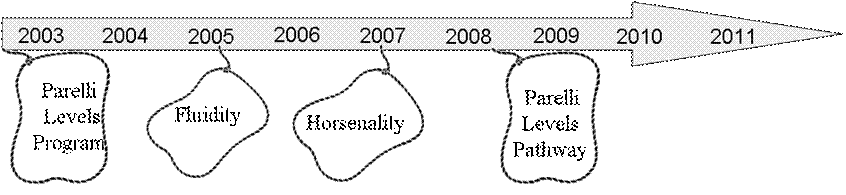
Figure 4 Parelli Program Updates
You can see that much of our progress through Parelli Level
2 was tied to the development of Horsenality.
I could finally associate Rocky’s behavior with his innate needs and
develop a set of effective responses. I
learned to read Rocky’s behavior and apply effective responses so that we could
finally make progress in our relationship.
After our rocky start (pun intended), I had a difficult time
trusting Rocky not to hurt me and trusting myself to be able to handle
difficult situations. Horsenality helped
me overcome my trust issues because I understood a lot more about Rocky’s real
needs.
The follwing figure shows our progress through the Parelli levels.
The following charts show the Parelli Horsenality Profiles. I used red checkmarks to indicate Rocky’s
characteristics. The first chart shows
Rocky’s profile before we did Levels 1 and 2. The right brain traits checked for
Rocky were not the typical fear response of a right brained
horse but rather the cold calculating acts of aggression associated with a
confident left brained horse. His tendency to rear was to attack in anger,
not an act of fear. The second chart is
his profile after we completed Level 2.
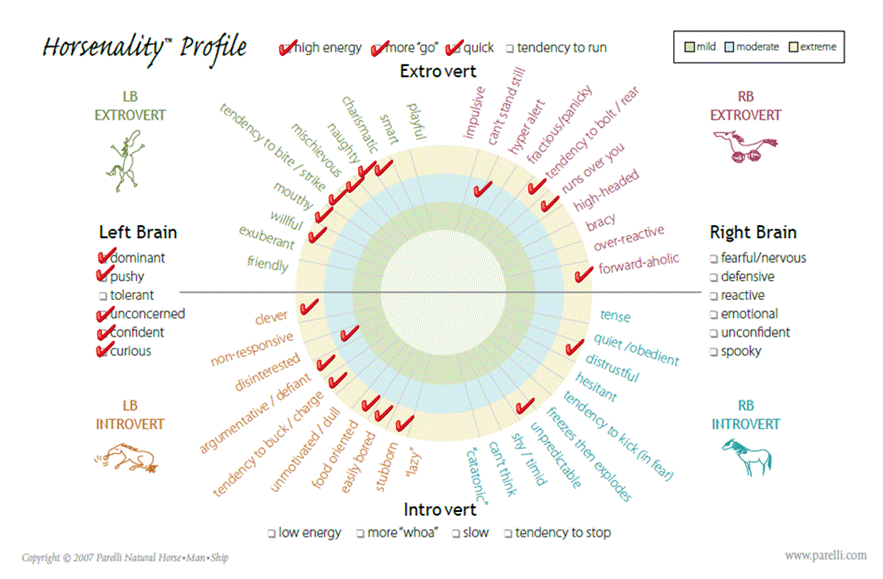
Figure 5 Rocky's Horsenality Profile Before Parelli
We spent a lot of time developing our relationship and
learning to trust one another. I spent a
lot of time just wandering around the pasture with Rocky while he ate. Rocky would follow me around the pasture
while I did chores like cutting weeds out of the fence row and dragging fallen
limbs out of the pasture.
We became devotees of the friendly game. I discovered Rocky’s favorite scratching spots and he started telling me where he wanted to be
scratched. He started walking up to me
and bending his head toward me to indicate that ear needed to be
scratched. He would bend his head and
use his nose to point to itchy areas on his body or legs for me to
scratch. He would also point to pesky
horse flies that he couldn’t remove himself.
Instead of waiting in the pasture with a defiant look as I
approach him, Rocky now crosses the pasture to meet me and see what we are
going to do. I often saddle him and just
sit on him for hours while he eats hay or grazes in the pasture. We spent 5 long years mastering the lessons
in Levels 1 and 2 to get to this point, but we finally developed the skills and
relationship needed to pass Level 2.
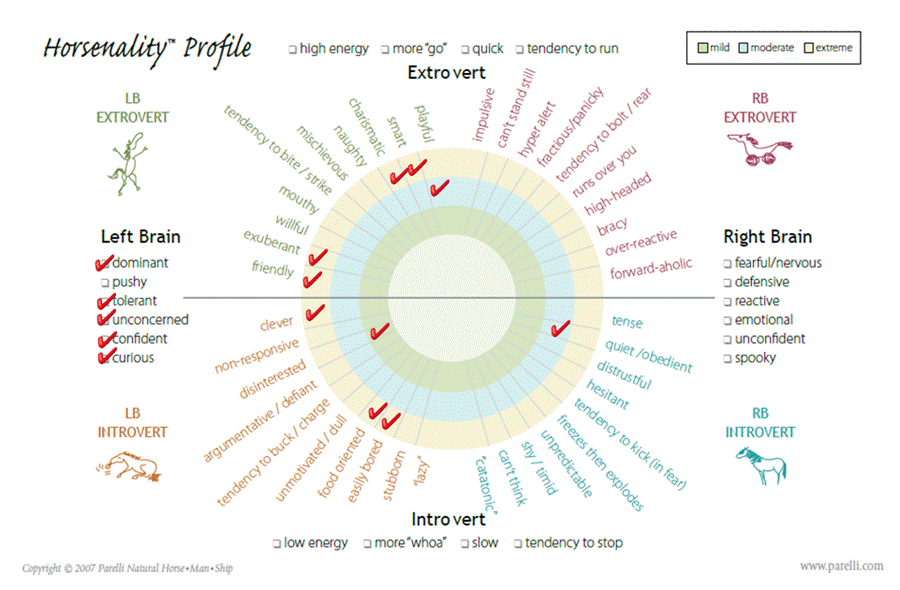
Figure 6 Rocky's Horsenality Profile After Parelli
Level 2
Rocky definitely exhibits the left
brained Introvert trait of “what is in it for me?” I must continuously find new ways for him to
get positive reinforcements like scratching, quiet time, and of course
FOOD. I have to
be very creative to make sure Rocky isn’t bored. When he is bored, he is very disinterested in
anything but food. In the remainder of
this book, I have tried to provide examples of keeping the left
brained introvert interested and not bored by our
activities.
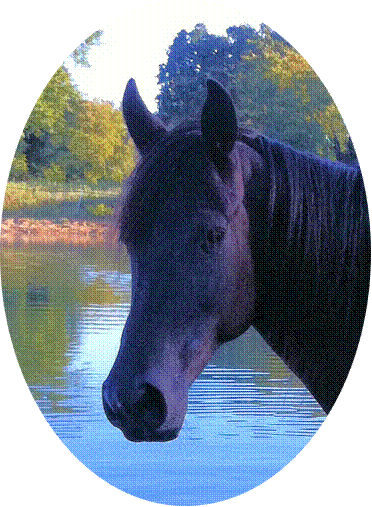
The following photos
show Rocky’s transformation from a very angry horse in 2004 to the happy
well-adjusted horse he is today. I chose
these two photos of Rocky’s head to illustrate the massive transformation that
Rocky has experienced. Rocky had the expression in the photo on the left
frequently when we bought him. I called
it his “unhappy face” because I didn’t understand what he was trying to tell
me.
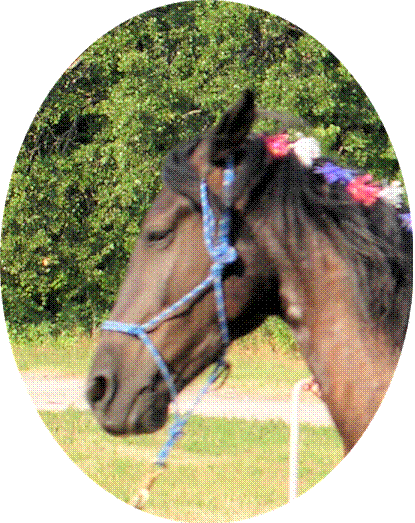
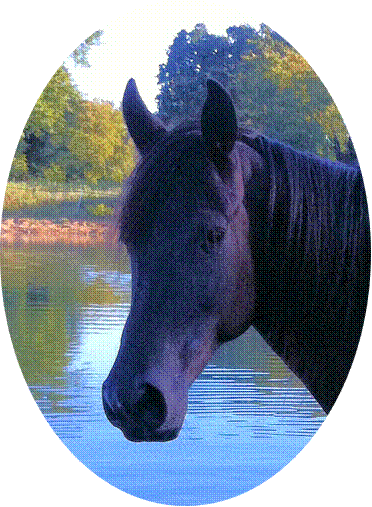
Figure 7 The Transformation
When we first bought Rocky, I did not have a clue about the
level of anger and unhappiness he was experiencing. In my search for help with Rocky, I bought
nearly every horse book in the bookstore and scoured the Internet for
help. I talked to a lot of people and
observed a lot of horses in many different settings. Not a single book, website, or expert
provided a clue about the massive quantity of angry emotion Rocky was
exhibiting in the photo on the left.
Rocky was screaming
for help and no one was listening.
I didn’t understand
what Rocky was trying to tell me with his expression and his behavior; but, I did understand that he could be very aggressive
toward humans and extremely dangerous when he was angry. Christi Rains and the Parelli Natural
Horsemanship training materials taught me to listen to Rocky and help him work
through his angry emotions. Parelli’s “Horsenality™”
taught me to understand Rocky and how to use natural approaches suited for his
innate left brained introverted personality.
Chapter 4 A “Rocky” Start with Parelli Level 1
In the Fall of 2003, the basic Parelli Level 1 kit included
little brown instruction booklets, a VHS video tape, a halter with a 12 foot lead rope, a riding hackamore halter, and a carrot
stick with a savvy string. I studied the
books and started watching the VHS tape.
The books provided progressive tasks that should be completed in a sequential order. Each
task had step by step directions with a set of
objections for the horse. I was
especially interested in the troubleshooting tips for each task because Rocky
never seemed to respond as described in the tasks.
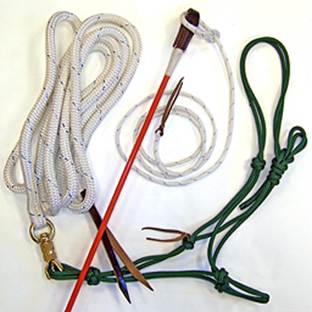
Figure 8 Parelli Level 1 Gear[3]
How did Rocky react to our new equipment? Using the halter was not a problem once I
mastered tying it. When I brought out
the carrot stick, Rocky reared up and grabbed the carrot stick with his
mouth. He jerked the lead rope out of my
hands and then galloped across the pasture to get as far away from me as he
could. He dropped the stick on the
ground and turned to face my direction.
I had no idea what to do. The
little brown books didn’t cover this reaction to the carrot stick but I
certainly recognized that familiar defiant look. I now know his look was declaring he would
fight any challenge to his dominance.
I walked slowly across the pasture to pick up the stick and
lead rope. Rocky acted like he was going
to attack me so I left the stick on the ground. I picked up the lead rope and walked Rocky
back to the barn. I put him in his stall
and then retrieved the carrot stick. I
went home to study the little brown books some more and try to figure out what
to do.
Our first attempts at using the old Level 1 books were
frightening. I am an engineer and know
how to analyze situations, develop solutions, and follow instructions. I went through the lessons in order but Rocky’s responses didn’t seem to match the horses
described in these books. Many times, I started over from the beginning
to make sure I didn’t miss anything. I
honestly tried to understand what was happening, why it was happening, and what
actions I should take to make the situation better.
The following table lists the Parelli Games and provides
examples of the kind of tasks you can do while playing each game. There are endless ways to use the basic idea
of the games and develop fun activities to play while teaching your horse.
Table 1 Introduction to Parelli Games
|
Parelli Game
|
Type of Tasks
|
Examples of the
Tasks
|
|
Friendly
|
Touch and rub the horse all
over their body. Horse is comfortable
no matter where you stand or touch.
|
Rub the horse with the
carrot stick. Gently toss the carrot string
over the horse. Use Extreme Friendly
by vigorously hitting the ground with the carrot stick and string.
|
|
Porcupine
|
Follow your feel and yield to pressure.
|
Backup with pressure on the
nose or chest. Sideways by alternating
pressure on the shoulders and hind quarters.
|
|
Driving
|
Give directions and move
the horse.
|
Drive horse backward. Yield the hindquarters. Yield the shoulders.
|
|
YoYo
|
Back the horse away and
draw back to you.
|
Simple back up and
draw. Back up over an obstacle like a
pole.
|
|
Circling
|
Send the horse backward,
allow the horse to circle, and come back to you.
|
Simple circles on a lead
rope. Circling with obstacles
requiring the horse to jump over barrels or trot over poles.
|
|
Sideways
|
Send the horse sideways.
|
Move sideways while
straddling a pole.
|
|
Squeeze
|
Send the horse through
small and narrow spaces.
|
Trailer loading or send the horse through a narrow space between you and a
fence.
|
The driving tasks were another version of the biting game
for us. He would bite me so fast when I
least expected it that I didn’t see it coming.
He moved so fast that I didn’t even see his ears go back before the
bite. Other times Rocky would rear up,
grab the carrot stick with his mouth, and gallop away with the carrot stick.
The YoYo game involves backing the horse away from you and
then drawing the horse to you. This game
offers a great opportunity for the horse to rear up and then lunge at you so he
can bite you or steal the carrot stick.
I was so stressed by these attacks that I resorted to standing in the
middle of a hay ring to play the driving and yoyo games.
The circling game presents an irresistible opportunity to
attack from the rear. Yes, some horses
love to be sent on a circle so they can bite you on
the back while you are standing still facing the other way. I quickly found out that Rocky relished a circling
sneak attack while my back was turned. He
also loved stealing the carrot stick – he would rush at me from behind, grab
the carrot stick from my hands, and gallop away with the carrot stick. How desperate was I to avoid being attacked
from behind? I started climbing onto a
stack of big round hay bales to be out of his reach during the circling game.
I made the conscious decision to NEVER TURN MY BACK and
RUN! This may sound really
stupid and dangerous but I reasoned that he
could easily outrun me and attack anyway.
I would rather keep my eyes on him.
Those of you that have studied the new Parelli HorsenalitiesTM realize that I was playing
dominance games with a very dominant horse.
These early lessons were teaching me to use dominant behavior with a
horse that played the dominance games to win at all
costs. Rocky responded in a natural way
to defend the threats to his position of dominance. At that time, I had no idea – the little brown
books didn’t say anything about this.
It took every ounce of courage that I could muster to work
with Rocky while I tried desperately to find some knowledgeable help. During this time, I told my husband that we
should make out our wills. We had a
child and needed to make sure she was well cared for if anything happened to
one or both of us. I made sure our wills
included a medical power of attorney and a medical
directive for life sustaining procedures.
I am a firm believer that as long as there is life, there is hope so our
medical directive instructions were “Do not pull the plug and keep alive”.
At this point, many people thought I was a dangerous fool
and that I was making Rocky mean. I was
desperate to keep the situation from escalating even further out of control. I frantically searched for some help and found Christi
Rains’ Parelli clinics. I immediately
signed up for a Level 1 clinic. During
the next year, I went to four Level 1 clinics and developed the skills needed
to officially pass Level 1.
Back in 2003, the Parelli Level 1 curriculum focused on
Safety. The Parelli Level 2 was called
Harmony and was the beginning of Parelli’s focus on the horse
relationship. I definitely
viewed our Level 1 situation with Rocky as a safety problem to be
solved.
Christi is a superb instructor with many years of
experience. Her weekend training camps
provided me with invaluable horsemanship skills. I always felt awkward introducing myself at
the start of each camp. The other camp
participants had wonderful and exciting plans for themselves and their
horses. I had absolutely no plans to
compete, do dressage, trail ride, or anything else. I just wanted to survive horse ownership and
teach my daughter about commitment in the face of difficult situations. I usually introduced myself as a Mom who wanted to make our horse safe for my daughter.
Rocky went through a lot of emotions during our Parelli
Level 1 activities. I spent a lot of
time observing Rocky and the other horses.
It was obvious that Level 1 presented Rocky with a lot of emotional
challenges. He became a loner
horse. He started hanging out by himself
in the pasture and not grazing or playing with the other horses. I knew I was having an impact on him and I hoped it was a positive impact. Rocky was a horse with a
natural charisma, high play drive, and energetic spirit. I certainly did not want to destroy Rocky’s
basic nature in order to keep his human companions
safe.
My top priority is safety and, for Rocky, this meant letting
him know that I would defend my personal space so that he could not get close
enough to bite. Wax-on and Wax-off
became new buzz words for our family.
Wax-on and Wax-off are defensive karate moves where you wave your arm
between you and the opponent. Christi
taught us how to use these moves. When
Rocky attempted to barge into our personal space un-invited, we would wave our
arms in a rhythmic arc so that he would hit an arm or sharp elbow before he
could bite. You don’t focus on the horse;
you are just moving your arms.
I learned to use the carrot stick like another appendage to
establish my personal space. While
walking with Rocky behind me, I would rhythmically move the carrot stick behind
me (like a dog wagging his tail) in a horizontal arc over the ground. When Rocky was in front of me, I would rhythmically
move the carrot stick to make a barrier between us. I would not focus on either Rocky or the
carrot stick. If Rocky tried to barge
into my space or get aggressive, then he would run into the barrier created by the
carrot stick.
The main idea behind the karate moves (wax-on and wax-off) and
using the carrot stick to establish your personal space is to let the horse
know you have a personal space boundary. Horses defend their personal space so they understand this concept. Also, you are not being aggressive toward the
horse. If the horse moves toward you,
then the consequence of their action is that they run into a barrier (your arm
or the carrot stick). Rocky grudgingly
learned that I would defend my personal space and he started to respect my
space.
Parelli uses seven basic games throughout the program to
develop the relationship between the horse and human. The games also
teach the horse to RESPECT the human. The
first three games are a foundation for all of the
horse activities. The other four games build on the three foundation games
so the games need to be mastered in sequence.
The games and our Level 1 experiences are captured in the following
table.
Table 2 Parelli Games in Level 1
|
Parelli Game
|
What the Parelli method teaches the
horse
|
What I learned from playing the games with my horse
|
|
Friendly
|
The horse learns to trust
you.
|
I learned to observe
Rocky’s emotions and what made him feel good.
|
|
Porcupine
|
The horse learns to yield
to pressure and move away from pressure.
|
I began to understand
Rocky’s sensitivities. I learned how
to use pressure in phases and recognize proper responses.
|
|
Driving
|
The horse learns to pay
attention to you and respond to your requests.
|
I learned volumes about
Rocky’s natural drive to be the dominant member of every relationship and how
to respond to Rocky’s aggression.
|
|
YoYo
|
The horse learns to back
away from you and be drawn back to you.
|
I started learning to use
pressure with effective phases to balance drive and draw and how to deal with
aggressive reactions.
|
|
Circling
|
The horse learns to be sent
on a circle and be drawn back to you. The horse learns to maintain gait and to
pay attention to the human.
|
I learned to use the lead rope and carrot stick together to safely play
this game with effective phases. I
started learning about Rocky’s emotions and the resulting acts of aggression.
|
|
Sideways
|
The horse learns to move
sideways. The horse is forced to slow
down and think.
|
Initially, I had to learn
to stay out of the kick zone. I
learned to use this as a comfort game for us.
|
|
Squeeze
|
The horse learns to think
and be calm in small spaces.
|
I learned to use the
squeeze game to keep Rocky interested and not bored.
|
The friendly and porcupine games reminded me a lot about the
games people play when they are developing a new relationship. When people first meet, they try to find
something in common like music or a hobby.
Then they try to find activities they can share and enjoy together. They also begin to set boundaries in their
relationship.
Rocky and I didn’t have too many issues with games 1 and 2. Rocky loved to be
groomed and scratched everywhere with my hands.
Compared to the other games, the friendly and porcupine games were easy
with my hands. Our challenge was using
the carrot stick. Rocky did not want the
carrot stick in our relationship.
Christi taught me to use a lot of “approach and retreat”
exercises to desensitize Rocky to the carrot stick. Approach and retreat forced me to learn to
recognize Rocky’s thresholds. I
practiced moving the stick toward Rocky until he was uncomfortable and then I
would back off. Christi taught me a variety
of ways to use the carrot stick with rhythmic motions to move the carrot stick
back and forth. Eventually, we overcame
his fear of the carrot stick. Now he
can’t wait for me to scratch his under belly with the leather tab on the end of
the stick. The following table describes
the basics of approach and retreat.
Table 3 Approach and Retreat
|
Tool
|
Longer Distances to
horse
|
Close to horse
|
|
Lead rope
|
Walk calmly at the end of
the lead rope with the horse behind you.
As the horse gets comfortable shorten the lead rope until he is
uncomfortable and then lengthen the rope a little.
|
Face the horse holding the
lead rope. When he is comfortable with
the distance, draw him to you by shortening the lead rope and back off when
he is uncomfortable.
|
|
Carrot Stick or other
object that upsets Rocky
|
Walk casually with the object
in front of you, away from the horse.
Use slow rhythmic motions to play with the object. Slowly start moving the object to your
sides as the horse gets comfortable. Finally,
start moving the object behind you.
Retreat to the front or sides when the horse is uncomfortable.
|
Use slow rhythmic motions
to play with the object. Move it up
and down, right to left. Start with
the object at your side and slowly move it in front of you. Whenever he is uncomfortable, make smaller
motions or move the object further away from him.
|
|
ME
|
Be calm, walk slowly, and
don’t focus on the object or Rocky.
|
Be calm, stand still, and
don’t focus on the object or Rocky.
|
My personal challenge was learning to relax and not putting pressure on Rocky.
I had to learn which of my actions put pressure on Rocky and how to
relax while doing the “approach and retreat” exercises. I realized that my tension was putting more
pressure on Rocky. I used these same
techniques to overcome his issues with other objects.
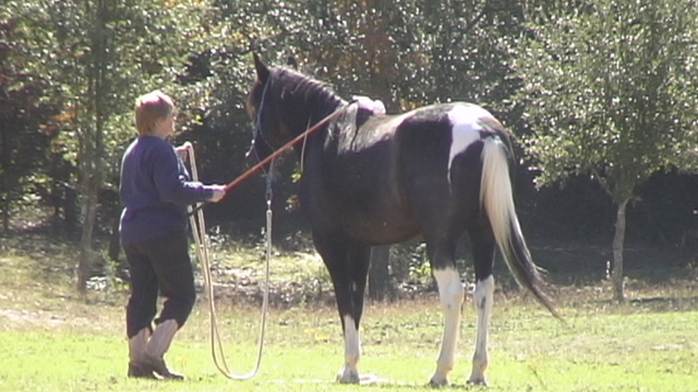
Figure 9 Approach and Retreat with Rocky
How did I help Rocky overcome his great sensitivity to the
carrot stick and savvy string? I used
many variations of approach and retreat.
The most successful one was to use the savvy string as a gentle fly
swatter. Whenever I saw Rocky vigorously
trying to get rid of a fly, I would use friendly with my hands to help
him. I gradually started introducing the
carrot stick and savvy string to help Rocky get rid of the fly. I am sure you have seen horses standing side
by side so they can use their tails to swat flies on one another. I would stand by Rocky and gently swing my
savvy string tail in the area where he had flies. It didn’t take long for Rocky to realize what
a great thing this was for him. Now, if
he has a pesky horse fly in some place he can’t reach (like his underbelly), he
will rush across the pasture to me so I can get the fly for him. While we are riding, the carrot stick and
savvy string also make a great a fly swatter.
Developing and using effective phases is a vital
horsemanship skill. The idea behind
effective phases is that you want to use the least amount of pressure possible
to communicate with the horse. Parelli
numbers the phases from 1 to 4 where phase 1 is the least amount of pressure
and phase 4 is “do whatever you need to save your life”. As an example for
making the horse back away from you with a YoYo, the phases
would be:
Phase 1: wiggle your finger without moving the
rope
Phase 2: wiggle your hand from the wrist to
shake the rope gently
Phase 3: wiggle your arm from the elbow to
shake the rope
Phase 4: use your entire arm and violently
shake the rope.
The idea is of a “long phase 1” gives the horse an
opportunity to respond to your request before you escalate the pressure to
phase 2. I learned to count to 10 using
phase 1 before moving on to phase 2. I
also learned to quickly use phase 4 if Rocky moved toward me or behaved in an
aggressive manner.
Driving is an extremely challenging game with a dominant
horse. I needed to learn effective
techniques to drive Rocky back a safe distance and keep him there. With Christi’s guidance, I learned to use the
lead rope and carrot stick with the driving game to keep Rocky at a safe distance.
Simply shaking the lead rope wasn’t usually effective when
Rocky was unhappy in Level 1 and it would inspire him to move toward me. The most effective technique to drive Rocky
back a safe distance was to move the carrot stick up and down forming a wall
above the lead rope and if Rocky didn’t back up I
would tap the lead rope with the carrot stick.
I had to keep the rope tight enough that the rope would vibrate the
halter snap and get Rocky’s attention.
These techniques are described in the following table.
Table 4 Level 1 Driving Techniques
|
Parelli Tool
|
Phase 1
|
Phase 2
|
Phase 3
|
Phase 4
|
|
Lead Rope
|
Shake the lead rope with
wrist action
|
Shake the lead rope with
elbow action
|
Shake the lead rope with
whole arm action
|
Send a rolling wave of
energy down the lead rope to violently move the metal snap attaching the rope
to the halter
|
|
Carrot stick and savvy string
|
Holding the string, slowly
move the carrot stick up and down
|
More vigorously move the
stick up and down
|
Tap the lead rope while
moving the stick up and down
|
Vigorously tap the lead
rope while moving the stick up and down making the metal snap move and if necessary march toward horse
|
One commonly used technique to drive the horse back a safe
distance is to use the carrot stick under the lead rope and move the carrot
stick horizontally in front of the horse’s chest with the carrot stick pointing
at the horse’s chest. This technique
worked for many of the horses at the camps. The horse doesn’t want to run into
the moving carrot stick so it backs away.
It only aggravated Rocky and inspired him to attempt to bite. By keeping the carrot stick above the lead
rope and moving the stick vertically up and down forming a wall between us,
Rocky would run into the carrot stick if he attempted to bite or move closer. The carrot stick is not pointing at Rocky, but is perpendicular to the lead rope and forms a
wall between us as it moves up and down as shown in the following pictures.
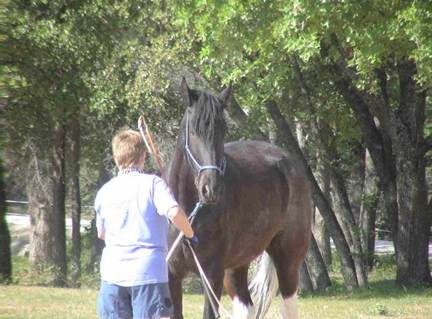
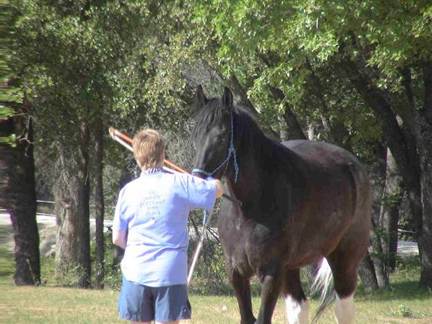
Figure 10
Driving Rocky Effectively
Once Rocky was back a safe distance, we would simply enjoy
one another’s company and not do anything.
Christi calls this dwell time.
Dwell time can be a reward for the horse. Rocky was a GO horse and liked to keep
moving. Dwell time was a way to let him
know it was OK to relax and just stand quietly around humans.
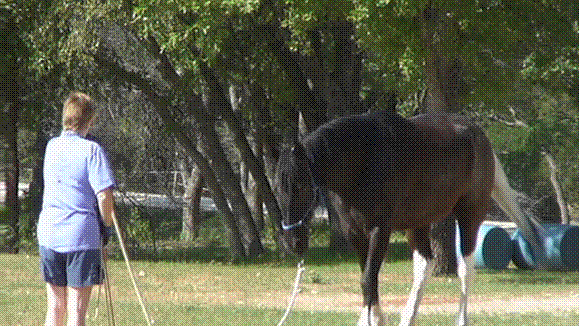
Figure 11 Dwell Time after Driving
If Rocky tried to move toward me, I would send him back
again. I would let Rocky into my
personal space at my discretion NOT HIS.
Rocky quickly learned to not charge into my space once he realized I
would drive him back if I didn’t invite him into my space.
Relaxing may sound easy to do but when you are terrified of
being bitten or worse, it is not easy. I
had to learn to relax around Rocky. Rocky
would not relax if I was still tense. I
used yoga exercises to learn to relax my whole body. After I relaxed, I would wait for Rocky to
relax. I would not do anything until he
relaxed. The following tables describe
our relaxed phases.
Table 5 My Relaxation Phases
|
Tools
|
Relaxed Phase
|
|
Lead Rope
|
Rope has no tension and
sags in the middle, the rope may even touch the
ground. You can keep a firm grip on
the end of the rope in case you need to take action.
|
|
Carrot stick and savvy string
|
Let the end of the carrot
stick and savvy string rest on the ground.
Keep your hands on the stick handle in case you need to take action.
|
|
ME
|
Stand quietly and relax
without moving. Breathe in and out
slowly. Don’t look at the horse
because it puts pressure on the horse.
BUT keep an eye on him. Don’t
move your hands or legs.
|
Table 6 Rocky’s Relaxation Phases
|
Tools
|
Relaxed Phase
|
|
Lead Rope
|
He allows the lead rope to
hang without tension. He is not
tugging on the rope or trying to move away or toward you.
|
|
Carrot stick and savvy string
|
He is not paying any
attention to the carrot stick or string.
|
|
Rocky
|
He doesn’t have any tension
in his face or body. He is standing quietly. His focus is on getting scratched, grazing,
or napping with his soft eyes mostly closed.
His head is up if he is interested in something, otherwise his head is
lowered.
|
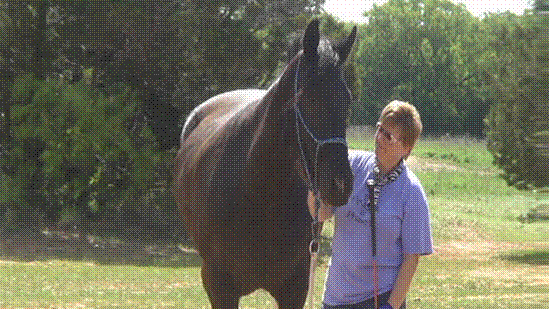
Figure 12 Relaxing Together
Driving and circling games brought out a lot of emotions for both of us.
We had to break old patterns and develop new ones. I had to learn to be effective and earn
Rocky’s respect. Rocky had to give me a
chance. Rocky bounced between responding
as expected and becoming more aggressive.
Rocky had a lot of GO and circling gave him a lot of opportunities to
get out of control. I bounced between
starting to feel like we were finally making progress and total despair when
things seemed to be moving in reverse back to old scary habits. We were working through some very emotional
“thresholds”.
The following photo shows Rocky all dressed up for the 4th
of July in 2004. I drove him away from
me when his face went “angry” and he started circling because it allowed him to
GO. He is exhibiting angry emotions with
his tense face, nose, eyes, and ears. This
is the face of an angry, aggressive horse that wants to take action to exert
his dominance. Unfortunately, this
expression was very common while we worked on Level 1.
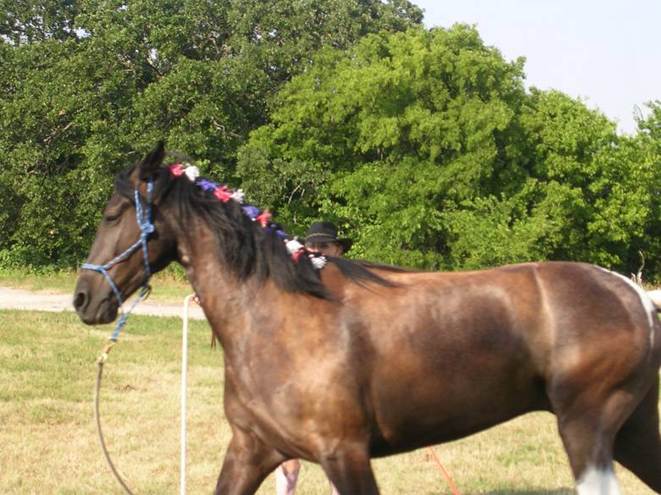
Figure 13 Angry Rocky on a Circle
I used a wave of energy down the 12 foot
line to interrupt his pattern in the next photo. I sent him in the other direction because a
change of direction makes him think.
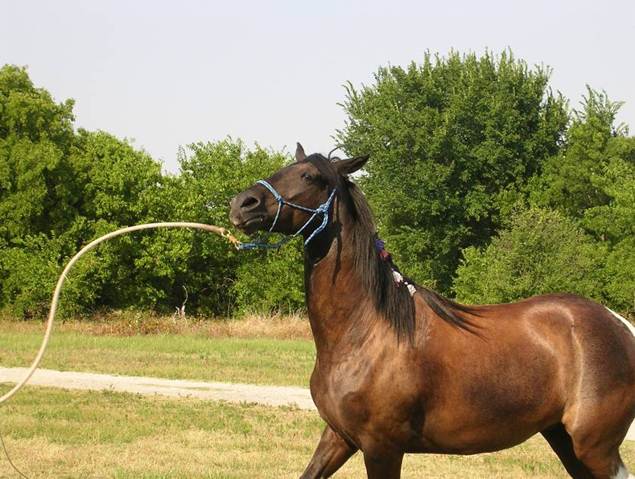
Figure 14 Wave of Energy on 12 ft Rope
After Rocky calmed down and had a “happy face”, I drew him
to me in the next photo. If you haven’t
noticed by now, I will admit that I am not exactly fashion conscious. As you can see in
most of the photos, I go for comfort when it comes to being with Rocky.
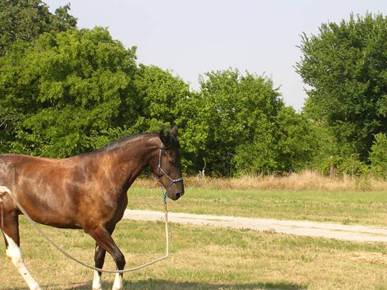
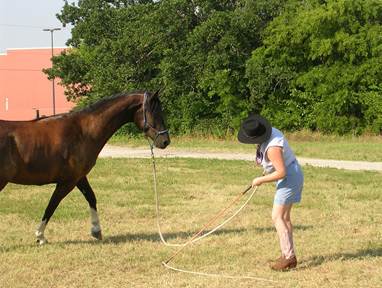
Figure 15 Drawn in with a Happier Face
After I drew Rocky back in from the circle, I scratched his
ear to make sure it was soft and not tense.
He likes ear scratches and frequently asks to have his ears
scratched. If he wouldn’t let me scratch
his ear or he was still tense, then I would drive him
away again and do another SLOW (NO GO) game like YoYo or sideways. In the next photo, Rocky gets some grazing
time as we spend some quiet dwell time.
Notice in the photo that I am keeping the carrot stick between the two
of us in case I need it to drive him back again.
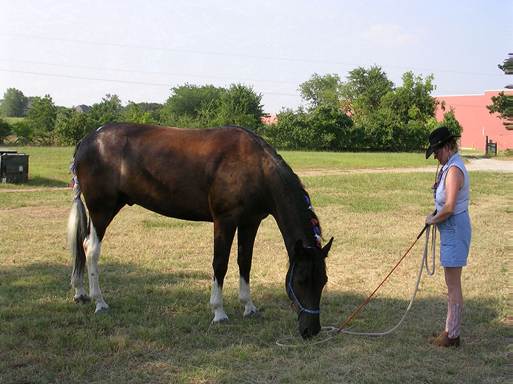
Figure 16 Dwell Time Reward
Sideways in Level 1 involves
standing by the fence, backing the horse away from you, sending the horse in an
arc to face the fence, and then putting rhythmic pressure on the front and rear
of the horse to get him to step sideways along the fence. We had a rough start, but I quickly realized
that sideways was a game we both enjoyed.
It became our comfort game.
Whenever things weren’t going right, I would move to a fence and
sideways Rocky for a few steps. A lot of
days I just released Rocky after a few successful sideways steps. Sideways became the answer for Rocky –
whenever he wasn’t sure what to do, he would start stepping sideways to see if
that was what I wanted. The following
photos show sideways with the 22 foot line.
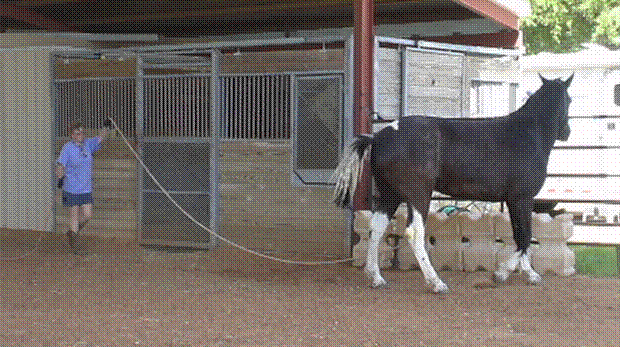
Figure 17 Basic Sideways with a Fence
Sideways over objects presented a new challenge. Initially, Rocky would not tolerate anything
under him. We started with very small
objects like a PVC pole on the ground.
Once Rocky overcame his fear of sideways over small objects, we rapidly
advanced to much larger objects such as logs and barrels.
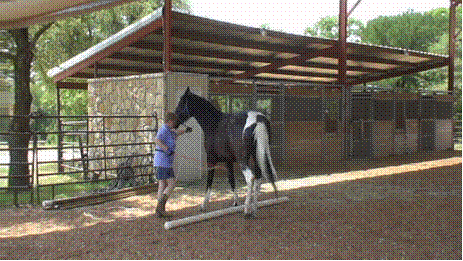
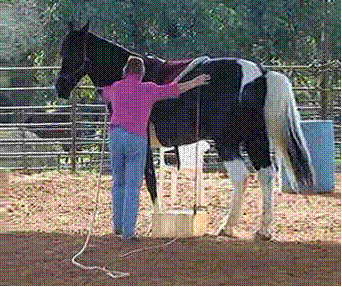
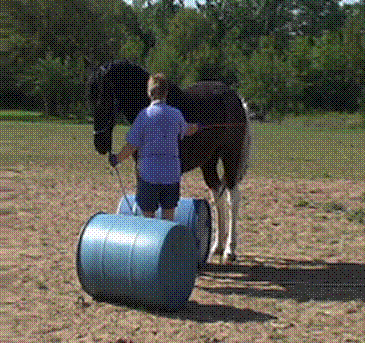
Figure 18 Starting Sideways over an Object
During one of Christi’s camps we
used umbrellas, hula hoops, and pool noodles to desensitize the horses. Christi also had a giant hula hoop circle for
the horses to stand in. Rocky had very
negative reactions to the hula hoops at the camp. When we got home, I bought a small hula hoop
so we could try “approach and retreat” to overcome whatever his issues
were. I played with Rocky in the pasture
for a while and then went to the truck to get the hula hoop. When I entered the pasture with the hoop,
Rocky reared and ran in the opposite direction until he reached the fence. He went sideways down the entire length of a 3 acre pasture fence until he reached the corner and
stopped. He didn’t look at me for a long
time. I was truly worried that I was
destroying his spirit.
Obviously, Rocky had a real aversion to hula hoops that we
needed to overcome. I used “approach and
retreat” games with the hula hoop to help Rocky. Using “approach and retreat”, I would bring a
hula hoop near Rocky until he reacted and then I would back off. We started by walking around with Rocky at
the end of the lead rope and then advanced to standing still. During these exercises, I would not put any
pressure on Rocky or any focus on the hula hoop. I would just walk around with the hula hoop
and not pay any particular attention to the hoop or Rocky. I even put hula hoops on the ground with
treats in the middle of the hoop so he would have to reach his head into the
hoop if he wanted the treat. Always
being interested in food, Rocky eventually decided hula hoops were a source of treats and he began to look forward to finding a hula hoop.
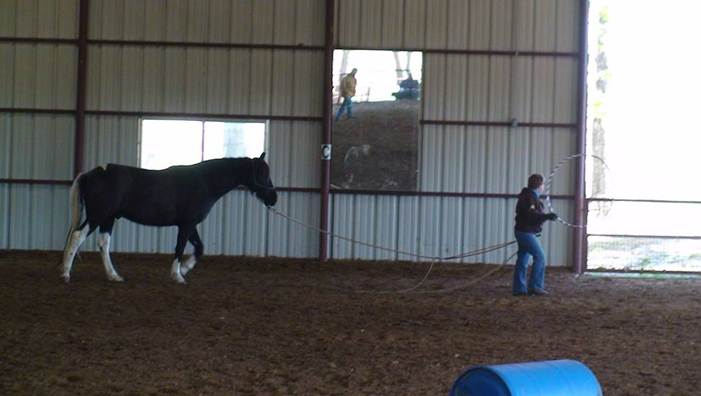
Figure 19 Approach and Retreat with a Scary Hula Hoop

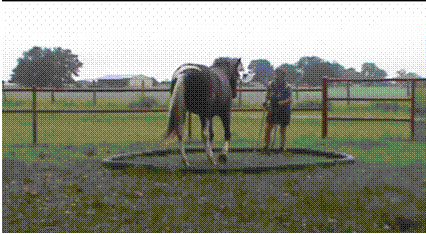
Figure 20 Approach and Retreat to Stand in a Scary Hula
Hoop
For months, I spent all of our time
together working on the ground. Most of
the people at the stable could not imagine owning a horse and NOT riding. Many of the other horse owners were convinced
that I was a bad influence and didn’t want me near their horses. We spent a lot of time doing nothing. It was difficult and scary for me, but I
learned to just wait quietly without putting any pressure on Rocky.
I spent a lot of time working on Rocky’s aggression toward
people around his food. I would arrive
at the stable before feeding time and stake out a small empty paddock (36 by 48
feet). I would put Rocky in the paddock
with a food tub by the fence. I would
put his sweet feed in the tub and stand or sit on the other side of the fence
and ignore him and the food. This way,
Rocky could not bite me but he had to be close to me
if he wanted to eat. Hunger usually won out but some days he spent a lot of time studying the
situation or wildly rushing around the paddock before eating. I gradually started moving closer while he
ate and got to the point where I could stand in the paddock beside him while he
ate. It took several weeks, but Rocky
was finally at the point where he showed no intentions of biting me around his
food. I was always wary and kept a close
watch – I had to learn to start trusting Rocky and my ability to properly
respond if he became aggressive. I
started grooming Rocky while he ate. He
seemed to enjoy this attention.
Rocky was our first horse and the first horse that I had
ever ridden. I had a huge learning curve
to develop the effective use of the lead rope and carrot stick. This learning curve required overcoming
emotional fears and developing the physical abilities and
coordination to orchestrate all the tools at one time. I had a bigger challenge learning to RIDE. I decided to start riding Rocky in the small
paddock where I was feeding him so he couldn’t run very far. I started each day by playing with Rocky
while I groomed and saddled him. We did a lot of YoYo backing up and sideways
around the sides of the paddock. I spent
a lot time just standing quietly with Rocky.
I started using the fence as a mounting block. We spent a lot of time just standing quietly
by the fence – both of us on the ground.
I started sitting on the fence while Rocky stood by the fence. I would get Rocky to stand quietly by the
fence while I got into the saddle from the fence. If he stood quietly, I would get off and wait
a few minutes before getting back on. If
he moved, I stayed on him until he stopped moving before I got off. I would wait a few minutes and get back on. This seemed to give him a sense of control –
if he wanted me off his back, all he had to do was go stand quietly by the
fence. We did this for weeks. Standing by the fence became a comfort spot
for Rocky. Even today, when Rocky thinks
we have been riding long enough or he is starting to get stressed, he will go
stand by the nearest fence and turn his head to look back at me with an
expression that I interpret to be “Can we do something else?” or “Are you ready
to get off?”
I started trying to actually ride
with some control like turning, backing up, and sideways. I did all this in that little paddock. Rocky would stand by the fence, I would get
in the saddle from the fence, we would walk a few steps along the fence, and if
he stood quietly by the fence, I would get off again. We would repeat the process riding around the
fence of the paddock and making small turns.
I started adding short backups along the fence. Rocky initially seemed stressed about backing
up so when he backed up a few steps and stopped, I would get off as his
reward.
We had mastered sideways on the ground
and I was amazed at how easy it was to start doing sideways in the saddle. He would voluntarily
sideways to the fence to see if I would get off. Sometimes I did, other times I didn’t. I started giving him little treats at random
when he stepped sideways to the fence instead of getting off.
I now had a slow poke horse.
People wanted to know why he didn’t move faster – was something wrong
with him? I said a huge prayer of
THANKS! I finally had a horse that
didn’t wildly attack me on the ground or give me a wild ride in the saddle. If you want to see what I mean by a wild
ride, check out “The Storm” photos in Chapter 7 that show Rocky bucking with
his saddle. I had a horse with better
ground manners than most and I had some tools for responding to aggressive
behavior.
How slow did I make this horse? In May 2005, we went to a playday at one of the
local riding clubs. I rode with the Parelli
bareback pad and intentionally walked him through every event just to make sure
he wouldn’t become angry about the other horses, announcers, dogs, kids,
folding chairs, umbrellas, traffic, lunch bags, wind blown bags, and anything
else you find at a horse riding club playday. In one of the events, we walked slowly by the
timer and Rocky flicked his tail just after we passed the timer. The announcer called us back to start over because
his tail flick had registered as the end time on the timer. Many people asked if I could make him go
faster – YAHOO – my GO horse was now well-adjusted enough to calmly walk
through anything at a noisy playday!
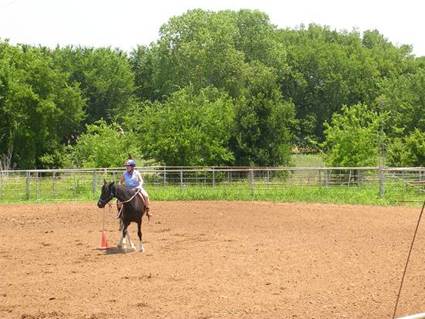
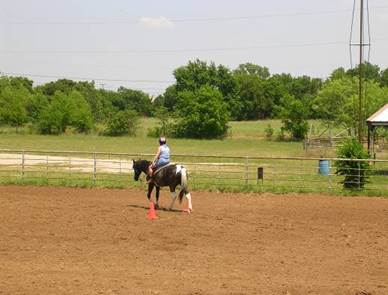
Figure 21 Calmly Walking the Cone Events Bareback
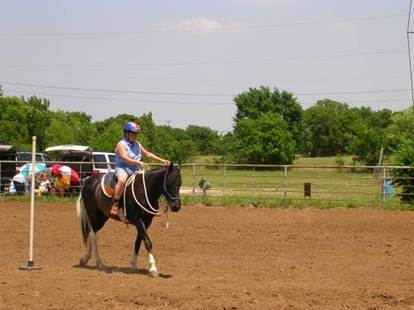
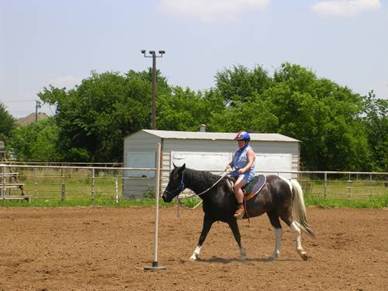
Figure 22
Calmly Walking the Poles Bareback
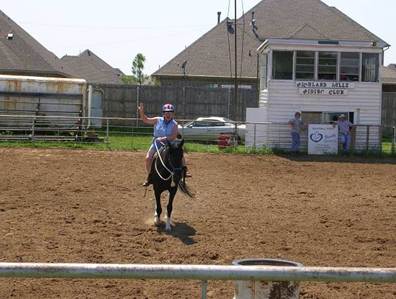
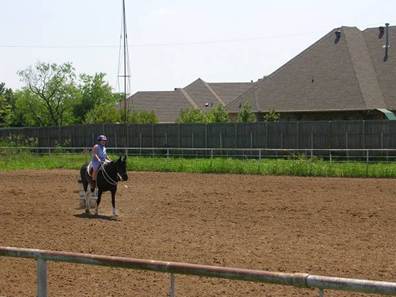
Figure 23 Calmly Walking the Barrels Bareback
There is so much
material that you read today or see on the Internet or TV that you begin to
wonder what is real and what isn’t. This
book is the story of our REAL natural horsemanship journey full of dirt, sweat,
and tears – tears of fear and tears of joy.
By now, you have
seen a lot of photos and there are many more photos in this book. These photos are not staged. You may wonder why I am sharing photos that
don’t show Rocky or me in our best form or physical condition. I have included the photos to show that this
is what really happened and how much Rocky and I have learned and grown
together as our relationship transformed into a partnership. We experienced so much that is hard to
describe and I included photos to help with many of the descriptions. It is especially hard to describe how I
learned to read Rocky’s emotions without photographs. When I looked back through the old photos, I
was amazed at how obvious some of his emotions would have been if I had only
known about Horsenalities.
My sincerest hope is
that others facing a difficult relationship can learn from our experience that is it possible to develop the skills needed to not only
survive but to succeed. Those tactics
that worked for us may not work for others but I hope
that we can provide a positive example of what is possible if you hang in there
long enough.
A relationship takes
two parties willing to work together and I came to
believe that Rocky was willing to be my partner. A lot of the photos in this book show a very angry
emotional Rocky and how we as partners learned to overcome the aggressive acts
associated with these emotions. Rocky
had a gentle and willing attitude that is hard to show in photos. We just had to learn to manage the “rocky”
moments as they happened.
I also realize that
in some cases, one of the partners may not have this willing attitude and
developing a positive relationship may not be possible. Fortunately for us, Rocky and I were both
willing to put the effort into forming our horse and human partnership. The upcoming Sneak Attack and Charge events
give only a hint of how much effort it took.
Chapter 6 A “Rocky” Relationship
My relationship with Rocky was very much improved after
passing Level 1 but our relationship was like a roller coaster ride. It was pleasant for a while and then there
was a frightening plunge into a dark chasm as we started using the 22 foot line. Parelli
Level 1 uses a 12 foot lead rope for all the
tasks. A big part of Level 2 is using a 22 foot lead rope to communicate
with the horse from a longer distance.
The longer rope teaches the horse to respect you and respond from
greater distances. I went through a
whole new set of challenges learning to respond effectively to Rocky’s
dominance games at a longer distance. Rocky
relished the dominance games with the freedom of a 22 foot
line.
There were several times I returned to standing in a hay
ring to back up Rocky in the driving and YoYo games or to send him on a circle. I also
found a fence that I could walk along one side and drive
Rocky down the other side of the fence.
Parelli switched to the new Levels Pathway in 2009, but I was still working
with the old Level 2 training books that didn’t cover Horsenalities and how to
handle extreme left brained dominant behavior.
There were times when Rocky seemed to think we were playing the old bite
and steal the carrot stick
games at a longer distance. The longer distance gave him more room to
play.
I attended many of Christi’s camps to learn effective phases
for handling the new level of our dominance games at a longer distance. I still introduced myself as a Mom trying to make our horse safe for my daughter. I attended basic and advanced Level 2 camps, Liberty camps, and trail
riding camps. During one of our dark
moments, Rocky even bit me while I was participating in one of Christi’s Level
2 Liberty camps. I broke down in tears
because I was so discouraged and afraid we were returning to the same old
patterns of escalating aggression. Christi
devoted a lot of time to helping me learn effective phases in response to
Rocky’s behavior. It took a long time to
learn to read the situation and respond with an effective response level. Rocky does not bite anymore!
I am a left brained personality and
Rocky is a left brained Horsenality. For
both of us, our daily decisions are a matter of life and death. I am an engineer and engineering decisions
must be precise and accurate with little margin for error. Left brained
personalities are a natural and necessary fit for my occupation. For Rocky, his position of dominance in the
horse herd determines his chances of survival.
The best food and water goes to the dominate
herd members. In times of scarcity, the
less dominant animals perish first. In order to survive, Rocky is driven to win the dominance
game at all costs.
I am an analytical person who studies the situation,
researches options, and carefully plans my course of action. Rocky obviously has the same traits as he sizes up the situation, thinks about his options, and waits
for the opportunity to exert his dominance.
The following paragraphs describe what I will call “Anatomy of a Sneak
Attack” and “Anatomy of The Charge”.
Once Rocky knew I could successfully drive him back a safe distance to
avoid a frontal assault, he resorted to sneak attacks where he would sneak in
close enough to bite. In “The Charge”,
he shows his determination with a frontal charge.
The following photos were taken at a Level 2 Christi camp in
June 2006. We began the day playing the
Parelli games in sequence. The first
game is friendly and we rubbed our horses all over with our hands, the carrot stick,
and lead rope. We played extreme friendly slapping the ground with the carrot
stick. During the porcupine game, we practiced
leading the horse by their ears and tails. We also did fun tasks like lifting their feet
using the rope.
Driving was and probably will always be a challenge to
Rocky’s natural dominance instincts. Rocky
is a very confident left brained horse with strong
drive to dominate. Rocky started
reacting with his own dominance driving instinct in the driving game. There are several warning signs in Rocky’s
body language in the following photo:
·
quick short swishes with his tail
·
ears are tense and going back
·
face and nose are tense
·
sneaking closer and closer
every chance he can find.
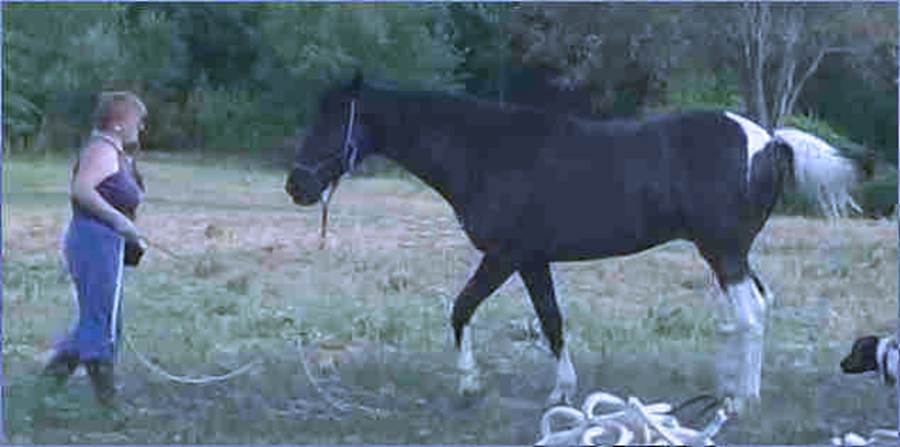
Figure 24 Reading Rocky's Attitude
Later, we did a fast driving task
where you bring up your energy and march toward the horse forcing the horse to
move back or run into the carrot stick.
The following photos show the carrot stick being used above the lead
rope to create a wall or barrier between me and Rocky to discourage him from
being aggressive and moving toward me while I drive him back. I drove him back a safe distance at the end
of the rope for some dwell time while Christi continued to talk to us.
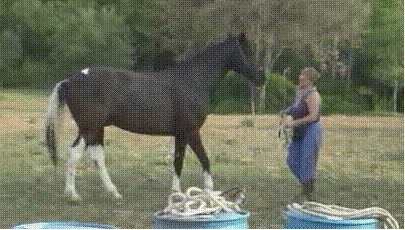
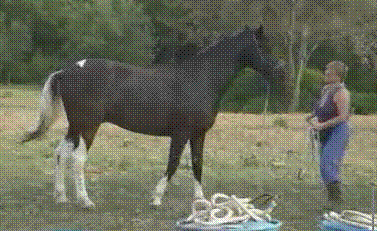
Figure 25 Driving Back Seems OK
The next photo shows Rocky sneaking in to attempt a quick
bite when I turn my back to listen to Christi.
The warning signs are his laid back ears, the
tension in his face, a quick tail swish, and the quiet determined energy in his
approach.
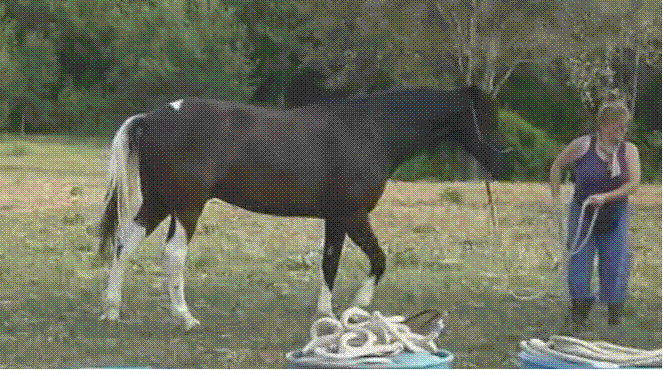
Figure 26 Sneak Attack
When I turned and noticed his approach, I immediately took
the actions that were becoming second nature to me:
·
Stand in my power posture and bring up my
energy.
·
Shorten the lead rope so it will have an impact
when I send energy down it.
·
Begin driving motions with the carrot stick and
create a barrier between us.
·
March toward Rocky as I vibrate the lead rope
and use the carrot stick to create a barrier between us so he would run into the
stick if he moved forward to bite.
There are two reasons why I am including details of Rocky’s
style of sneak attack. The first reason
is to illustrate the stress of constantly being in a situation where you are in
fear of an attack. The second reason is
to show that I had learned to deal with the situation using horse psychology; I
didn’t have to make contact with Rocky to win this
battle. The following stress scenario is
the “Anatomy of a Charge’ where Rocky charges at me during the driving game. This scenario was not an unusual event in the
early days of learning Parelli, what is unusual is that Lisa Carter was there
to record the event.
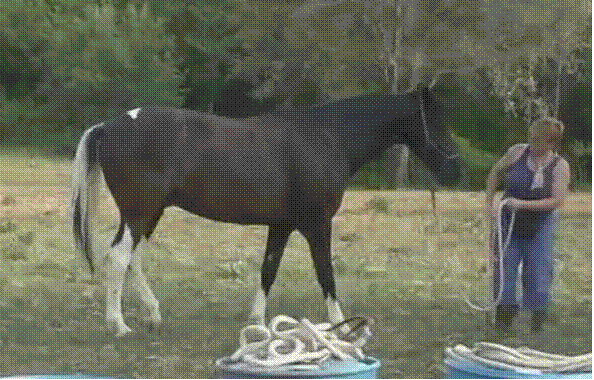
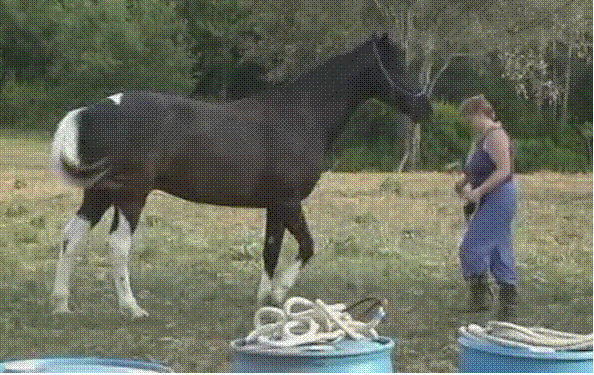
Figure 27 Driven Back after Sneak Attack
“The Charge” happened shortly after the “Sneak Attack”. The following photos show Rocky during
driving games where we were trying to balance drive and draw. In this particular game,
you send the horse back a safe distance on the 22 ft rope and draw them to you
at a trot by slapping the savvy string on the ground behind you and if necessary backing up to improve drawing the horse to you. Rocky loved this game, but his version was a full frontal attacking charge the minute the carrot stick
was not creating a barrier between us.
Rocky charged toward me with these
warning signs in his body language:
- quick
short swishes with his tail
- ears
are back
- face
and nose are tense
- charging
forward and building speed.
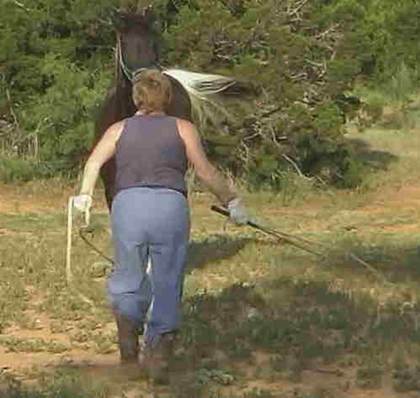
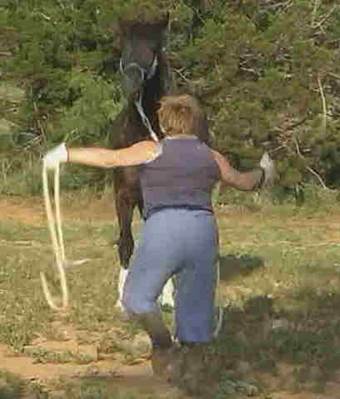
Figure 28 The Charge
I immediately took the actions that were becoming second
nature to me:
- Stand
in my power posture and bring up my energy.
- Shorten
the lead rope if there is time, and here there wasn’t
time
- Begin
driving motions with the carrot stick and create a barrier between us.
- March
toward Rocky as I vibrate the lead rope and use the carrot stick to create
a barrier between us so he would run into the
stick if he moves forward to bite or rear up using his front feet to
attack.
In this particular situation, I did
not have time to shorten the lead rope so that I could use the maximum amount
of pressure by vigorously shaking the rope or sending a rolling wave of energy
down the rope. I still shook the rope,
but my main tool was using the carrot stick to form a wall between us. I am 5 foot tall and the carrot stick is 4
foot long. With my arm reach and the
carrot stick, I can make a moving wall bigger than Rocky.
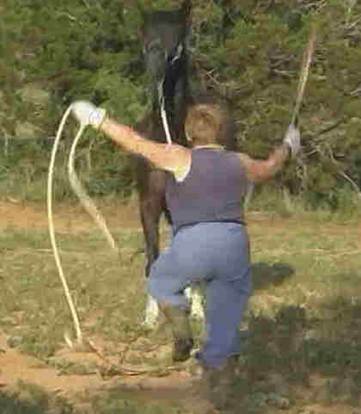
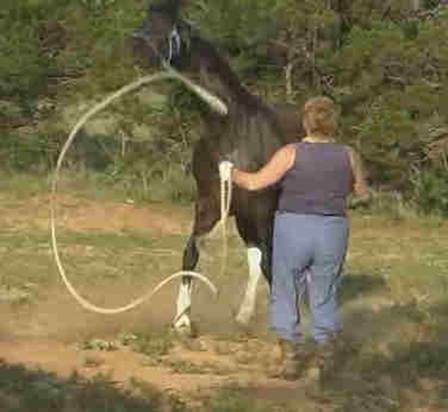
Figure 29 Stopping the Charge
In this particular incident, Rocky
tried to rear up as he approached but he backed down when the carrot stick wall
approached him. As you can see in the following
photo of Rocky as he circles to my left, he wants to continue the dominance
battle. His body language in the photo
on the left is a dominant horse ready to fight.
Unfortunately for me, the lead rope is far too long to use with an
effective phase and my only effective tools are the
carrot stick and horse psychology. This whole
incident lasted less 5 seconds
and I didn’t have time to shorten the rope while making the carrot stick
wall. I gave him a stern warning look and firmly held
the carrot stick ready for his next move.
Rocky calmed down quickly once the incident was over. Notice in the following photos that the
carrot stick stays between us.
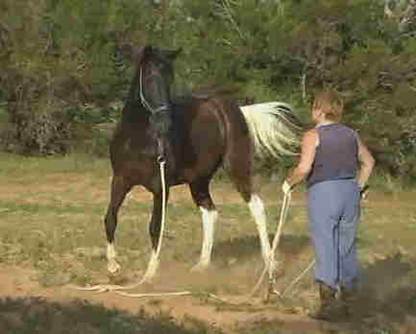
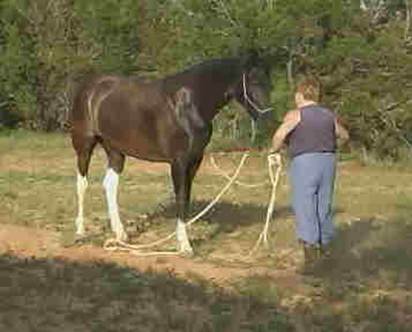
Figure 30 Calm Down after the Charge
I learned quickly to never let Rocky approach me if he
showed any of the warning signs of aggression: ears back, rolling eyes or hard eyes,
tail swishing, or tense face. This
sounds so easy on paper but it is not easy in the hot
sun with stinging sweat in your eyes, trying to listen to the instructor, and
watching out for other horses.
Why did Rocky Back Down?
Why did Rocky back down from the carrot stick barrier and
energy in the lead rope? Let’s face it –
Rocky could easily bite me or hit me and knock me down. The purpose of Rocky’s attacks usually seemed
to be to bite me or steal the carrot stick.
The general pattern of his past sneak attacks was:
- Sneak
in close enough to make contact
- Make
a quick lunge to bite me
- Retreat just out of range as fast as he could and watch
my reactions
- Jerk
the lead rope out of my hands if possible.
The general pattern of Rocky’s past frontal charge attacks
was:
- Retreat
to the end of the lead rope
- Turn
and face me, watching me
- Wait
– I’m not sure what his criteria for a good time to attack is
- Make
a quick charge toward me
- Either
bite me or grab the carrot stick
- Retreat
just out of range as fast as he could and watch my reactions.
Both of these tactics were too common
in our early relationship.
What changed?
Why did he back down and effectively lose these dominance battles?
The answer is Rocky’s Respect for my ability to use an effective Phase
4.
On several occasions, Rocky has galloped head
first into a carrot stick wall as the metal buckle of the lead rope
banged into his chin. If he had not
backed down, this would have happened again and again
until he backed away. This is my
effective phase 4 during an attack from Rocky.
He knew I had an effective phase 4 and would not hesitate to use it.
The phase 4 uses the carrot stick to make a wall bigger than
Rocky as a barrier to keep him away from me.
If he moves too close, he runs into the carrot stick wall – I am not
being aggressive toward him, I am defending my space with my wall. If he runs into my wall, it is his own fault
and not mine. I can march toward him
using the carrot stick wall to make him back down. The phase 4 can also use the lead rope in the
following ways to interrupt Rocky’s pattern of thought during the attack:
- If I
have sufficient tension in the lead rope and Rocky is far enough away from
me, I can send a rolling wave of energy down the lead rope to violently
vibrate the metal snap attaching the lead rope to the halter.
- If
the lead rope is short enough with sufficient tension, I can use the
carrot stick to violently tap the lead rope causing violent vibrations of
the metal snap attaching the rope to the halter.
- If
the lead rope doesn’t have much tension, I can still violently shake the
rope.
In both of these incidents, Rocky
was the aggressor and I was defending my space.
I was not being aggressive toward Rocky.
I used the carrot stick wall and the lead rope to define my space. If he violated my space, then his aggressive
actions caused him to run into the carrot stick wall and lead rope that
protected my space.
Rocky expected me to respond to his aggression with my own
anger and aggression. I was doing the
opposite of what he expected and wanted.
I was not letting him define the rules of the dominance game – I was
telling him that I didn’t need to play his game to maintain my position. I worked really hard
to not become “a predator” and respond with my own angry acts of aggression in
response to Rocky’s angry emotions and acts of aggression. I knew that Rocky would only escalate his
acts of aggression if I were to respond with aggression. It is very stressful to be on guard all of the time expecting the next acts of aggression. At times, I felt like Rocky was baiting me to
make me angry and force me to respond to him with anger. I had developed effective phases, but I was
fearful that Rocky might need more.
The old Parelli Level 2 program was called Harmony and as
the name implies the goal of Level 2 was to improve the quality of your relationship
with better communication. The idea is
to improve your relationship with the horse so that the horse wants to do the
tasks with you (like a partnership). The
tasks were divided into 4 categories: On Line, Liberty,
Freestyle Riding, and Finesse Riding. The
Harmony Official Assessment required the following tasks to be officially
demonstrated to pass Level 2.
Table 7 Parelli Level 2 Harmony Assessment
|
Category
|
Tasks
|
|
On Line
|
Play the seven games with
an obstacle
|
|
|
YoYo over a pole and return
|
|
|
Squeeze jump over an 18 – 24 inch jump
|
|
|
Circle both directions with
canter - trot - walk - trot – canter transitions
|
|
|
Change direction at trot
maintaining gait
|
|
|
Sideways without a fence
for 20 feet both directions
|
|
|
Send horse under a hanging tarp or into a trailer
|
|
|
Lead horse using 22 foot line around front leg
|
|
Liberty
|
Extreme friendly game with
carrot stick and savvy string
|
|
|
Play all seven games at
liberty in seven minutes
|
|
|
Horse smells his tail for
10 seconds on each side
|
|
|
Hold your horse’s tongue
|
|
|
Pinch horse’s neck and he
relaxes
|
|
Freestyle Riding
|
Send horse to saddle and
pad to sniff them
|
|
|
Saddle horse without
touching lead rope
|
|
|
Bridle horse from your
knees or while sitting in a chair
|
|
|
Mount horse from ground or
mounting platform
|
|
|
Trot a figure 8 on a casual
rein around tow markers 50 feet apart
|
|
|
Canter showing 3 simple
lead changes using a casual rein
|
|
Finesse Riding
|
Show 3 YoYos from walk to
backup using Parelli 9-Step Backup
|
|
|
Ride sideways in both
directions at least 20 feet without a fence
|
I successfully demonstrated most of the tasks in 2006 and
2007. Riding was my big challenge and I finally passed my last task, the Freestyle
riding canter task, in December 2008 to complete Level 2. Rocky and I were now able to enjoy one
another’s company.
If I were asked to provide a one word summary of the lessons learned by the Level
2 games it would be “communication”. The following table describes the generalities
that Rocky and I learned playing the games in Level
2. We played the games
and related tasks with the Parelli 22 foot line, at
liberty, and while riding. The games
really helped develop the communication patterns we used to listen
and respond to one another.
Table 8 Parelli Games in Level 2
|
Parelli Game
|
What Rocky learned
|
What I learned
|
|
Friendly
|
Rocky learned to trust me
and to expect to be treated fairly.
Rocky learned to ask for special favors like “scratch this spot” as he
would point with his nose.
|
I learned to trust Rocky
and to treat him fairly with effective phases. I learned to listen to Rocky and read his
emotions. I learned to recognize when
Rocky was asking me questions or I needed better communication.
|
|
Porcupine
|
Rocky learned to yield to
minimal pressure – just a look from me.
He began to respond to minimal pressure in mounted activities.
|
I learned how to use the
minimum amount of pressure necessary to communicate my plans to Rocky. I learned to listen to Rocky’s responses
and decide when more pressure was needed or when I had used too much pressure
and needed to back off.
|
|
Driving
|
Rocky learned that I had
effective phases and would use them.
He became attentive and responsive.
His natural dominant tendencies were becoming less aggressive. His playful spirit was still there but no
longer aggressive.
|
I learned how to channel
Rocky’s natural drive to be the dominant member of every relationship into
playful activities. We learned to play
at greater distances and at liberty. I learned to be Rocky’s partner. I was forced to learn to use consistent
body language on the ground and in the saddle.
|
|
YoYo
|
Rocky learned to pay close
attention to my body language.
|
I learned to pay close
attention to Rocky and respond with the least amount of pressure possible.
|
|
Circling
|
Rocky learned to respond at
greater distances. He learned to respect
my requests when I used effective phases. Circling still isn’t his favorite game but he enjoys it more without getting bored.
|
I learned to read Rocky’s
emotions and use effective phases at greater distances. Effective phases were really
important because ineffective phases annoyed Rocky. I learned to mix other activities with
circling to keep Rocky from getting bored.
|
|
Sideways
|
Rocky loves sideways
online, at liberty, and in the saddle.
When he is confused by my uncoordinated directions, he tries sideways
to see if it is the answer.
|
I used sideways as a
comfort game for us. I learned to vary
the sideways games to prevent boredom by using a lot of obstacles and
sideways from zone 1 (like dancing).
Zone 1 is in front of Rocky.
|
|
Squeeze
|
Rocky learned to love
squeeze jumps especially at liberty.
He loves standing on pedestals and getting his belly scratched.
|
I learned to trust Rocky to
be safe and calm in small spaces. I
learned to devise fun squeeze activities so Rocky doesn’t get bored.
|
It is very difficult to describe reading
Rocky’s attitude at any given moment.
The Parelli Horse Behavior lessons really helped me to understand
general horse behavior and Christi helped me apply that knowledge to understand
Rocky and his needs. She helped me realize
that Rocky easily got bored and we couldn’t keep repeating the same tasks
without a change of pace. I learned to integrate
multiple tasks so he didn’t become bored.
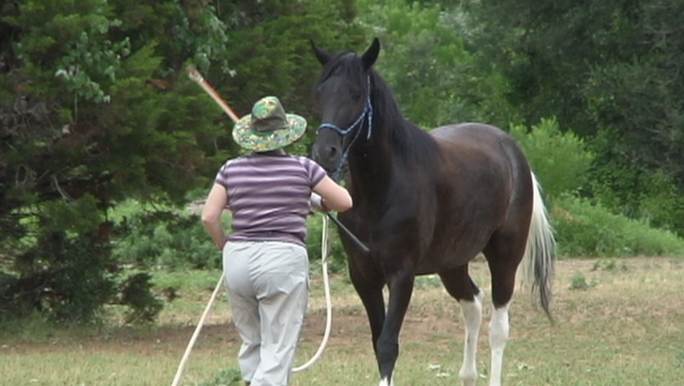
Figure 31 Driving Game
I also learned that several activities simply upset
Rocky. I have no idea what happened to
Rocky in the first four years of his life and can’t possibly understand the
emotional baggage he brought into our partnership. Christi helped me recognize patterns in
Rocky’s behavior. We realized that he became
very emotional and downright angry while circling and we developed approaches
to overcome his emotions and develop his interest in circling. Rocky is a GO horse
and circling does not calm down a GO horse.
He needs to be forced to think instead of GO. A basic pattern that I used was to have Rocky
circle just one or two times and then move on to some other task
he enjoyed. I learned to slowly increase
the number of times we circled before moving on to another task.
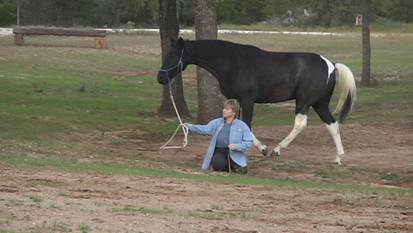
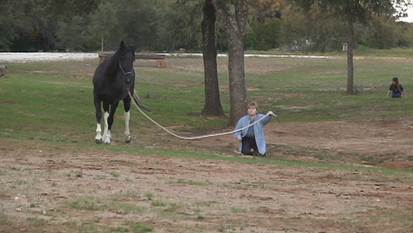
Figure 32 Circling while Seated on Ground
After seeing the above photos of Rocky quietly circling me
while I am sitting on the ground, it is hard to believe how scary circling
could be. Rocky needed me to use
effective phases. Rocky viewed
ineffective phases or inconsistent use of body language on my part as annoying
and scolding when he didn’t deserve it.
The images below show us in a Liberty lesson at a Christi camp in
2007. We had mastered circling while
online at this point in time. Liberty
brought out new challenges with Rocky’s behavior. As you can see, Rocky may appear attentive
with his tense ears but the way he is holding his head with his tense nostrils and
angry eyes shows HE IS NOT HAPPY ABOUT CIRCLING! I learned to recognize this look as a sign
that Rocky was about to explode and would bite me if he could get close enough
to make contact.
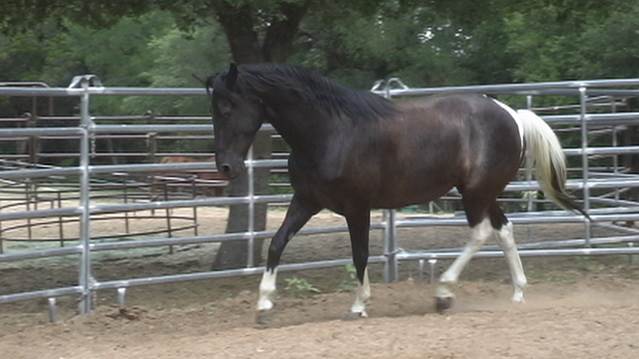
Figure 33 Angry Emotions about Liberty Circles
As you can see in these three photos, Rocky is showing his
unhappiness and raw anger about playing the circling game. Rocky is not acting in fear, he is
ANGRY. Christi taught me how to develop
and apply effective phases to convince Rocky that I was the leader and would
not tolerate this extreme dominant left brained behavior.
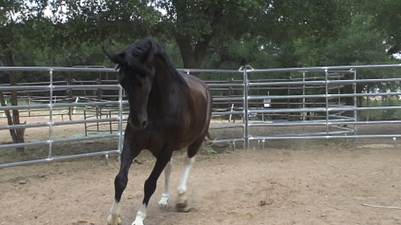
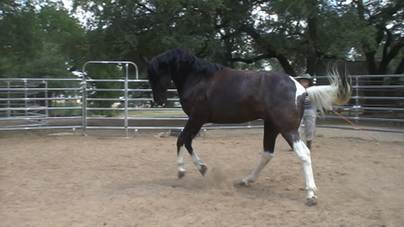
Figure 34 Rocky with Angry Circling Emotions
During Rocky’s angry circling episodes
he would run around wildly, getting closer and closer
to me. His intent was to bite or attack
me. Christi taught me to push him back
onto wider circles by putting pressure on his front shoulders. He only got to stop circling when he was calm. I would reward him with a carrot stick
massage on the neck – he really likes getting his neck rubbed and I could keep
him at a distance by using the carrot stick to give him his massage.
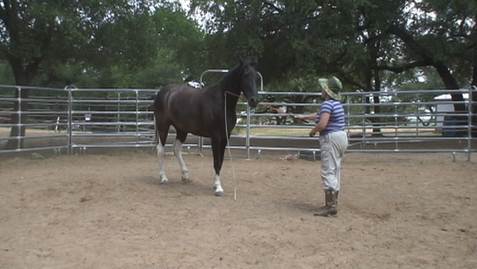
Figure 35 Rocky Calm after Emotional Circling
As a left brained horse, Rocky is
easily bored and doesn’t see any value in running circles. I learned to keep Rocky from being bored by
adding obstacles and other variations to the circling game. The following photos show Rocky circling
barrels in a 2009 camp. Notice his
attentive face and ears as the circles the barrel.
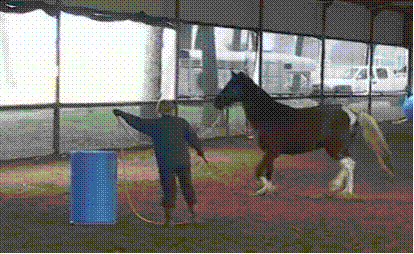
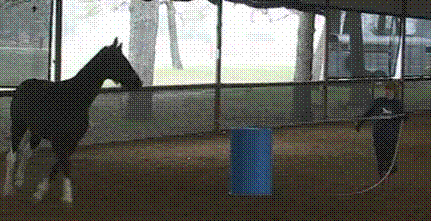
Figure 36 Circling Obstacles is More Fun
With practice, I began to be able to read Rocky’s attitudes
so I could help him work through his angry emotions and calm down. I learned to slow down the pace and start
with activities that were less stressful for Rocky. Eventually, Rocky wanted to quickly calm down and the incidents of his extreme anger dwindled. It took a very long and stressful 5 years from
the time we started Parelli until we reached the point where Rocky and I were
really partners. He became a very
willing and yet playfully spirited horse.
I can determine Rocky’s attitude by
his ears. Tense ears are an indication
that Rocky is not in a good mood and could become aggressive. If he will not let me rub or scratch his ears then he is not in a friendly mood. The same is true if his ears are tense when I
rub or scratch them. I always check
Rocky’s ears before we ride. He may pass
all of the respect tests and still have tense
ears. We play friendly and respect games
until his ears are relaxed and he lets me rub them.
If you watch Pat Parelli during his horse demonstrations,
you will see him play with the horse’s ears a lot. Christi taught us that Pat uses this to
determine the tension level of the horse.
I really appreciated learning this because it is a great safety
check.
Two activities that really help Rocky relax are a pedestal
and the sideways game. I let him stand
on a pedestal if one is available. He
loves to have his underbelly rubbed while standing on a pedestal. If there are flies, I use the carrot stick
and savvy string to gently swat the flies.
For the sideways game from zone 1, I like to find a place to sit down,
yoyo him back a few steps and let him sideways back and forth a few steps in
front of me. For some variety, Rocky
also likes to sideways over obstacles. I
have him sideways one direction a few steps and we wait until he relaxes a
little before I sideways him the other way.
Rocky usually finds zone 1 sideways more relaxing than zone 3 sideways. Zone 1 is in front of the horse and zone 3 is
the middle of the horse (his stomach).
Rocky loves to be scratched and especially loves to have his
ears scratched. One of the big
breakthroughs in our relationship happened when Rocky realized that he could
ask me to scratch for him. While grooming Rocky, I would scratch those
areas where his hair was matted down from scratching with his mouth. If he looked back at me, I would gently move
(porcupine) his head to the area and scratch it for him while I held his head. He has learned to approach me and use his
nose to point to areas for me to scratch.
Rocky has dry skin in his ears and
it must really itch because he rubs his ears all the time. It took some time, but eventually Rocky let
me rub and scratch his ears. When I
would see Rocky rubbing his ears against a tree or the fence, I would approach
him and scratch another area and eventually make my way to his ears. I would start by scratching the outside of
his ears and the advance to the inside edge of his ears. Now, he rushes across the pasture just to
have me scratch his ears.
I use the carrot stick when we are riding to swat flies for
Rocky. I use the leather tab on the end
of the carrot stick to rub his ears and shoo away flies when he gets little
flies or mosquitoes on the edge of his ears.
He really enjoys this. If I think
he is getting tense, I will rub his ears with the carrot stick. If he does not let me rub his ears then I know he is getting tense and I may need to get
off.
Liberty Bridling Task
The following photos show the Level 2 task to bridle your
horse at liberty. Playing the friendly
game with Rocky’s ears was my key to making this task easy. Rocky expects me to scratch his ears when I
sit down and he lowers his head. Putting
the hackamore halter or bridle on while seated was an easy follow-on to scratching his ears while I am seated.
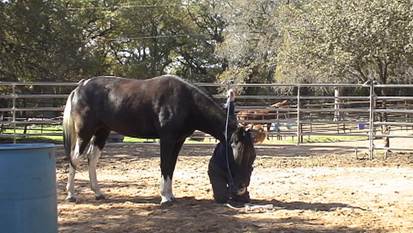
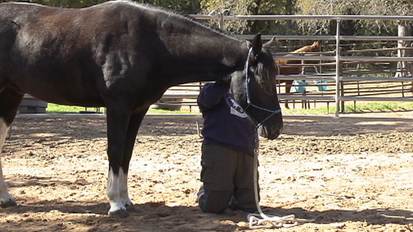
Figure 37 Liberty
Bridling Task with Hackamore Halter
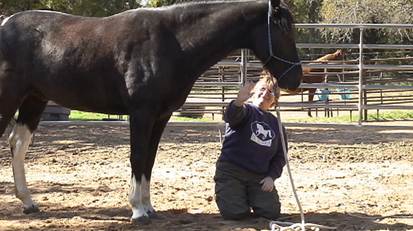
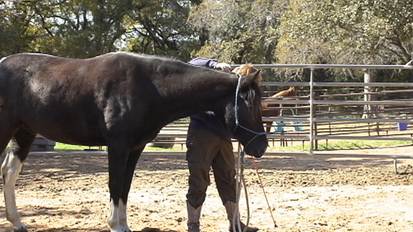
Figure 38 Dwell Time After Liberty Bridling
Mirroring is a communication skill used to develop a bond and trust.
People mirror one another all of the time without even
realizing it. Children mirror their
parents. People mirror others that they
admire. College psychology, management,
and marketing classes teach students to understand mirroring and how to use it
to lead others.
Mirroring body language involves following the body language of
another person, using the same pace as the other person, and then subtly taking
over the lead so that the other person begins to mirror you. Christi teaches mirroring the horse as a way to bond with the horse; as well as,
to get the horse and rider in synch with one another.
The following photos were taken when I was just learning to mirror
Rocky. I had to learn to keep my hand on
his withers while keeping the rope and carrot stick out of the way of his
natural motions.
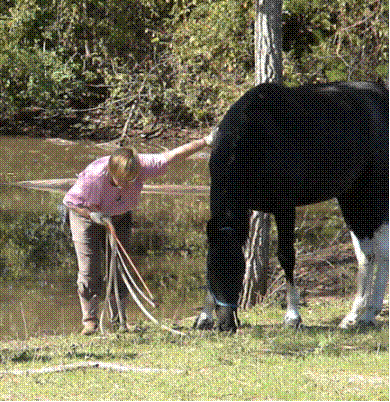
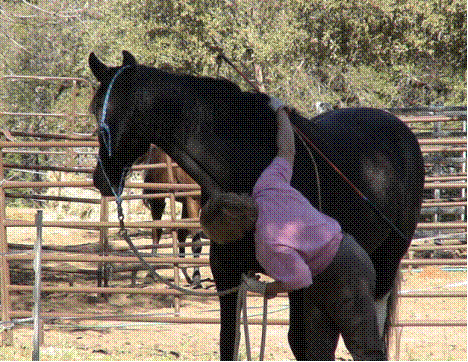
Figure 39 Learning to Mirror Rocky
Rocky has a lot of energy.
When we are out in the open pastures, he likes to check out the entire
pasture at a quick pace before settling down to graze.
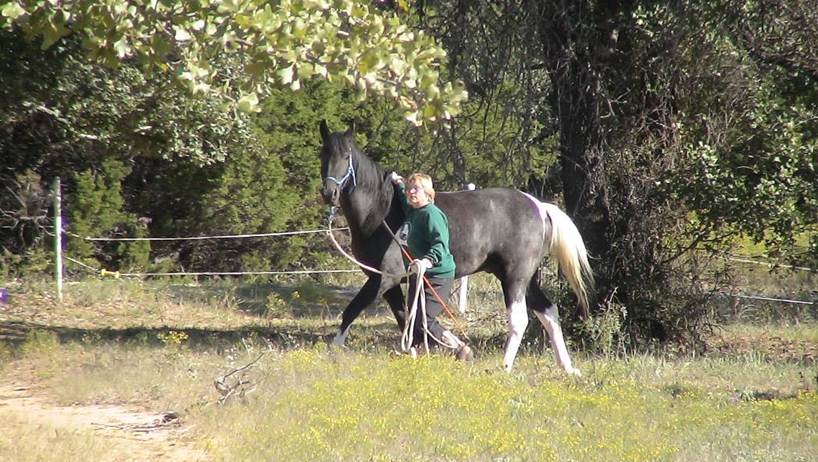
Figure 40 Mirroring on the Alert and Moving
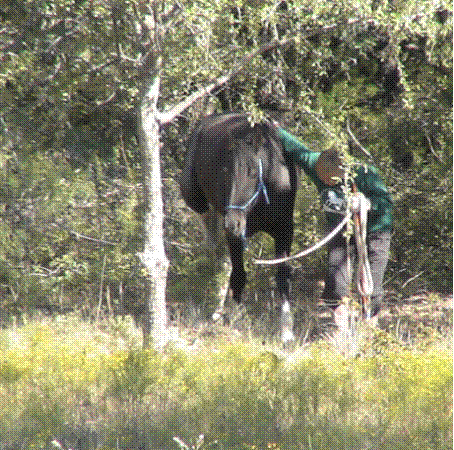
Figure 41 Mirroring Relaxing in the Shade
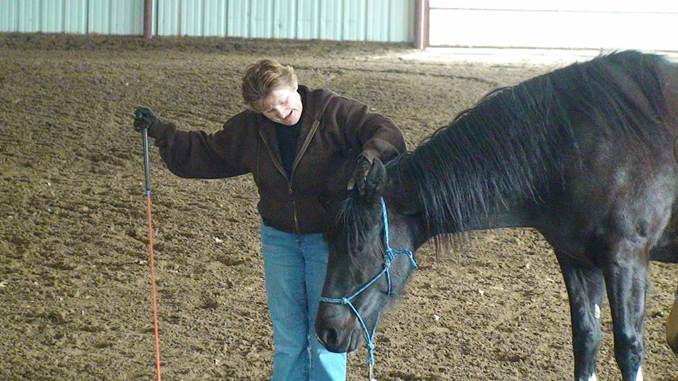
Figure 42 Checking the Ears while Mirroring
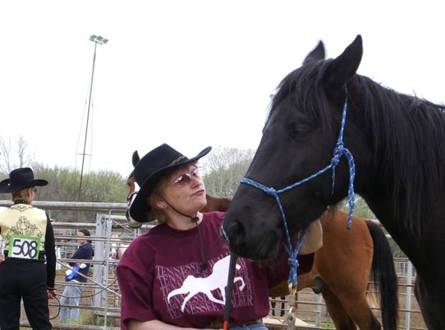
Figure 43 Mirroring a Frown
Mirroring Rocky taught me about my energy levels. Rocky has a lot of energy
and I had to learn to bring up the level of my energy to match his. I also had to learn to lower my energy level
to match his as he relaxed. This
understanding of energy in my body really helped improve our communication
while riding. The following table
summarizes our mirroring exercises and how I was able to start taking the lead
during our activities.
Table 9 Mirroring
|
Phase
|
Rocky
|
ME
|
|
Observe
|
Just being
Rocky.
|
Observe Rocky’s
normal behaviors and his emotions.
This includes his posture, head position, muscle tension, and pace. Listen to his breathing.
|
|
Match
|
Rocky behaves
normally.
|
Place one hand
on Rocky’s withers and mirror all of his
actions.
|
|
|
Head motions
|
Turn your head
to match Rocky as he moves his head.
When he bends his head down, you bend down. Shake your head when he shakes his.
|
|
|
Body and Feet
|
Try to mimic his
body and foot actions. For example,
stomp your feet when he stomps his feet to shake off a fly. Paw with your hands if he paws the ground.
|
|
|
Emotions
|
Match his
emotions. Match his level of
relaxation or tension. When he stares
intently, you should stare intently.
Be tense when he is tense.
|
|
Pace
|
Rocky sets the
pace.
|
Match Rocky’s
pace. This is very tiring if you have
a GO horse in a large pasture with rough terrain.
|
|
Rocky in the lead
|
Rocky in the
lead.
|
Do everything he does matching his
emotions, breathing, energy level, and pace.
|
|
Taking the Lead
|
Rocky relaxed
and standing still.
|
Match Rocky and
then I start leading Rocky by moving my head down to graze. As a food oriented
horse, when Rocky was standing still, I would bend my head to the ground and
touch the grass with my free hand.
Eventually, he started bending over to graze.
|
|
Taking the Lead
|
Rocky relaxed
and grazing.
|
Match Rocky and
then I put forward energy into my body without actually
taking any steps and change my focus on grass in front of us to let
Rocky know I wanted to move forward to another patch of grass. Rocky would naturally move forward to
graze.
|
|
Taking the Lead
|
Rocky tense and
alert while standing still.
|
Match Rocky and
then I just relax and slowly bend my head forward until I am
able to touch the ground and wait.
Rocky usually releases his tension and bends his head down to match
mine. Actually, he
probably wants to graze but it forces him to relax and follow my lead.
|
|
Taking the Lead
|
Rocky on the
move.
|
Match Rocky and
then I slowly change my focus to a slightly different direction and use a
slight porcupine with my hands on his withers. We drift with my focus.
|
Mirroring is an important part of riding preparations for
us. Mirroring with the saddle on Rocky
helps me understand his focus and energy levels before I get into the
saddle.
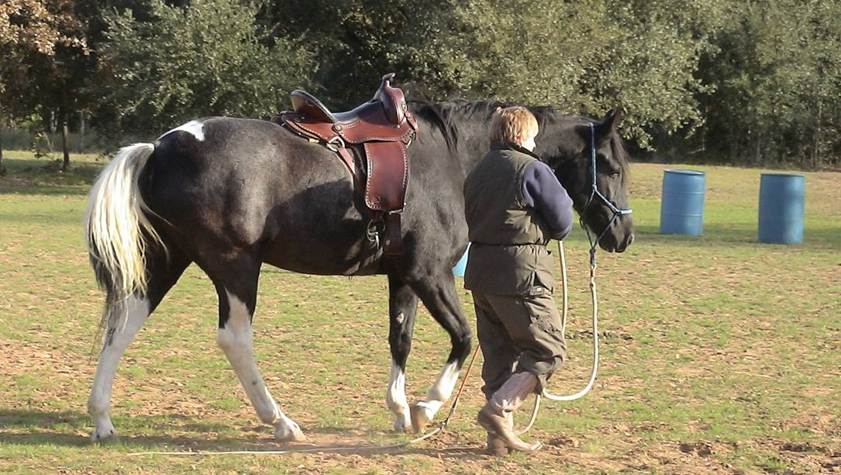
Figure 44 Mirroring Before Riding
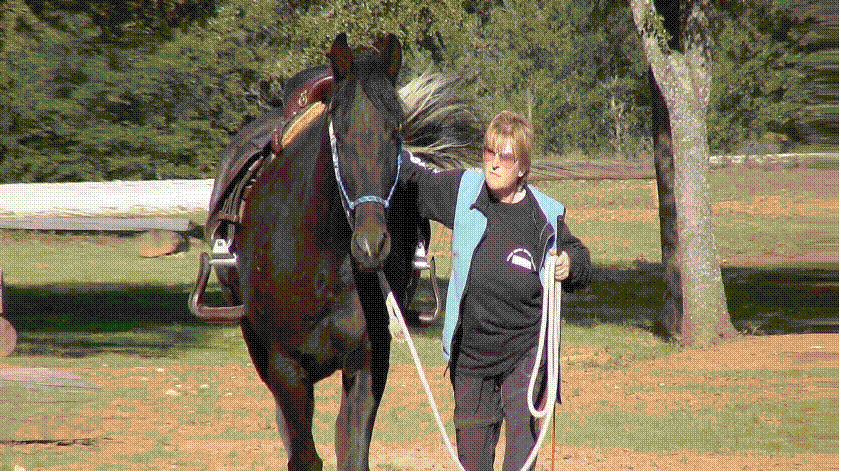
Figure 45 Mirroring Energy Level before Riding
Once you have mastered mirroring on the ground, you can do
the same in the saddle. This really
helps the horse follow the feel of your body language in the saddle.
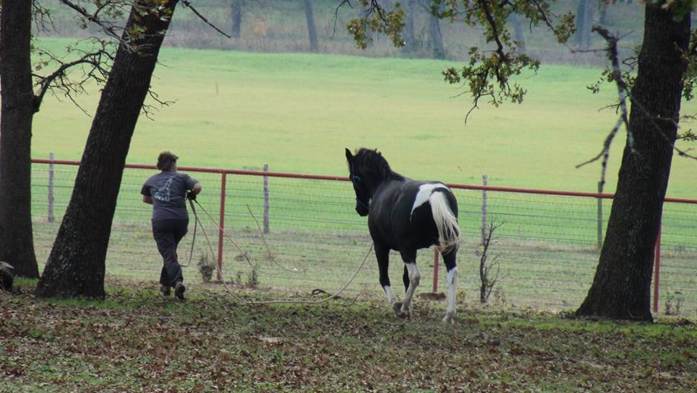
Figure 46 Mirroring on the RUN
Rocky tends to exercise his dominance more when he is
hungry. I’m not sure if he suffered from
food scarcity or competition when he was young or if he is just naturally
grumpy when he is hungry. His aggression
and biting when I am near his food are gone.
Now, if he frowns when I approach him with food, I just give him a stern
look and if necessary point an index finger at his
ears – he immediately has a friendly face.
Over time, I realized that Rocky was far more prone to
acting on his dominance urges when he was hungry. Rocky grazes in the pasture all day and I put
him in a paddock at night. I work full
time and the only time I have to spend with Rocky
during the week is after work.
Unfortunately, this is usually before night feeding time in the winter
and when the pasture is bad, he is really hungry. The same thing happens on the weekends if I
try to work with him before his breakfast hay flakes. During the summer, there is plenty of time
for him to eat dinner and have playtime before sunset. It takes us a few minutes for him to mentally
adjust to our activities when he is hungry so I start
with slow activities.
Rocky gets hungry when we spend the day away from home at a
training camp or a playday. I have noticed
that when he is hungry, he shows more aggressive ears toward the other
horses. When we are in an arena and he
is hungry, he pins his ears and swings his head toward the other horses. When Rocky has had a good meal, he usually
ignores all of the other horses. I always make sure Rocky has a stall or quiet
area to eat by himself during breaks and make sure he has enough feed so that
he doesn’t get hungry.
For a dominant horse that is easily bored, the old adage “Variety is the spice of life” really rang true
for Rocky. Christi taught me to add a
lot of variety to our everyday activities. The following photos show some circling fun. Notice that Rocky is not angry about
circling. He can focus on moving up the
hills or jumping the barrels instead of letting his emotions make him angry.
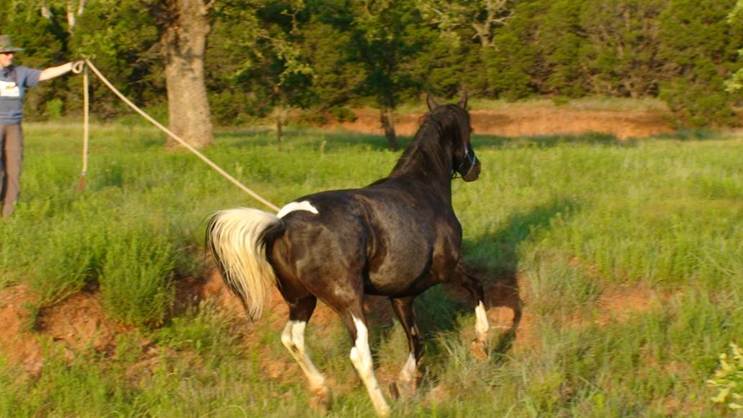
Figure 47 Using Hills to Spice Up Circling
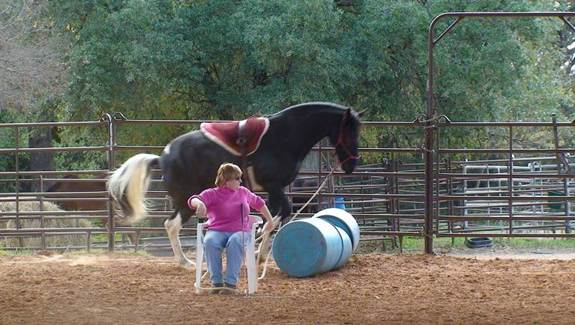
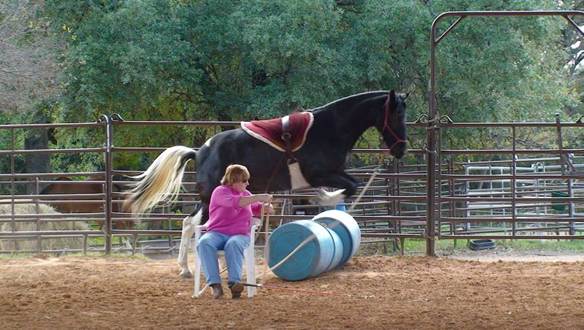
Figure 48 Using Barrels and a Chair to Spice Up
Circling
It was a long journey for us to reach the point where I
could sit down and trust Rocky to circle around my back without a sneak attack
to bite me. Of course, we take dwell
time to relax and avoid any negative emotions between circling and other
tasks. Notice that I am quietly
checking out his ears for any signs of tension in the photo on the right.
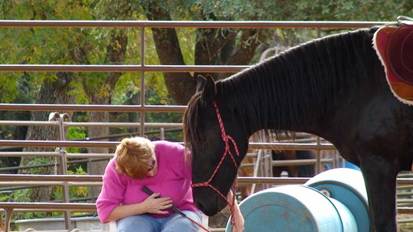
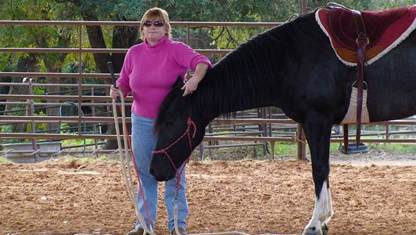
Figure 49 Mirroring and Dwell Time After Circling
One of the great treats for me while playing the Parelli
games is to find as many excuses as I can to sit down and ask Rocky to do the
games. The following photo shows me
getting some rest while I YoYo Rocky through some obstacles on the 22 foot line. I am
only using my index finger to ask him to backup. The rope is limp on the ground.
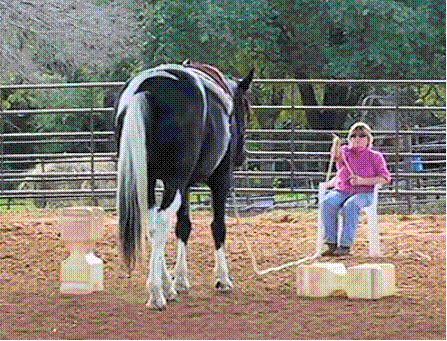
Figure 50 YoYo Through Obstacles while Seated
It may seem miraculous but I passed
the Level 2 riding tasks riding with the Parelli bareback pad. I began using the bareback pad for two
reasons: first, Rocky’s saddles didn’t’
fit well and second, I needed to learn to develop riding fluidity and rhythm.
Christi devoted time in her camps to proper and safe
preparations before riding. She also
devoted a lot of time to saddle fit for the horse’s
health and to make sure the saddle did not restrict
the horse’s movement. We experimented
with different saddles and evaluated muscle tone and muscle wasting during her
camps. During these activities, it
became clear that my saddles did not fit Rocky properly.
Christi taught us to use a four part
respect test to make sure your horse was in a good frame of mind for
riding. The standard respect test
involves yielding both shoulders, both hindquarters, driving the horse back and
drawing them in, and making sure the horse will calmly follow you like the mare
follows the foal. The following photo
shows a calm Rocky quietly following me as we set up some obstacles in
Christi’s arena prior to riding.
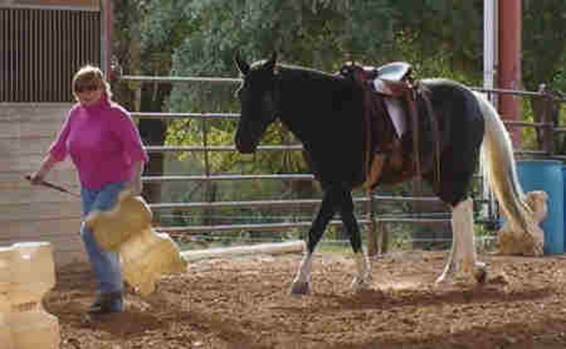
Figure 51 Rocky Calmly Following Me at Liberty in Riding Preparations
The next photo shows an eager Rocky trotting in with a quick
draw in the driving game.
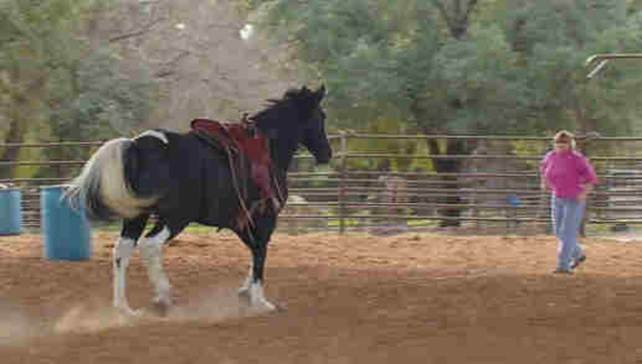
Figure 52 Riding Preparations Liberty Drive Back and Draw
at Trot
As a GO horse, I also need to make sure Rocky does not have
any emotions associated with moving faster than a walk or a slow trot. Rocky may be perfectly calm with slow
activities but have some pent up emotions that only
come out at a faster pace. I check out
his GO emotions with faster activities; such as, running side by side with me, sending
him at a trot over small obstacles, squeeze jumps over
barrels, or a short circling game.
Earlier in the background chapter of this book, I listed the
warning signs that worried me about Rocky before we started our Parelli lessons. One of the warning signs was what I called “Cowgirl
at the rodeo”. I had several extreme
bucking rides with Rocky before we started Parelli. The following photos show how Rocky can buck
under saddle. He doesn’t do just one
buck, but he bucks round and round the arena. These photos should help explain why I spent
so much time riding Rocky in a very small paddock in Level 1.
Christi taught me to make sure Rocky was in the right frame
of mind to ride before even considering getting in the saddle. She also taught me to GET OFF IMMEDIATELY if Rocky showed any of his emotional warning
signs. The following table identifies the respect tests with some suggestions for helping Rocky
work through his emotions.
Table 10 Riding Preparation Tests for Rocky
|
Respect Tests
|
Examples of games
|
Rocky Shows
Emotions or is Tense
|
|
The Ears
|
Rub or scratch his ears
|
Spend some dwell time if he
has tense ears or won’t let you rub or scratch his ears. Let him stand on a pedestal and scratch his
underbelly. Play some slow thinking
games like sideways or yoyo over an obstacle.
Use porcupine backups.
|
|
Yield Hind Quarters
|
Online or liberty yield
|
Slow the pace with some
friendly and porcupine. Use porcupine
backup with your hand on his nose or chest.
Use yoyo and back up games to engage him.
|
|
Yield Front Shoulders
|
Online or liberty yield
|
Slow the pace with some
friendly and porcupine. Use yoyo and
back up games to engage him.
|
|
Drive back and draw toward
you
|
Online or liberty driving
games
|
If he has emotional
thresholds in the driving game, slow the pace with an obstacle yoyo or
sideways game. If he is shows emotions during these, slow the pace with
friendly and porcupine. Try porcupine
backups with your hand on his nose or chest.
|
|
Stick to you
|
Walk around obstacles, back
up, run over poles together
|
If he won’t stick to you or
shows emotions, try some hind quarter yields and back up games with dwell
time to get him to focus on you. Send
him to stand on a pedestal with some dwell time.
|
|
Faster Actions
|
Circling, squeeze jumps, extreme friendly
|
Slow the pace and get him
to think about a task. Use sideways,
sideways over obstacles, slow figure 8 around barrels, squeeze jumps, and yoyo
with dwell time or an obstacle to get Rocky to think without becoming
emotional or angry.
|
On this particular day in 2007, we
had to work through a lot of emotions before Rocky would be calm at faster
speeds. We had been
playing online Parelli games like sideways without a fence and sideways
over obstacles just before saddling Rocky.
We played liberty games with Rocky wearing his saddle. The following photos show Rocky in two
different bucking episodes as he worked out his angry emotions. When I asked Rocky to circle, he frantically
moved all over the arena. He did not try
to move in and attack me; he just had a lot of emotions to work out. In this session, I had to remain calm but
keep him moving until he calmed down. I
used direction changes to break his emotional pattern and force him to think
about the new direction instead of his GO GO GO bucking.
The bucking episode in scene 1 was just the beginning of
Rocky trying to work out his angry emotions.
Rocky came down from bucking in scene 1 and just kept on bucking. Later in bucking scene 2, you can see the warning signs in the first
photo. His buck starts with his signs of
anger - lowered head, arched neck, and tense body. He then seems to explode with angry energy as
shown in the other photos. I actually rode Rocky when he bucked like this before I
started Parelli. Now maybe the reader
can understand some of my desperation to get help and make sure Rocky was a
safe horse for my daughter.
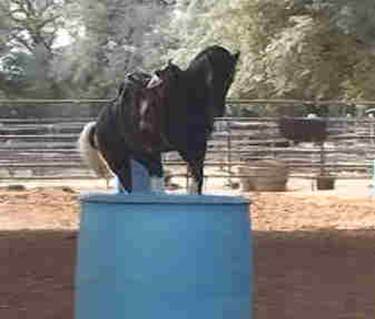
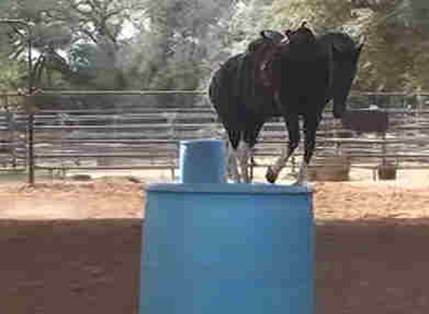
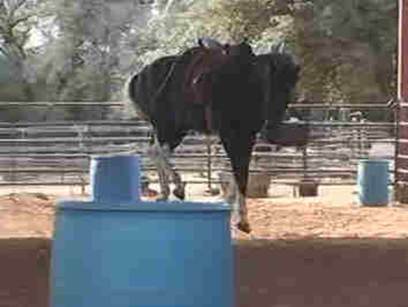
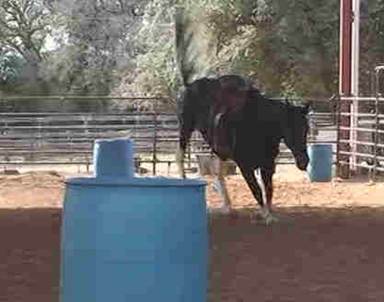
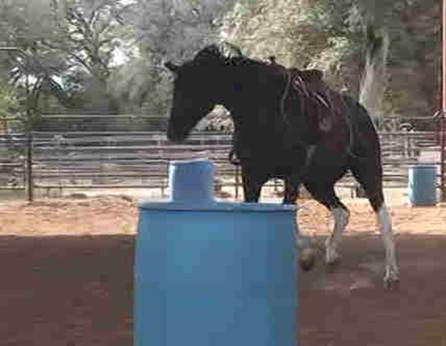
Figure 53 Bucking Under Saddle Scene 1
Rocky was not trying to attack me in these bucking
episodes. We have made great
strides. His energy is frantically
directed toward working through his angry emotions. Rocky has a lot of energy. When I first started Parelli, it might take
some time for him to calm down. Now, he
doesn’t need to buck to work out his emotions, thank you Christi!!
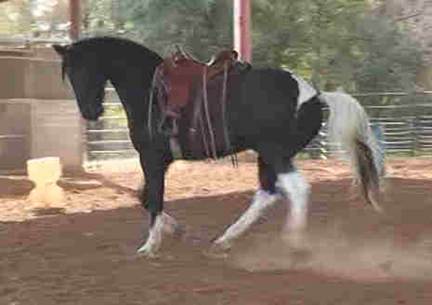

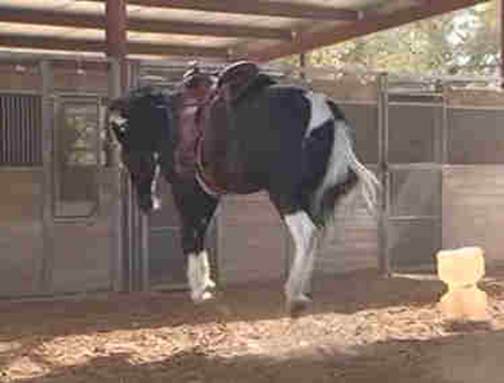
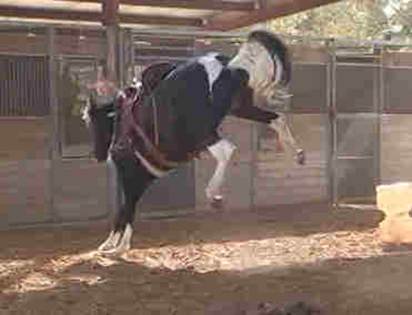
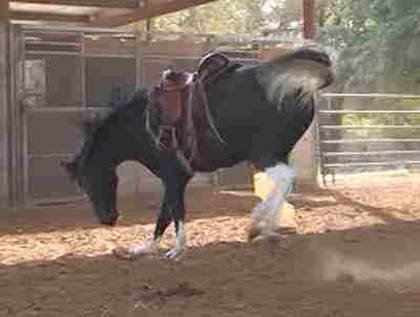
Figure 54 Bucking Under Saddle Scene 2
Rocky calmed down after a few minutes of these frantic
emotional displays. He stopped in a
corner of the arena and looked at me in the photo on the left below. He has worked out his emotions and is ready
to come back to me. Because he is now
calm, I let him come to me. In the photo
on the right, I scratch his soft ears and check for tension while we spend some
dwell time.
I was always amazed at how calm Rocky could be after his angry
emotional episodes. It was like he was
finally free of some demon. I had to
work really hard to not become emotional with him and
stay calm. He would have a hard time
being calm if I were tense when he wanted to join me again. I must admit that I was terrified when Rocky
did these angry emotional displays and am exceeding grateful to Christi for
teaching me how to respond and help Rocky work his way through his
emotions.
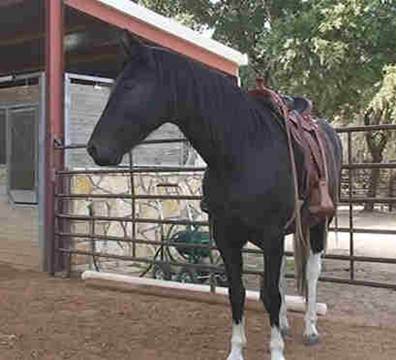
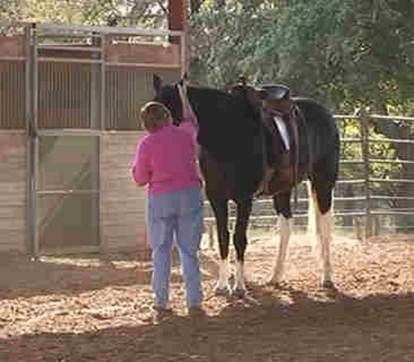
Figure 55 Rocky Calms down Quickly After Bucking
Christi taught me to back off to slower paced games after
Rocky calmed down from his emotional bucking episodes. Rocky was at liberty and I used low pressure
to ask him to weave between barrels and do small slow circles around the
barrels in the next photo.
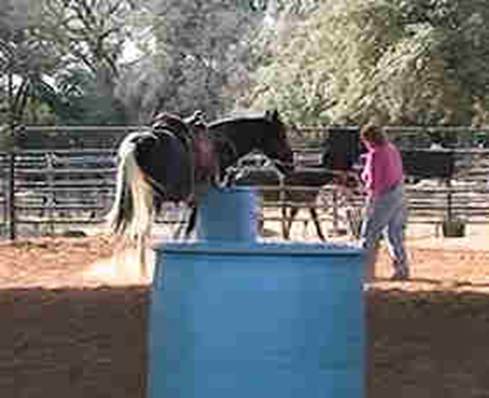
Figure 56 Slow Liberty
Circles Around Barrels
We also played some slow sideways without a fence liberty games. At the time of
this 2007 lesson, we were just learning sideways without a fence
so I had to alternate gentle pressure on his front shoulders and hind quarters
to direct his movement. Sideways is a
game that helps slow a GO horse. Rocky has to concentrate on moving his feet sideways and that
forces him to shift his focus from his emotions to moving his feet
sideways.
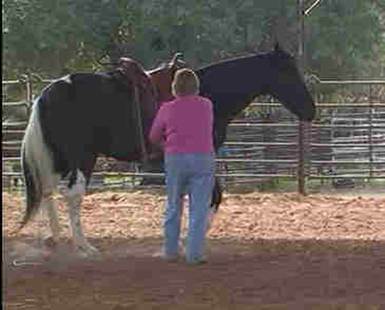
Figure 57 Slow Liberty
Sideways
We also played the squeeze game over some low jumps. Rocky enjoys jumping and this game gets him
moving faster but keeps his mind focused on a task rather than GO or his
emotions. As you can see in the
following photos, his has worked through his emotions
and is enjoying the jumps. You should
also notice that I need very little direction at liberty to ask him to jump the
obstacles.
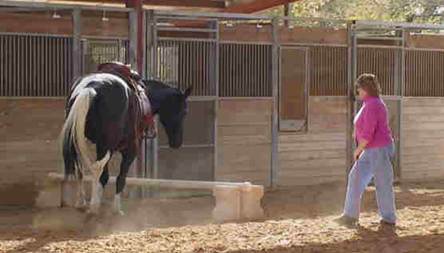
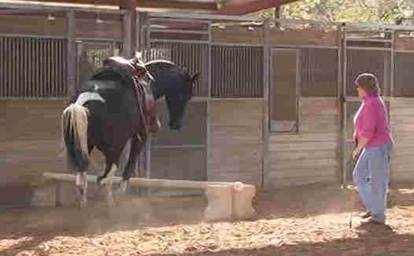
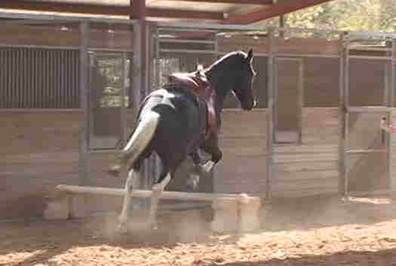
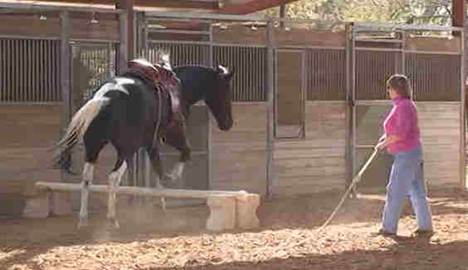
Figure 58 Liberty
Squeeze Jump
The next two photos illustrate the difference in Rocky’s
body language between an emotional horse in the first photo and a calm horse
circling in the second photo. The first
photo was taken during the angry bucking episodes. The second photo was taken after Rocky worked
through his emotions and we played the slow paced
barrel circles, sideways without a fence, and squeeze jumps. In the first photo, Rocky is throwing his head
wildly and his whole body is tense. In
the second photo, he is calmly trotting the circle with a soft face and
attentive ears. I am always amazed at
how quickly Rocky can calm down and enjoy playing the games after he works out
his emotions.
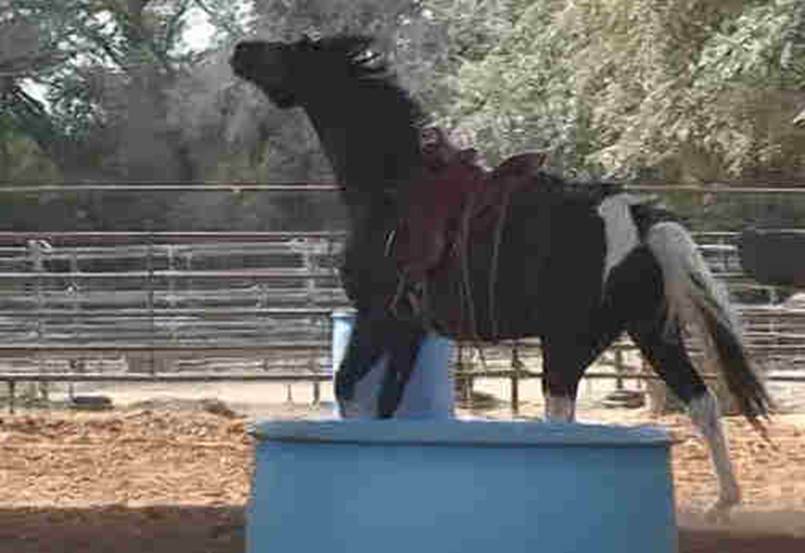
Figure 59 Emotional Posture during Bucking Episode
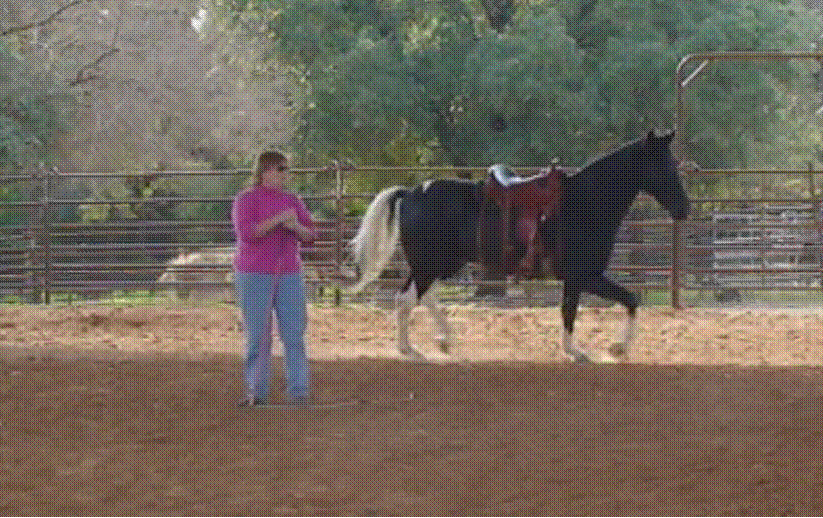
Figure 60 Calm Liberty
Circles after Bucking Episodes
How did I facilitate this transformation from the wild,
emotionally out of control horse to a calm Rocky? Christi taught me the techniques in the
following tables. It is so easy to type
the words in these tables; but, it takes time and experience
to actually read Rocky’s changing emotions and then physically
do the actions needed at the right time.
Table 11 Calming The Storm
|
Rocky’s Actions
|
My Goal
|
My Actions
|
|
Moving toward me
|
Safety FIRST
|
Keep him out of striking
range. Use pressure on his front
shoulders if he is circling toward me.
Use driving games to keep him back.
If he is online, use the lead rope to force him back. At liberty, use
the carrot stick and savvy string keep him away.
|
|
Wildly Moving Around the
area
|
Keep him moving until he
works out his emotions
|
Keep him moving away from
me. Stay relaxed while he is circling
or moving. Change his direction to
force him to think. Match his energy while
changing his direction.
|
|
Stops but is still very emotional
|
Keep pressure on him until
he works out his emotions
|
Send him in another
direction. Drive him to keep
moving. Match his energy levels while
you are driving him.
|
|
Stops but is calm
|
Release teaches him this is
the right answer
|
Let him come to you for
some dwell time as a reward.
|
|
Soft ears
|
Keep him relaxed
|
After some dwell time, do
some slower paced thinking activities.
|
After Rocky is calm and has lost his emotional demons, we
spend some dwell time and then move on to some slower paced activities that
require him to think about moving his feet instead of his angry emotions. My overall goal is to start slow and then
move to faster paced activities while maintaining Rocky’s calm state. If he starts becoming emotional, then we have
reached a threshold and I need to back off to a slower
paced activity and start over. Some of
these activities are described in the following table.
Table 12 Playing Games after The Storm
|
My Goal
|
Games
|
Activities
|
|
Re-enforce the bond.
|
Stick to me and mirroring
|
Slowly walk around with
Rocky. Mirroring is a good bonding
activity. I can also have Rocky stand
on a pedestal.
|
|
Get Rocky to think about
moving his feet and not get emotional.
|
Slow sideways in both
directions
|
Slow, close activities to
stay bonded. We can do a slow sideways
walk in both directions or a slow yoyo.
|
|
Get Rocky to think about an
obstacle instead of his emotions.
|
Slow figure 8 or weaving
between cones. Sideways over an
obstacle
|
I stay close to Rocky and
walk with him around the obstacles. I
can also send him around or through the obstacles. I can also send him sideways over an
obstacle.
|
|
Picking up the pace and keeping
Rocky calm.
|
Squeeze jumps
|
Squeeze jumps and other activities
that get his feet moving and force him to think about the jump instead of his
emotions.
|
|
Picking up the pace to make
sure he won’t get emotional.
|
Circling
|
Send Rocky on a circle for only 2 or 3 laps in both directions. Dwell time between directions is a reward
for staying calm.
|
I used a regular saddle for training
camps during the first part of our Level 2 training. Christi has a gorgeous property adjacent to
the Brazos River.
During her camps, we took trail rides to the river. I was always pleased at how well behaved Rocky was after our proper preparations for
riding. The following photos show riding
with a regular saddle.
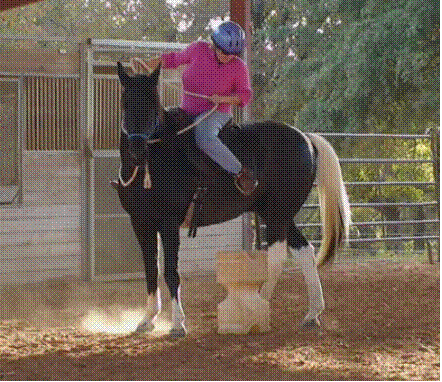
Figure 61 Learning Sideways over an Obstacle
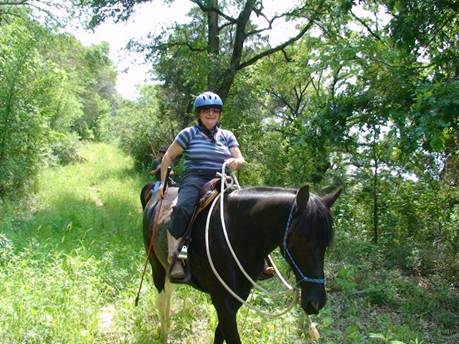
Figure 62 Trail Riding with Saddle and Carrot Stick
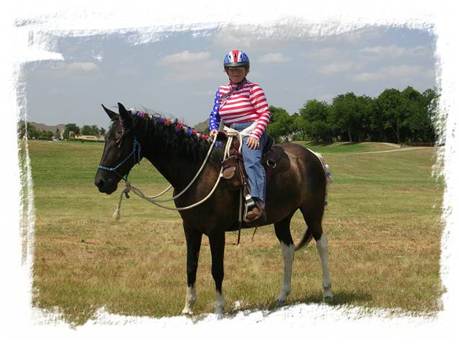
Figure 63 Riding in the 4th of
July Parade
I experimented with different saddles including extra wide
Tennessee Walking Horse saddles and treeless saddles. None seemed to fit properly so I bought the
Parelli bareback pad and began riding bareback in small arenas. When I first started riding bareback in 2005,
I was amazed at how much Rocky’s front legs stretched out and moved. I could also feel the movement of Rocky’s
body and legs. Obviously, the regular
saddles restrained his movements.
Linda Parelli started introducing her riding with fluidity
concepts in 2005 and as a novice rider, I needed to learn to develop a sense of
rhythm while riding. I have never been
an athletic or coordinated person and I was having a
hard time learning to move with the horse.
Based on our rough history, it may seem fool hardy
but I decided to start riding in a small arena with the Parelli bareback
pad. I always made sure Rocky was ready
to ride before ever getting onto his back.
Rocky and I rode as usual. Rocky
would stand by the fence for me to get on his back and we rode around the arena
as usual. We gradually started leaving
the arena and going to the pasture to graze.
Rocky would get bored with riding in an empty space. I learned to fill our riding space with all
sorts of objects just to keep him interested.
The objects presented endless opportunities for sideways, circling,
stopping, backing, etc. using the obstacles.
The following photos were taken in 2007 during some lessons at Christi’s
place. These photos were taken on the
same day as the bucking episodes described earlier. The proper preparations for riding make all of the difference between a safe ride and a terrifying
ride. The difference between a calm and an emotional Rocky never
ceases to amaze me.
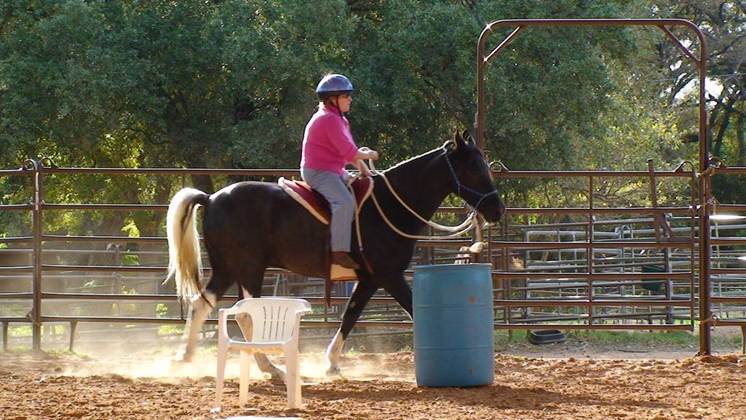
Figure 64 Riding Bareback with Obstacles
“Take the time it takes” is a common Parelli
expression. It is so true with regard to helping Rocky through his emotions. He rarely has an emotional
episode today because I took the time needed to help him work through
his emotions.
I started riding with the bareback pad during Christi’s
Level 2 horse camps in 2007. At first,
it was a little scary with the other horses but it
worked out very well. The number of
frightening moments dwindled dramatically and we have
both learned to trust one another.
Initially, I was really insecure riding around
other horses. If Rocky feels like his
space is being crowded by other horses, he finds a comfort spot by standing
quietly by the nearest fence to see if we can do something else. Rocky does not attempt to buck me off or give
me runaway rides anymore. Of course, I use
Proper Preparations and know how to get off if a dangerous situation
presents itself to us.
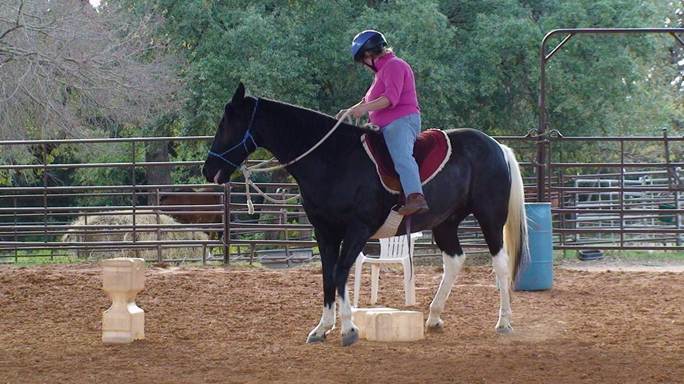
Figure 65 Riding Bareback Sideways Over Obstacle
I started riding with the bareback pad during Christi’s
Level 2 horse camps in 2007. At first,
it was a little scary with the other horses but it
worked out very well. The number of
frightening moments dwindled dramatically and we have
both learned to trust one another. Initially,
I was really insecure riding around other horses. If Rocky feels like his space is being
crowded by other horses, he finds a comfort spot by standing quietly by the
nearest fence to see if we can do something else. Rocky does not attempt to buck me off or give
me runaway rides anymore. Of course, I use
Proper Preparations and know how to get off if a dangerous situation
presents itself to us.
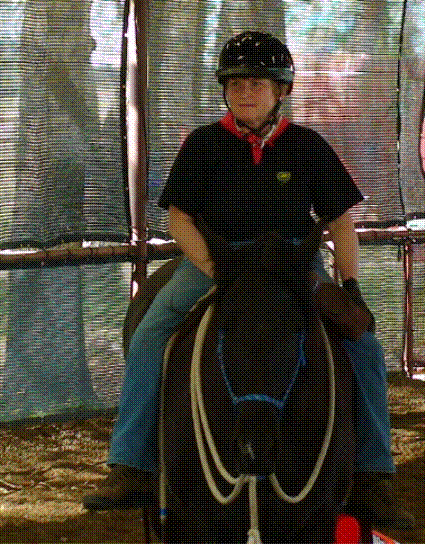
Figure 66 Standing Quietly
It seems like a miracle to me, but Rocky is quite happy to
be calm and unemotional while we stand quietly, walk, or trot. If you compare these photos with those of
Rocky during the bucking episodes, you will understand why it seems like a
miracle to me! He no longer feels the
need to constantly move as a way to deal with his emotions. Other horses no longer bother Rocky while we
are riding.
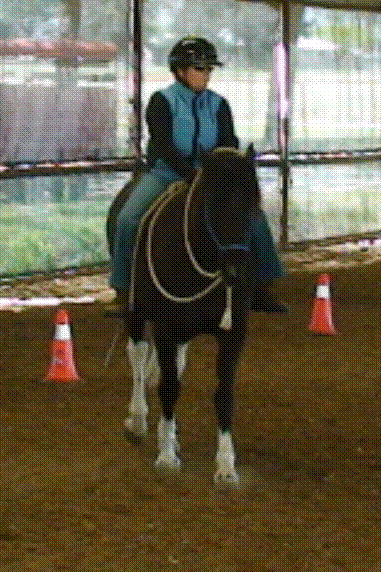
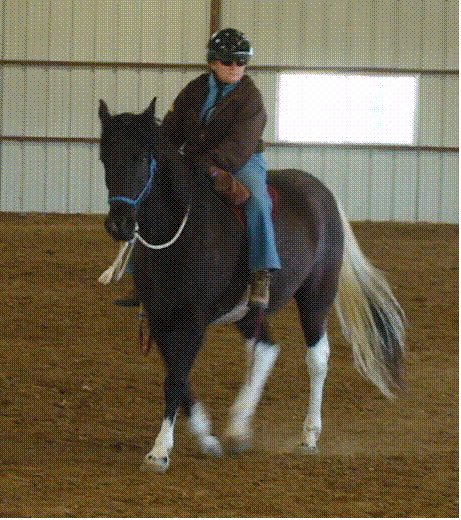
Figure 67 Slow Walks
and Trots
Rocky enjoys standing on pedestals while we are riding. He will just climb up on the pedestal and
stand there. He loves it!
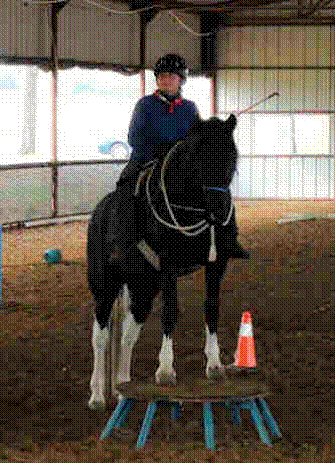
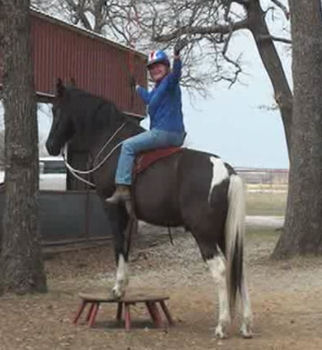
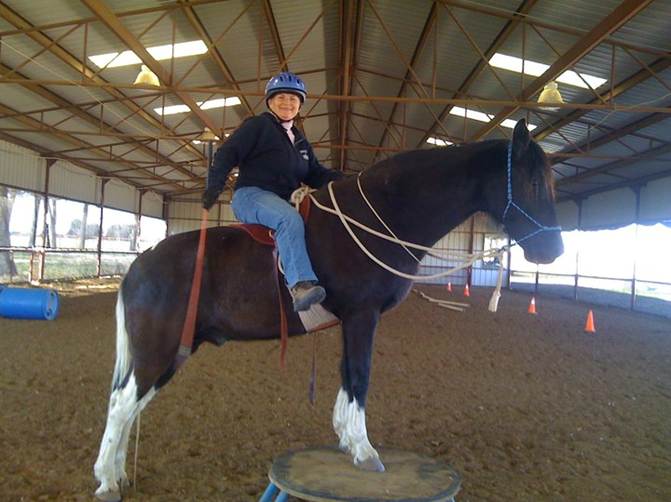
Figure 68 Riding on the Pedestal
Chapter 8 Parelli Horsenality Strategies
Check out http://www.parelli.com
for Parelli Horsenality information and guidance. Parelli continuously adds new and interesting
material on the web site.
I just wish Parelli had developed these strategies before
Rocky joined our family. It would have
saved both of us a lot of pain and tears.
Rocky is a very confident and dominant left brained
horse. He tends to be more introverted
even though he does have quite a few extroverted characteristics. Parelli provides the Horsenality Leadership
Strategies shown in the following figure.
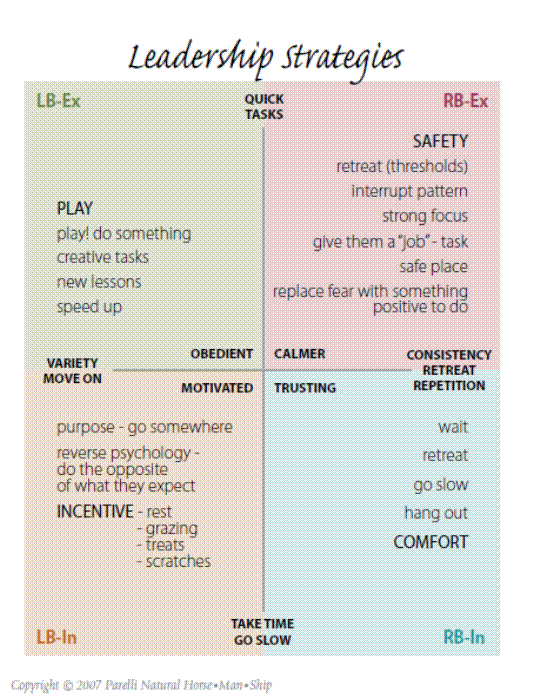
Figure 69 Parelli Leadership Strategies
Rocky definitely needs variety to
be motivated. If you look at the left brained
side of the Parelli Leadership Strategies, you should recognize a lot of the
activities that Christi taught me to do with Rocky in Levels 1 and 2.
Variety is the spice of life. The driving, circling, and falling leaf games
are examples that illustrate how Rocky is easily bored and needs variety. Christi taught me to mix the games and
obstacles to create a new experience every time we play. He does not see any purpose in circling
online or in a small space. I don’t have
any photos of circling at Liberty
in our large pasture, but Rocky absolutely loves to play at liberty in a really large natural space.
I included photos of circling Rocky up and down ditches. He loves circling up and down our steep pond
bank. He also shows a lot more interest
and less stress when we circle obstacles.
Incentive. Rocky is definitely motivated by FOOD and scratching. He especially loves to have his ears and
belly scratched.
Purpose. Yes, Rocky
likes to have a purpose to his actions. I usually use food. We ride to the
pasture to graze. We ride
in and out of the paddocks to check out all of the
food buckets. He gets to lick the
buckets and feeders. Rocky needs a
purpose to circling and obstacles are a good way to
add purpose and variety to circling. I
have chickens and Rocky helps me herd the chickens into the coop at night. We ride around the
pasture to shut the gates and check the water tanks.
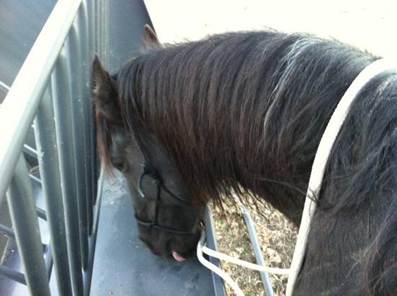
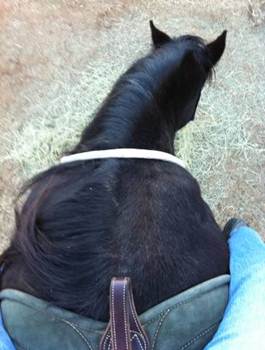
Figure 70
Riding with Purpose:
Checking out the Feeders and Eating Hay
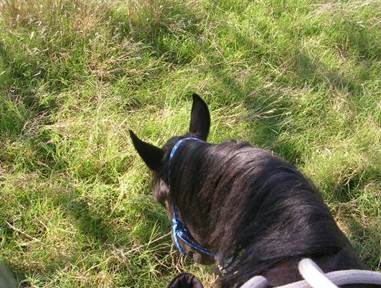
Figure 71 Riding with Purpose: Grazing and Herding Chickens
Parelli provides a Horsenality chart identifying
difficulties and solutions for the Seven Games.
The difficulties chart aptly describes many of our experiences.
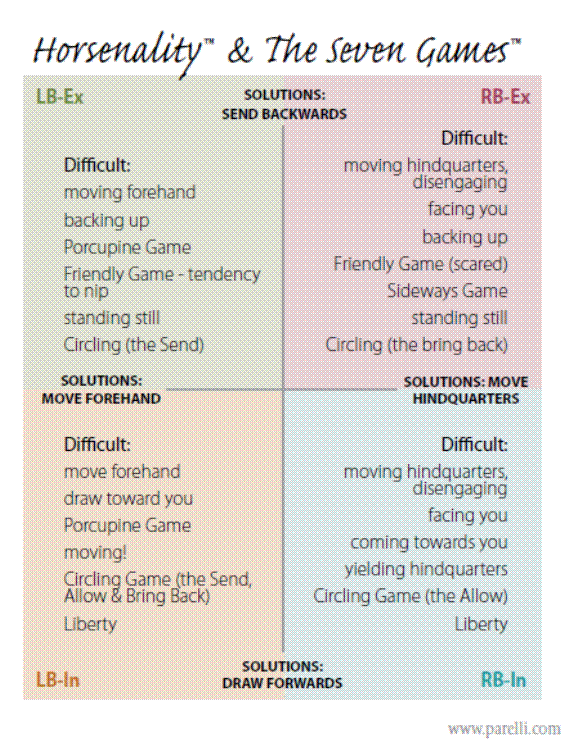
Figure 72 Parelli Horsenality and the Seven Games
The following table summarizes some of the general difficulties
with the Seven Games as we worked our way through Levels 1 and 2.
The rest of this chapter describes some of the specific difficulties
we had with the seven games. I tried to
provide enough pictures for the reader to recognize the problems Rocky was
having and to describe the techniques that I learned to help him overcome the
difficulties.
Table 13 Left Brained Difficulties and Rocky
|
Left Brained
Difficulties
|
Rocky and Janet’s
Experience
|
|
Circling
|
We definitely
had problems with circling as you have seen in the examples included
in this book. It took a lot of effort
for me to learn how to use an effective phase 4 when needed. Once Rocky didn’t need the
phase 4, I had to learn to be sensitive and use the least amount of
pressure required.
|
|
Forehand yield
|
It is interesting but the
hindquarter yield came relatively easy compared to his forehand yield. We are still working on getting a really good forehand yield in the saddle.
|
|
Liberty
|
Our initial attempts at liberty
were also very difficult but now liberty games are the ones we both enjoy the
most. Our Level 2 experience includes
some examples of Rocky being very emotional during some liberty lessons.
|
|
Back Up
|
Driving Rocky back brought
out aggressive emotions. Check out the
detailed descriptions of his sneak attacks and the frontal charges described
with our “Rocky” relationship.
|
|
Porcupine Game
|
We had huge emotional
issues with the friendly and porcupine games using
the carrot stick in Level 1. We spent
months doing different approach and retreat activities to overcome the issues. Our Level 1 discussion includes some
detailed examples.
|
|
Moving
|
I spent a lot of time
helping Rocky understand that he didn’t need to GO all the time – he could
stand quietly and walk slowly. Our
Level 1 experience discusses Slowing a GO Horse.
|
|
Draw Toward Me
|
Rocky usually has excellent
draw. In our early days, drawing Rocky gave him an opportunity to bite. Check out the “Anatomy of a Charge” as an
example of an emotional draw situation.
|
Interrupting the pattern of behavior is a common approach to
handling difficult situations by changing the current focus to something
else. A new mom quickly learns ways to
redirect her toddler’s attention to another activity. A successful salesman knows how to analyze
his customers and focus their attention to the product he wants to sell. Direction changes help a horse calm down by
forcing them to think and focus on something else. I learned to change the pattern of Rocky’s movement
to calm him by forcing him to think.
Circling still presents a challenge for us at times, but I
am now prepared to help Rocky work out his emotions, calm down, and be a safe
horse. During a Christi camp in 2009,
Rocky was unhappy with circling in a small arena while we were practicing lead
changes. Send on the circle started out
fine but then Rocky became tense with his head lowered, started snorting, and
his nostrils flared on the first lap.
I used pressure on his front shoulders to keep him circling
at a safe distance. I used frequent
direction changes to force him to think and calm down. He became calmer each time he changed
direction. Rocky was not allowed to stop
until he was doing a calm circle. After
some dwell time, we played falling leaf in the pasture
to practice more direction changes. The
following photos show our progression through the whole process of circling in
a small pen and advancing to falling leaf in an adjacent pasture.
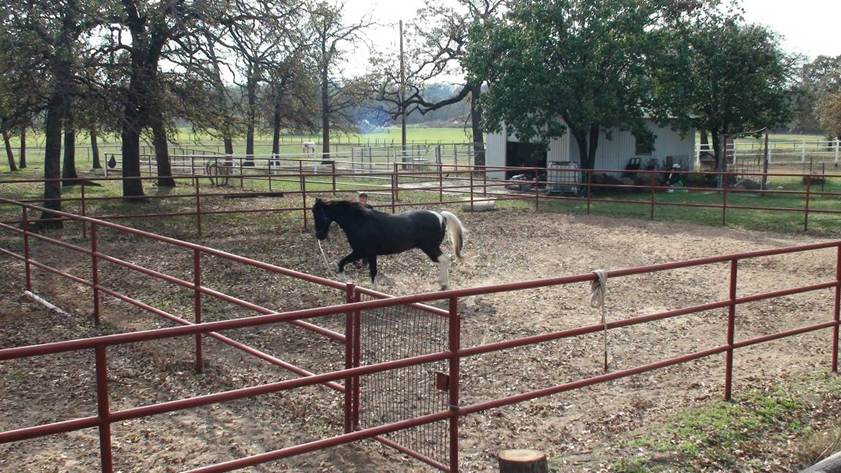
Figure 73 Rocky Starting out on the Circle
Rocky started out on the circle and
immediately started to show signs of discontent and anger. You can see his head start
to bend down and his ears start to go back.
The photo does not show how tense his whole head becomes and his eyes
develop a hard glaring stare that is hard to describe. He starts to look like he wants to explode
with angry energy. These are signs of
impending acts of aggression. When Rocky
enters this temperament, his old pattern of behavior was to move close enough
so he could either bite or rear up. Christi
taught me to use effective phases to manage Rocky when he shows these signs of
aggression. I had learned to send a wave
of energy down the lead rope and use the carrot stick to put pressure on his
shoulder to get him to stay on a bigger circle and not
drift toward me while he works out his emotions.
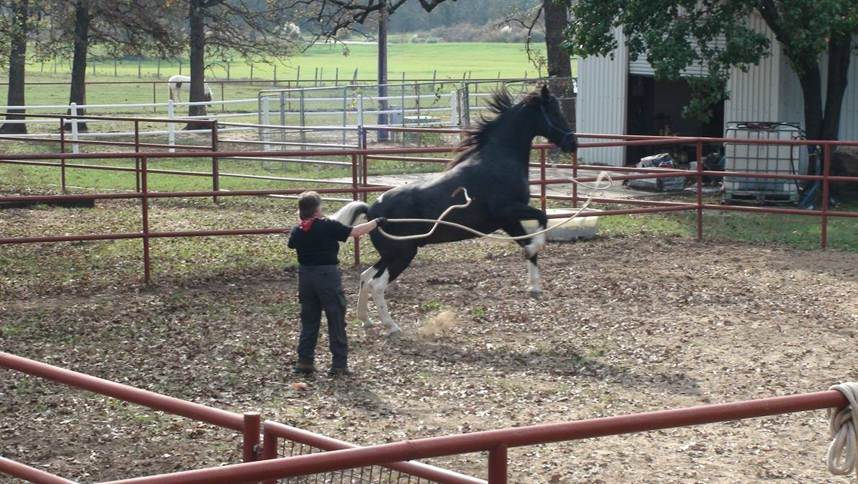
Figure 74 An Emotional Rocky on the Circle
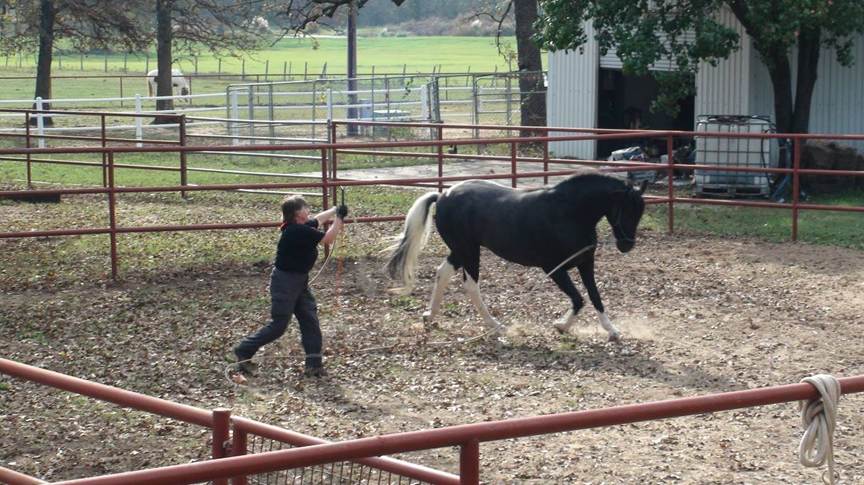
Figure 75 Keeping Rocky at a Safe Distance on the
Circle
Looking at these photos, it may be hard to believe but Rocky
is now very sensitive to how much pressure I put on him. If I push him out on a wider circle holding
the carrot stick pointing up it puts more pressure on him than if I hold the
carrot stick down. Holding it down is
like a little “shoo away” whereas holding it up is more like “get away
NOW”. In the above photo, Rocky wasn’t
quickly moving in toward me so I used less pressure to
avoid an escalation in his level of aggression.
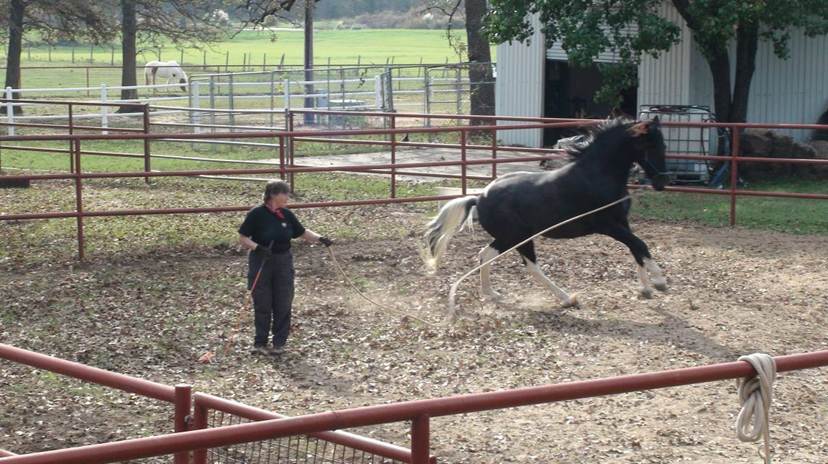
Figure 76 Waiting to Change Directions on the Circle
Direction changes interrupt his pattern of behavior and help
Rocky calm down by forcing him to think.
He usually calms down with each change in the pattern of his
movement.
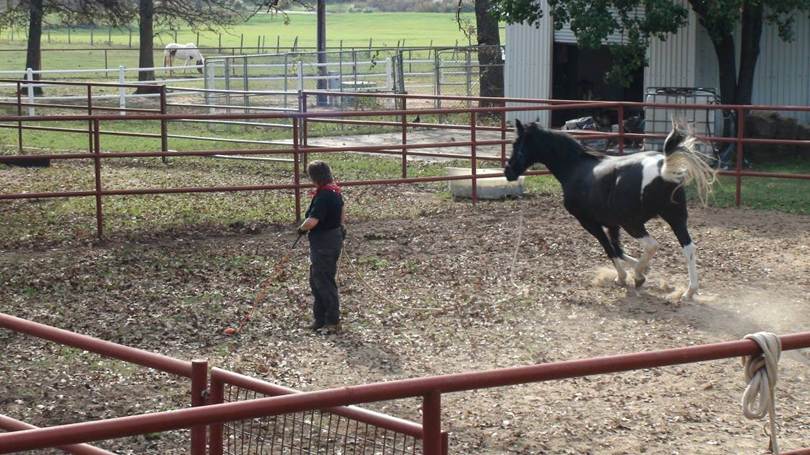
Figure 77 Calmer After a Direction Change on the Circle
After a few minutes of circling with direction changes in
the small arena, we went to the pasture to play falling leaf to practice
direction changes and further interrupt Rocky’s frantic circling pattern by
only using semi-circles. Falling leaf is
a game of semi-circles with a direction change at each end of the
semi-circle. You basically send the
horse on a semi-circle in front of you.
When the horse reaches one side, you make him change direction and
circle the opposite direction in front of you.
You move forward across the pasture as the horse does semi-circles in
front of you. The direction changes
force the horse to focus on the direction change which in turn helps Rocky calm
down.
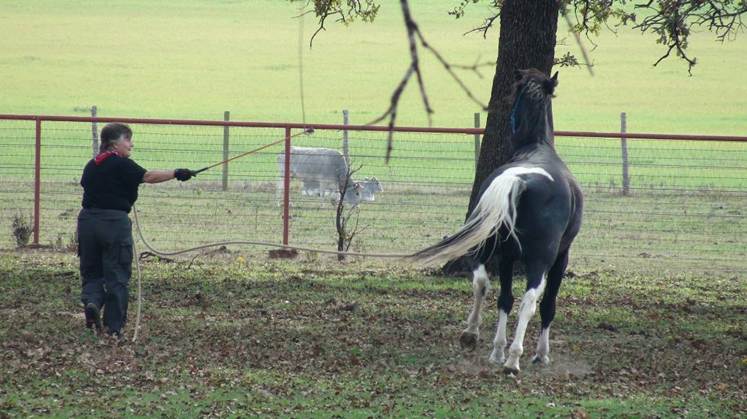
Figure 78 Starting Falling
Leaf
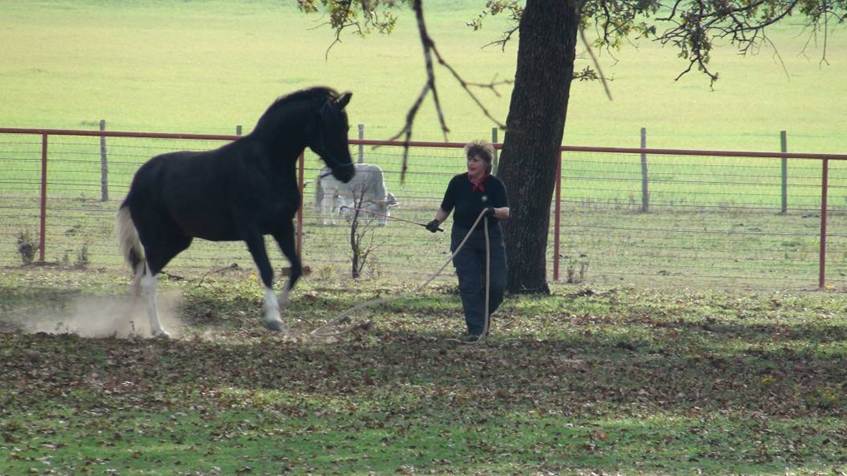
Figure 79 Stress during Direction Changes
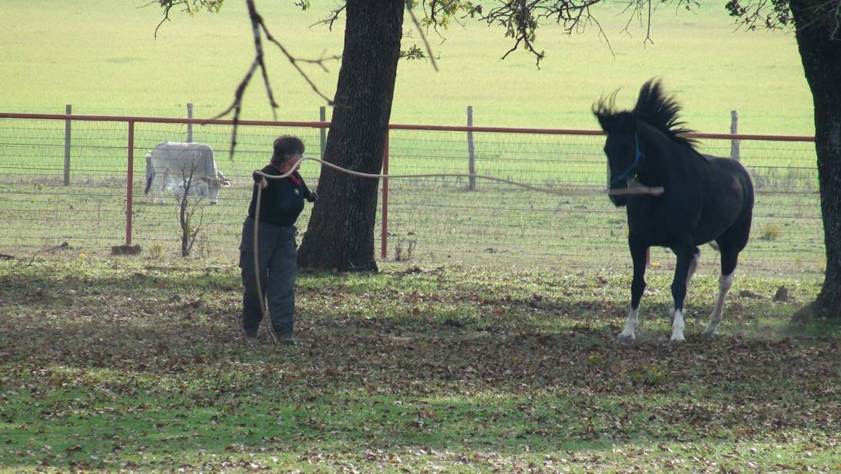
Figure 80 Keeping a Safe Distance during Falling Leaf
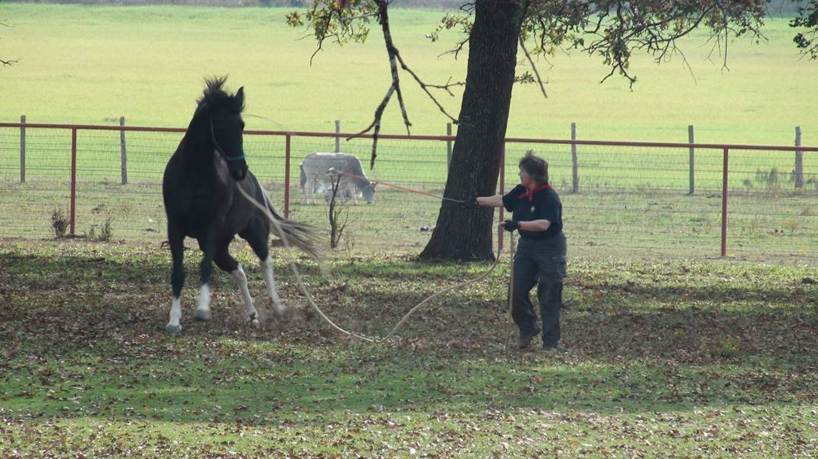
Figure 81 More Stress during Direction Changes
When he refused to complete a direction change, I would have
to apply pressure to his front shoulders to convince him to continue in the
arc. We stopped the falling leaf pattern
after a couple of successful direction changes.
We spent some dwell time after a few stressful
minutes of the circling and falling leaf patterns. Notice the carrot stick is between us just in
case but Rocky’s face is now relaxed and his eyes are
soft.
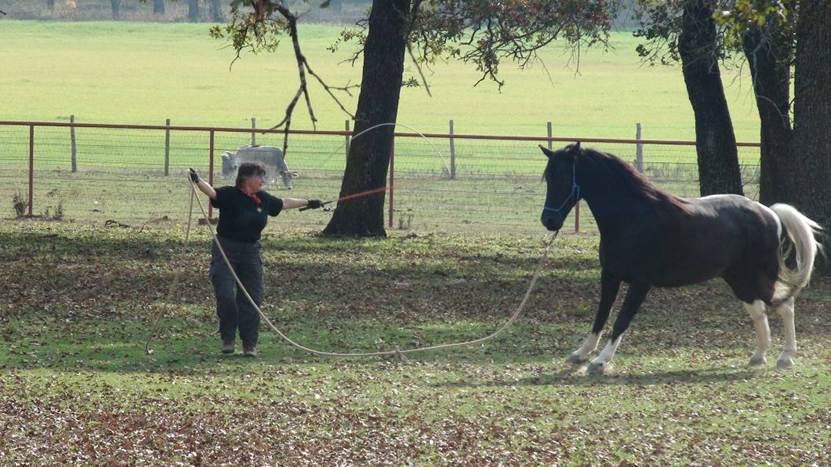
Figure 82 Refusing to Change Direction
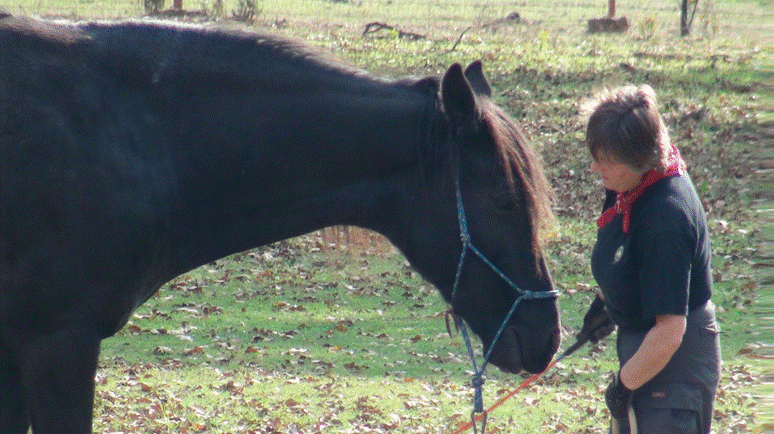
Figure 83 Dwell Time after Falling Leaf
I learned a lot about making sure Rocky is ready to ride
before even considering getting onto his back.
On this day, Rocky enjoyed being groomed and saddled. We do the Parelli four part
respect test as part of our preparations to ride. The four parts are driving the horse
backwards, yielding both hind quarters, yielding both front shoulders, and “stick
to me” getting the horse to follow you like a foal follows the mare. Rocky was fine with yielding and following
but he wasn’t happy about being driven backwards so we did some YoYo and sideways
as slow (NO GO) activities and moved to short circling games with direction
changes. You can see that he is unhappy
circling in this photo.
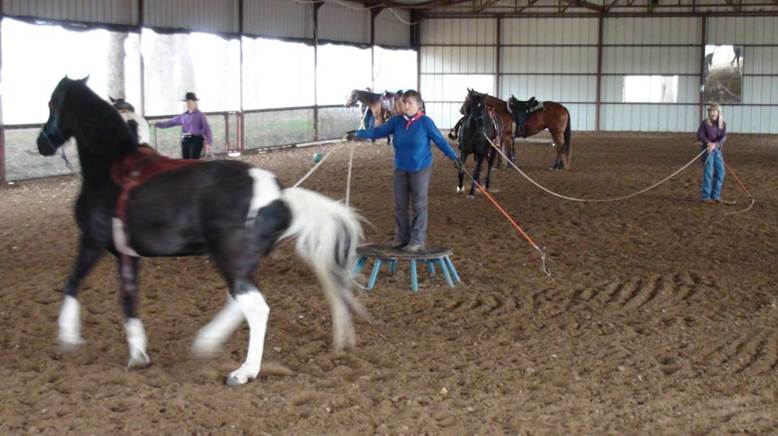
Figure 84 Unhappy Circling before Riding
Even though Rocky is not happy about circling, he is not
making any aggressive actions to move in toward me. Rocky can be a GO horse on
the circle and changing directions a lot forces him to think and calm
down. I can also wiggle the lead rope
gently to slow his pace. The next photo
shows Rocky doing a slow, calm tight circle.
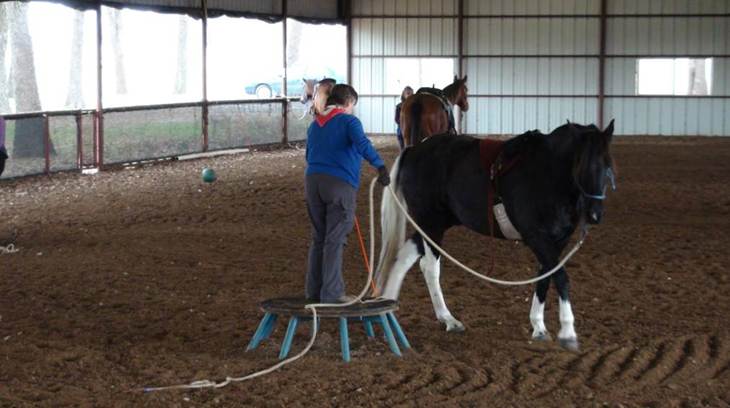
Figure 85 Slow Happy Circle before Riding
We both enjoyed some dwell time after Rocky calmed
down. I got off of
the pedestal and he climbed onto the pedestal with his
front feet. He enjoys relaxing on the
pedestal. What is in it for the left
brained introvert? He is hoping for a
good belly rub.
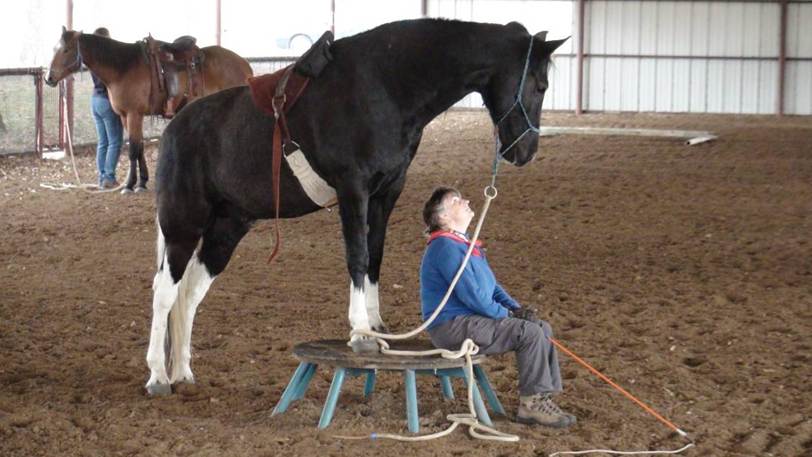
Figure 86 Dwell Time and Communication before Riding
Sideways is a good slow activity to get Rocky prepared for
riding. Basically, Rocky and I go for a
sideways walk. Rocky has
to think about moving his feet instead of any negative emotions he may
be experiencing at the current time. The
following photos show a slow sideways walk without a fence. It takes very little pressure to ask Rocky to
move sideways and keep him moving sideways in front of me. I am not using the rope
or the carrot stick.
I am simply walking and directing my energy for him to move
sideways. He is calm and paying
attention to my body language as we walk through the other horses and people in
the arena.
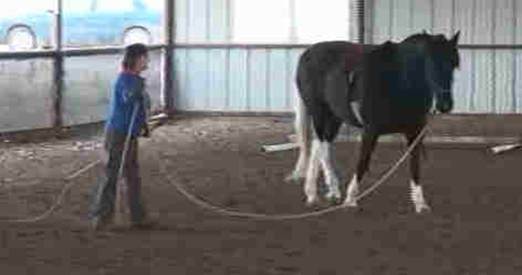
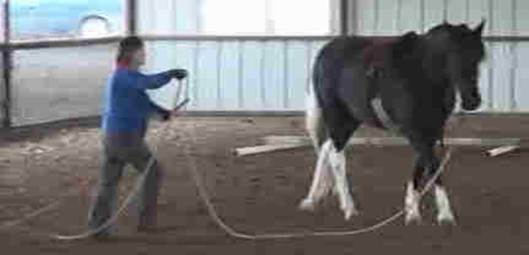
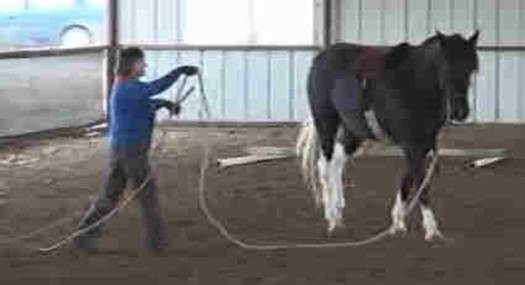
Figure 87 Sideways Walk Riding Preparation
In December 2008, we officially passed the old Level 2 that
had online, liberty, freestyle riding, and finesse riding tasks. Parelli released the Levels
Pathways in 2009 and we began using the
Pathways for Level 3. In the
Levels Pathways, Level 1 is online only, Level 2 is online and freestyle
riding, and Level 3 is online, liberty, and freestyle riding.
Level 3 introduces a 45 foot lead
rope for the online tasks. The official auditions for Level 3 online let
you use either the 22 or 45 foot ropes. I used the 22 foot
for our audition tapes. The 45 foot rope is not a soft lead rope like the 12 and 22 foot lead ropes used in Levels 1 and 2. This is a rough rope
that requires special handling to make it coil and uncoil correctly. I am still working on my 45
foot rope skills.
My real challenge is not with Rocky – it is learning to
handle the stiff rope and recoil it correctly.
Christi has us do a lot of exercises with the rope just to learn how to
use it. These are beneficial but I need
to practice enough to develop muscle memory and a new strength in my wrists and
arms. I also need to learn new
techniques to use the stiff rope effectively to communicate with Rocky without
putting too much pressure on him.
The following photo shows us learning to drive from zone 5
with the 45 foot line.
Zone 5 is behind the horse.
Notice how calm Rocky is. Where
is the carrot stick? The savvy string
and end of the carrot stick are resting on the ground as I feed out the rope
and use gentle motions to keep him moving.
I am asking Rocky to move and he wants to move.
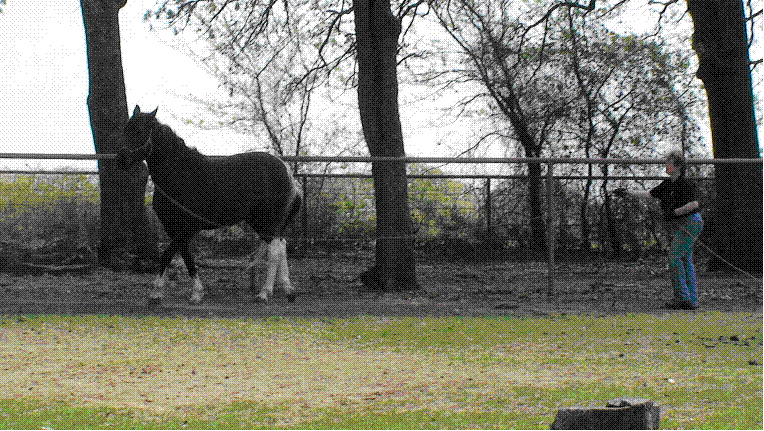
Figure 88 Driving from Zone 5
The next photo shows us starting to learn to do the sideways game with the 45 foot
line. Notice that I don’t need a lot of
carrot stick direction to keep him moving
sideways. I started him moving sideways
with a little pressure on his front and back.
He kept moving as I fed out the rope and then walked with him.
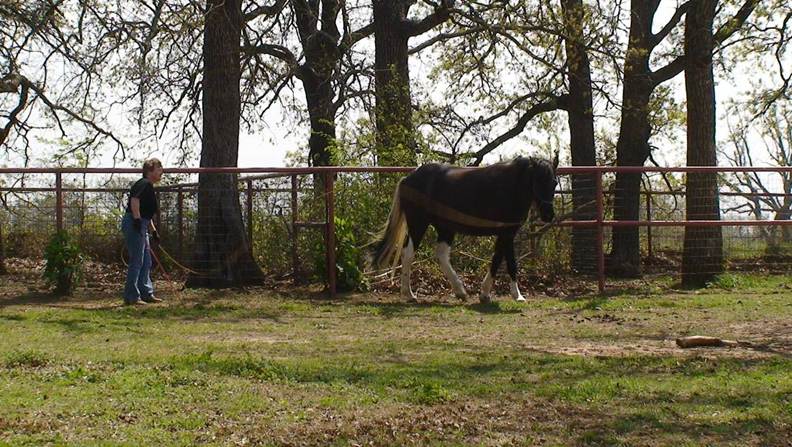
Figure 89 Sideways with the 45 Foot
Line
Rocky loves to jump.
He jumps over ditches in our pasture when he is out on his own. He jumps over the obstacles that litter his
paddock when I put him up at night. The
following photos show Rocky jumping logs on the 45 foot
line. Notice that I don’t need a lot of
carrot stick direction and in fact the carrot stick is resting on the
ground. My big challenge is keeping the
long rope out of Rocky’s way as he trots into the jumps. I also have to work
hard to make sure the rope doesn’t get caught on the natural obstacles in the
pasture.

Figure 90 Jumping Fun with Logs
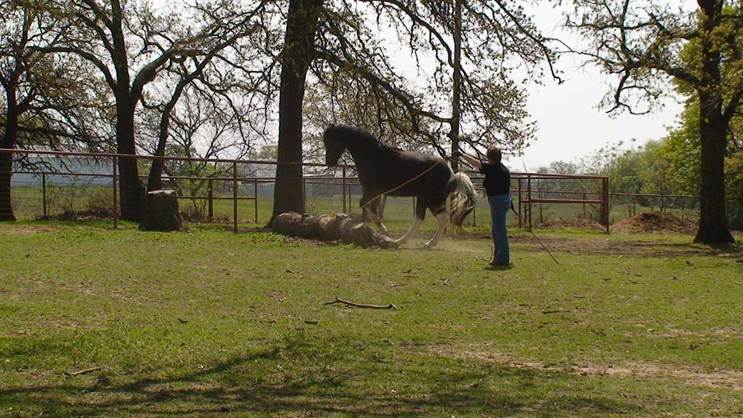
Figure 91 Jumping Logs with the 45
foot line
In the following photo, you can see the coils in the 45 foot line as it litters the ground around us. You should also notice that the carrot stick
is no longer between us during dwell time after a jumping session using the 45 foot line. Rocky
is happy.
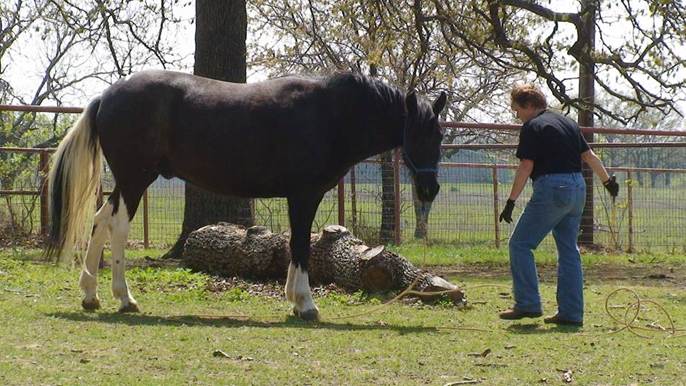
Figure 92 Dwell Time and Mirroring after Jumping
Do you remember the earlier photos of our circling and
falling leaf challenges? We still occasionally
have an emotional circling episode
but they are no longer a common occurrence.
The following photos show how much calmer Rocky has become and how much
less pressure I must use in our falling leaf sessions.
In the following photo, Rocky has on the bareback pad and we are exercising before we ride in the arena.
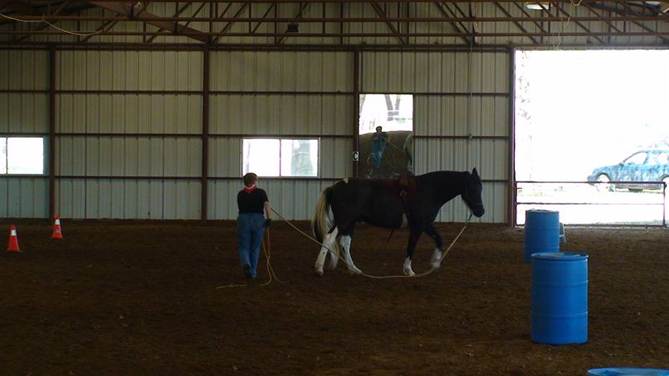
Figure 93 Slow Falling Leaf
The following falling leaf game was part of a Level 3 camp
where we are preparing to use the 45 foot line. We practiced using the 22
foot line first and then moved on the 45 foot line. You can
see how much energy Rocky has in the photos.
He doesn’t show any signs of aggression or other negative emotions –
Rocky is enjoying the falling leaf run.
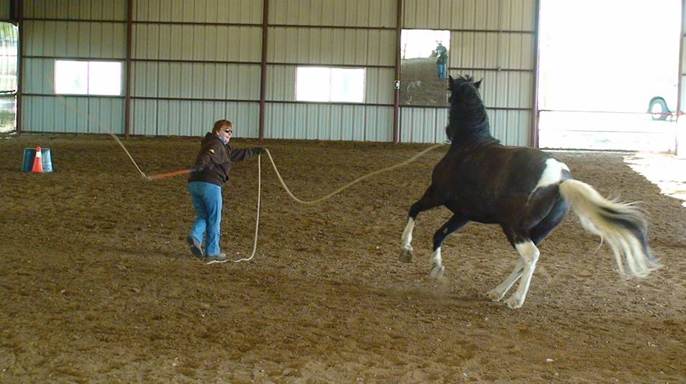
Figure 94 Energetic Direction Change in Falling Leaf
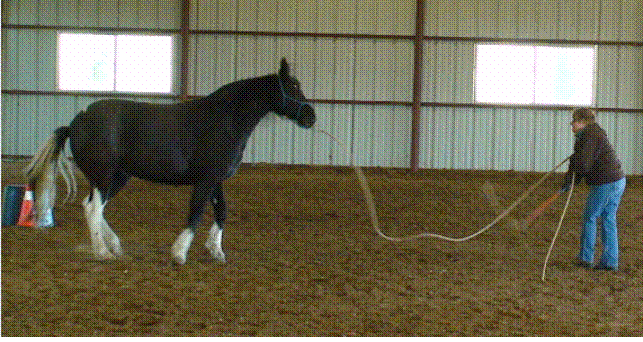
Figure 95 Asking for the Turn
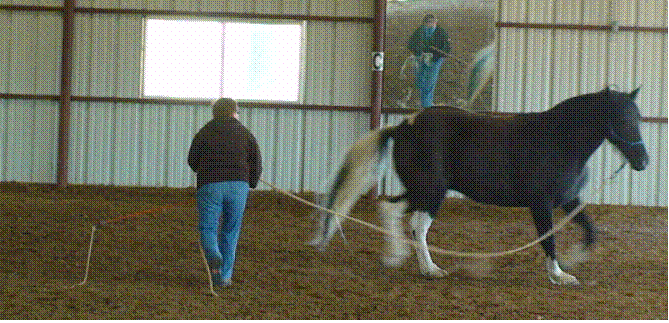
Figure 96 Rocky Calm after the Turn
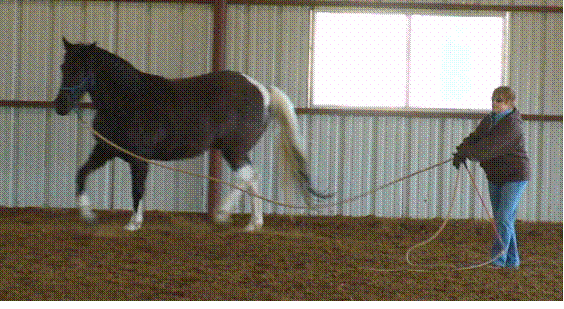
Figure 97 Calm after Falling Leaf
My biggest challenge with circling using the 45 foot line is the rope itself. I am still learning to feed the rope out on
the send and pull it back in on the draw for the bigger circles. Rocky seems to like the freedom of the longer
rope. I have a hard time keeping the
rope untangled and out of our way. The
following sequence of photos show 2 circling game
sequences on the 45 foot line at a Christi Level 3
camp in 2009.
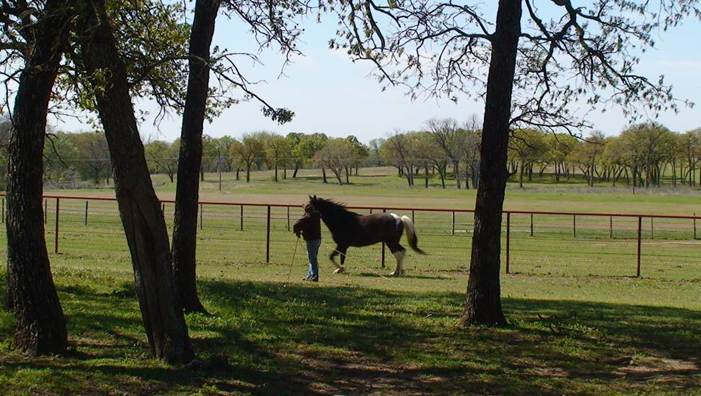
Figure 98 Rocky Circling on 45 foot
line
Rocky is calm on the circle and
enjoying it. In the next photo, he is
shown just after a direction change. He
is usually energetic with a direction change on the circle. In a lot of the past photos, you saw a very
angry and aggressive Rocky on the circle and especially with direction
changes. He is full of energy in this photo
but not angry about circling.
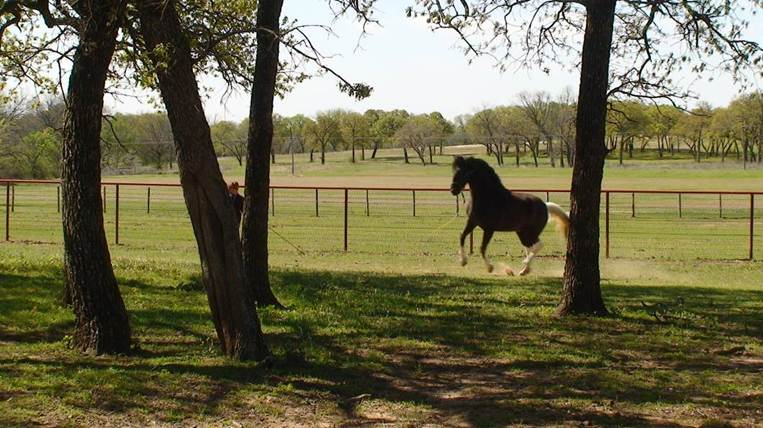
Figure 99 Change of Direction on the Circle
In the following photo, we had just finished another
direction change and I dropped the 45
foot line. Rocky kept circling
while I tried to pick it up and get it out of his way
so he didn’t trip on it. Notice how energetic
and happy he looks on the circle compared to the earlier circling examples.
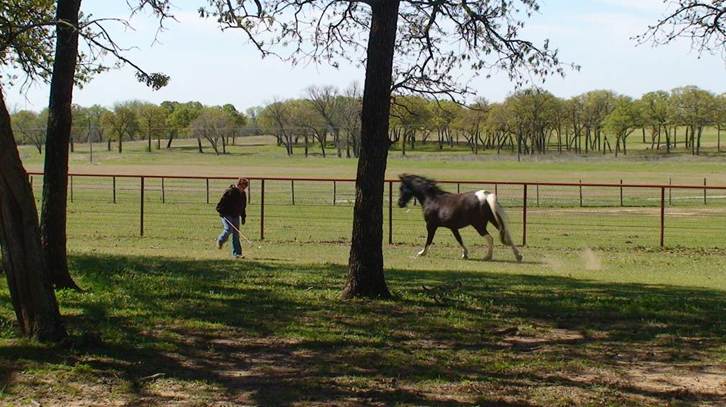
Figure 100 Rocky Circling
The next photo shows my poor 45 foot
line skills as we move through the trees.
Notice my feet are trying to keep up with his front feet and mirror
them. He is full of energy and wants to
keep moving. Rocky is annoyed with my
rope handling and has his ears back a little to show his annoyance
but he is not showing any signs of aggression.
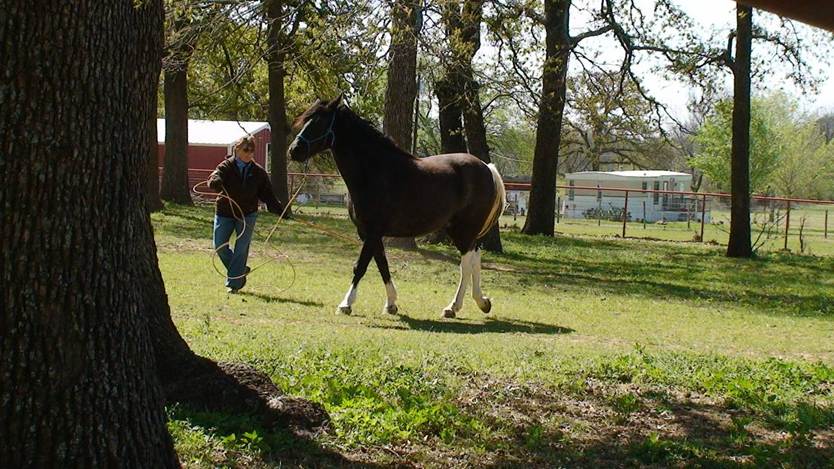
Figure 101 My Poor Rope Skills
The next photo shows a calm Rocky on the circle after I got
control of the rope again.
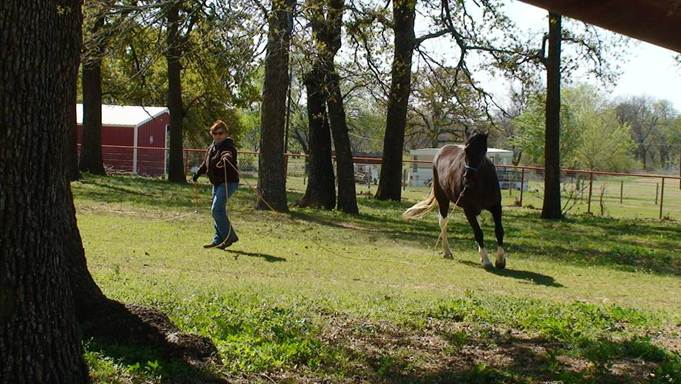
Figure 102 Circling on the 45 Foot
Line
Rocky was calm after the circling games and in the next
photo he is looking at me asking “what are we doing next?” He didn’t have any negative emotions about
circling on the 45 foot line. Rocky likes to do circles around a big
pasture. The photos you see here were
taken at a Christi camp where the pasture has a lot of trees. Our pasture at home has some wide open spaces between the trees. Rocky and I do what I call “circle walks” in
the open pasture. Circle walks are like
falling leaf only with full circles instead of
arcs. I send Rocky on
a circle and walk forward as he circles me.
We do change of directions and keep walking. He finds this more interesting and fun than
circling in one spot. Plus, when we
reach the end of the open area, he gets to graze on the good grass there.
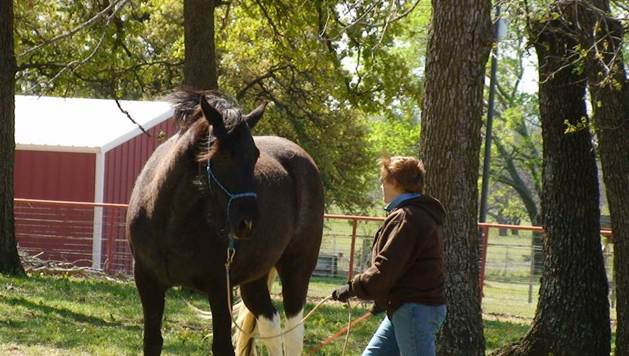
Figure 103 Rocky Calm after Circling
We spent some dwell time after the circling games. During dwell time, I still mirror his calm
posture and focus. You will notice how
calm Rocky is and that the carrot stick no longer needs to be between us.
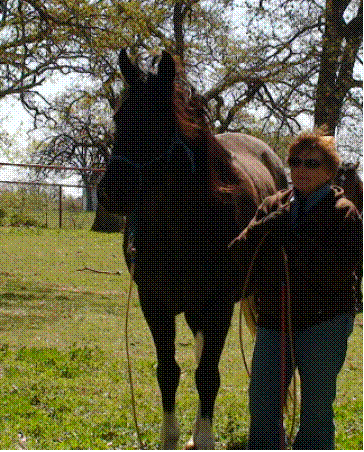
Figure 104 Dwell Time after Circling
On Line
Games
We play a lot of games in Level
3. For the on line games, my biggest challenge is no longer
communicating with Rocky but keeping the 22 and 45 foot
lead ropes out of our way as we play with obstacles. I feel really clumsy
with the lines, especially when the weather is cold or the lines are covered
with mud.
I am asking Rocky to weave between cones in the following
photo. Notice how I am gently nudging
him with the carrot stick. The stick is
pointed down and I am just gently wiggling it to indicate
he should move his hind quarters. This
is less pressure than a stick pointed up in the air and toward him.
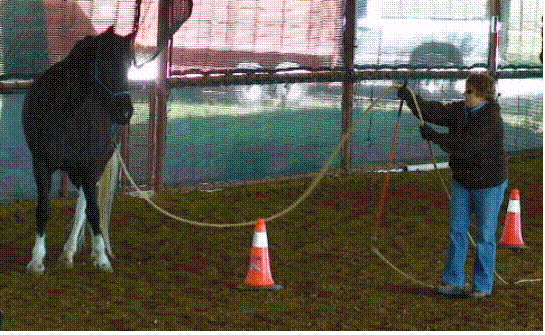
Figure 105 Asking Rocky to Weave Cones
The following photo shows yoyo through an obstacle course on
the 22 foot line.
Remember the phases for yoyo are Phase 1, wiggle your index finger
without wiggling the rope. The rope is
resting on the ground and not moving.
Rocky is intently watching and responding to my request to backup by
wigging my index finger.
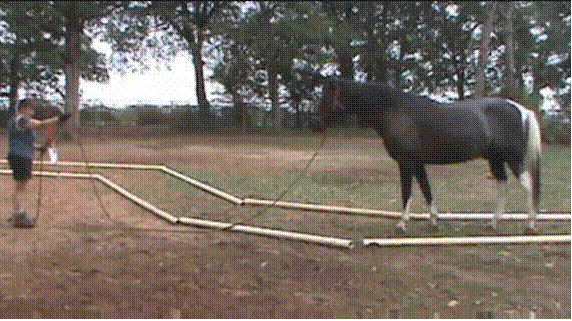
Figure 106 YoYo through Obstacles
Liberty is OUR Game
After we moved to the country in 2006 and lived with Rocky,
I started doing everything with him at liberty.
We discovered the fun of playing in the pasture without a halter and
lead rope. I would send him around trees,
circle, and jog with him up and down the sides of
ditches and through the pasture to get to the good grass. We would walk to his paddock at night for
feed, stopping at every gate. I would
use liberty YoYo to back him through all of the gates. He would get either a treat or a scratch as
his reward.
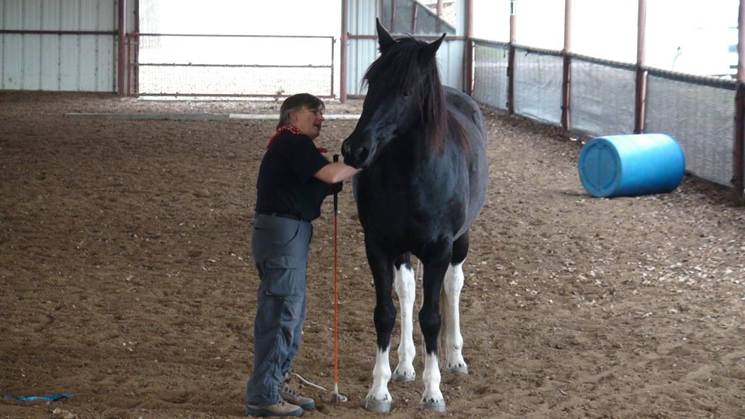
Figure 107 Friendly Reward during Liberty
Rocky loves getting scratched on his belly, neck, and
ears. This is a major reward for him and it really calms him down. I always scratch Rocky before we do any
activities. His ears let me know if he
is tense. I play with him at liberty in
the pasture all of the time. We use “stick to me” games to go hunting for
the best grass to eat and I just stand with him while he eats. This really helps us play the Parelli liberty
games.
In the following photo, Rocky runs through the cone pattern
with me. I stay on one side of the cones and he weaves the cone pattern as we run at
liberty. Notice that my legs are
mirroring his front legs. I use subtle
hand gestures to tell him when to weave.
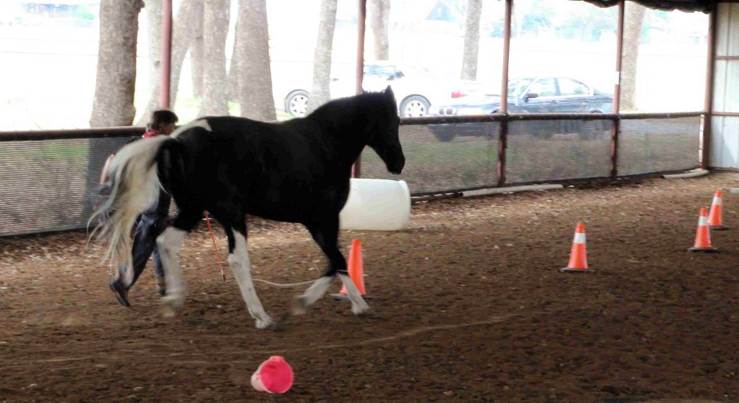
Figure 108 Liberty
Running through the Cones
In the following photo, we are weaving
the cones again. My job is to stay on
one side of the cones and guide Rocky to weave the cones at a walk or trot.
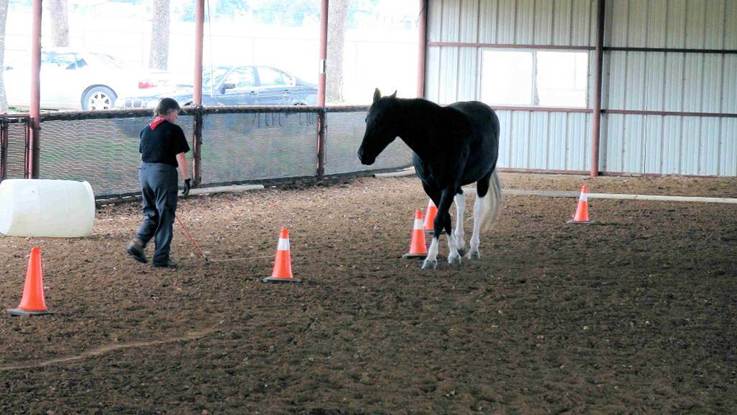
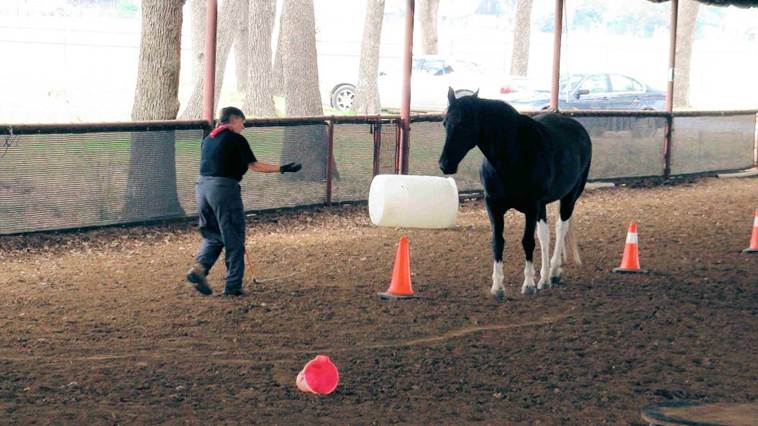
Figure 109 Liberty
Coaxing Rocky through Cones
We spend a lot of time mirroring one another at
liberty. In the following photo we are
both running through the obstacles and Rocky is going to jump the barrel while
I run beside him. I jump the shorter
obstacles with him. I run beside him and
jump in the air when he jumps the taller obstacles that I can’t jump.
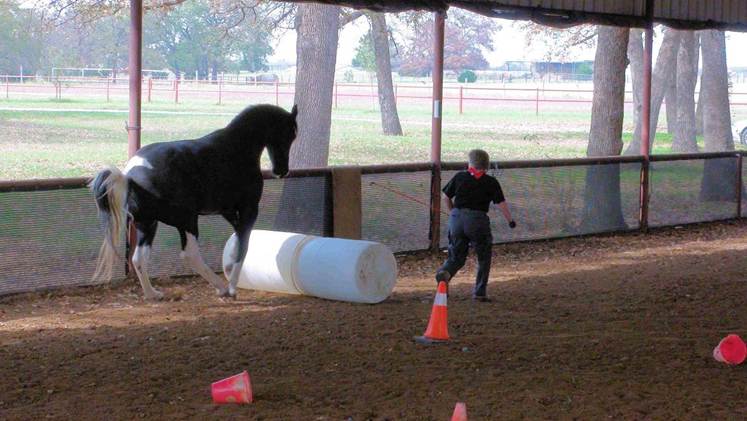
Figure 110 Liberty
Barrel Jumping
Rocky just loves to stand on pedestals. Whenever I use poor body language to
communicate or he doesn’t know what I want, he will go stand on the pedestal if
one is available. Of course, as a left brained horse, what is in the pedestal for him? He is hoping for some dwell time with a belly
scratch or maybe a treat.
In the following photo, Rocky is looking at his reflection
in the dressage mirror at the end of the arena.
Rocky loves looking into that mirror.
He is a real ham. The image of the
other horse never bothers Rocky, he just looks at it. When we ride by the mirror, he always swings
his head to check and make sure that other horse is
still there.
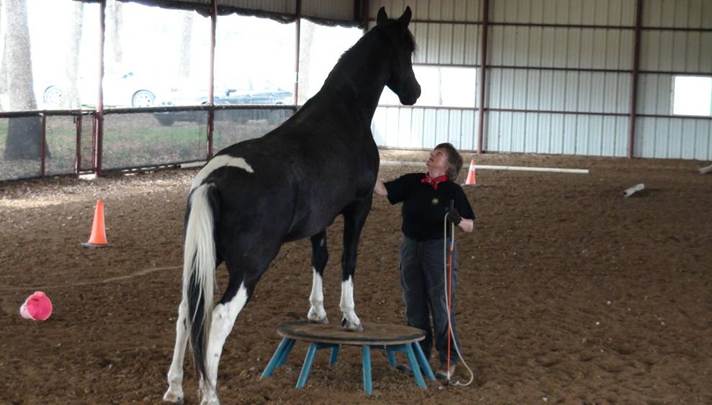
Figure 111 Rocky on Pedestal
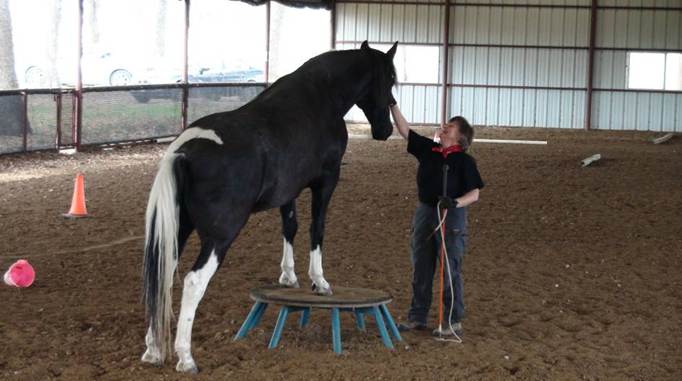
Figure 112 Bonding with Rocky on Pedestal
In Level 3, we started learning to use the carrot stick for
communication during riding. We also started using the savvy string around
Rocky’s neck to ride bridleless. We
started by using a carrot stick to re-enforce my body language. My body language is to use “eyes, body, legs,
and then carrot stick” to tell Rocky where I want to go before either picking
up the reins or using the carrot stick. Later,
we started riding without the carrot stick and using just the savvy string
around Rocky’s neck.
The following photos were taken in the summer of 2010. We were playing a carrot stick riding game
where you use the carrot stick to get rings off of
bracket on the fence.
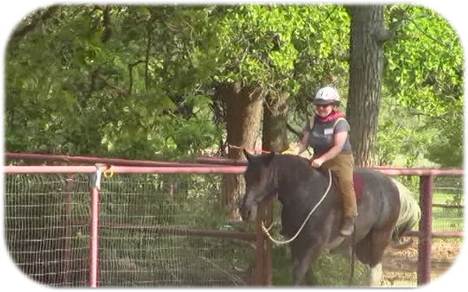
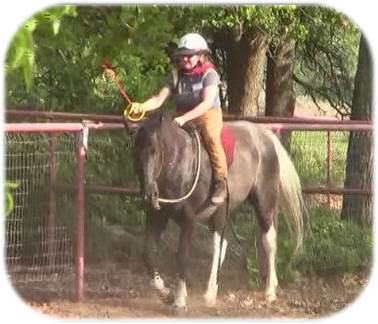
Figure 113 Playing Games
while Carrot Stick Riding
The following photos show us practicing freestyle riding, jumping,
and carrying tarps while riding bareback.
We practiced riding with and without the carrot stick. Rocky has a savvy string around his neck. In the photos, I am learning to use my body
to communication more that the savvy string.

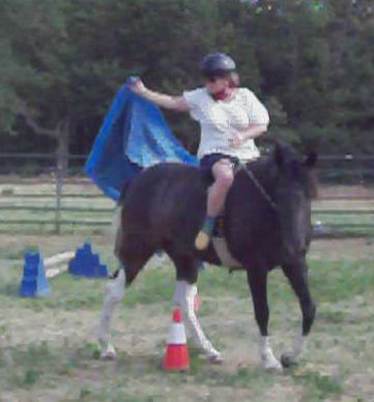

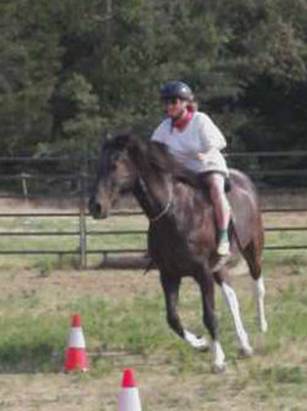

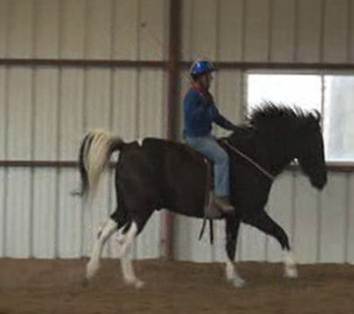
Figure 114 Freestyle Riding


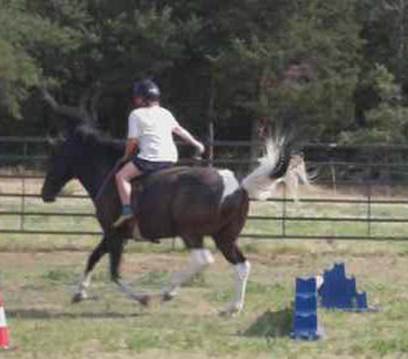
Figure 115 Freestyle Jumping
Level 3 has self assessments and official audition
assessments using video tapes. In the Parelli
Levels Pathways, Level 3 has three areas of assessment: Online, Liberty, and Freestyle riding. Once you have completed all
of the tasks in the Official Self Assessment, you create a 10 minute video for that area of assessment. Each area has a list of compulsory tasks and the video should show you and your horse doing
those compulsory tasks. The Parelli team
reviews the audition tape and offers advice for any areas where you need more
practice to achieve a Level 3 competency.
I made our Level 3 Online, Liberty, and Freestyle audition tapes using a
camera mounted on a tripod in a second floor window of
our house. I recorded playing with Rocky
every night for several weeks and cut out 10 minute
sections that seemed to show most of the compulsory tasks needed for the Liberty and Online
auditions. We passed Liberty with the first audition tape. I had to submit a second Online audition tape
showing more subtle directions at the end of the 22 foot
line. We passed Online with the second
audition tape.
We passed the Level
3 OnLine and Liberty
assessments in December 2010. Freestyle
riding was a challenge for completing Level 3.
Rocky has a fantastic TWH rocking chair canter, but the transition into
the canter is very rough. We worked really hard on maintaining gait and direction, especially at
the canter and transitions from the canter to a trot. Rocky is a GO horse and when we start
cantering, he gets excited and wants to GO GO GO. He is not being aggressive in any way, he is just happy to be going. After cantering, it takes a few minutes to
slow him down for other activities. Once
we start cantering, he thinks cantering is the answer to everything until we
stop and spend a few minutes of dwell time. We practiced transition tasks, walk – trot –
canter – trot – walk, to improve our skills with transitions and maintaining
gait.
We passed the Level
3 Freestyle assessment in July 2011 riding bareback and bridleless!
Chapter 10 Retrospection
Just imagine, the horse stands 15 ½ hands at the shoulder (his shoulder is
taller than you) and weighs in at 1100 pounds.
He is 20 feet in front of you and facing you. You have just sent
him there, hoping for a few seconds of dwell time to collect your thoughts in
the hot sun and wipe the stinging sweat from your eyes. His tail suddenly
makes a quick swish and he simultaneously pins his
tense ears back, his eyes roll, his nostrils tense up, and he charges directly
at you. What do you do?
He was only 20 feet away and now he is closing in fast. His first giant stride puts him halfway to
you. You can’t run – he would be on top
of you with his next powerful stride. You
don’t have time to shorten the lead rope. You pivot into a power position
with both feet firmly on the ground, bend your knees slightly, and lower your
center of gravity. You try to send a wave of energy down the lead rope as
you swing the carrot stick into position between you and the charging
horse. Once the carrot stick is making a barrier between you and the
charging horse, you put a determined look on your face and vigorously march
toward the horse. Remember to keep making the carrot stick barrier and as
you advance shorten the lead rope, if you can. When he sees the carrot
stick won’t let him bite you, he tries to rear and use his front hooves. You stretch up to raise the carrot stick barrier
up to match his height and keep moving toward him. You can make a barrier to match his rearing height with your arm reach and the 4 foot long carrot stick.
He pivots
to your left side to avoid the carrot stick barrier and swings around to face
you. He is ready to continue the
dominance battle. You give him a stern
warning look and firmly hold the carrot stick ready for his next move. This event took less than 5 seconds but it seemed like an eternity to you. He doesn’t like it
but you won this round of the dominance game.
Why did Rocky back down from the carrot stick barrier and
the energy in the lead rope? Let’s face
it – he could easily bite me or knock me over.
His past patterns were to bite me or to grab the stick and run away with
it. What changed? On several occasions, he has galloped head first into the carrot stick wall as the metal buckle of
the lead rope banged into his chin. If
he had not backed down, this would have happened again and
again until he backed away. This
is my effective phase 4 for a charging Rocky. He knew I had an effective phase 4 and would
not hesitate to use it.
I know most people cannot possibly understand the stress and
frustration of living with a horse that you fear will physically hurt someone. With Rocky, I quickly entered a mode of being
on constant guard. Rocky had proven that
he was not afraid to carry out a frontal attack and I could not turn my back to him because he would attack from the rear. This kind of stress is absolutely exhausting,
both physically and emotionally. There
is no break or relief – the stress is with you whether you are with the horse
or not.
I took all the steps a sane, rational person would to deal with the situation. I immediately started educating myself and
seeking help from an expert. I began the
Parelli home training program and sought expert guidance from a trained Parelli
instructor. I followed the curriculum
and guidance. I attended many seminars
and training camps to get as much knowledge and help as I could to improve my
horsemanship skills and train Rocky. And
it still took me 3 years to stop Rocky’s biting and attempts to bite!
The real turning point in my relationship with Rocky
happened when I finally matured enough in my understanding of Rocky to have an
effective phase 4 that Rocky could understand and I could use it at the right
time. As Christi says
“Timing is Everything”. Christi did an
excellent job teaching me the concepts and helping me develop the skills for an
effective phase 4. However, I had to
learn to read each situation and choose the correct response. Of course, while I was learning so was
Rocky! Every time I learned new
techniques, Rocky came up with his own new approaches to counter them.
There was a period of time when I
moved too quickly from phase 1 to phase 4 and it was detrimental to our budding
relationship. Once I understood enough
about using effective phases, I starting moving too
quickly through the phases to phase 4 and it would further aggravate
Rocky. I had to learn to give him a
chance to respond with less pressure before increasing the pressure. Once Rocky realized I could deliver effective
phases, I had to learn to trust Rocky and my ability to respond effectively if
needed. This was a long process for both
of us.
This sound so easy
doesn’t it? I will always remember one
of the first Parelli articles I read. It
was in the October 2004 Savvy Times. The
article was about biting and how it is the humans
fault if the horse bites them. This is a
great article and I agree with the premise of the article but I must admit I nearly gave up so many
times. I never thought it would take SO
LONG to get to the point that Rocky stopped biting!
The article also made me realize that Rocky must have been
hit frequently in the past in response to his acts of dominance. When he bit me for the first time, I stepped
away in shock and did nothing. Later
when he bit again and I (under the advice of the 30 second rule) slapped his
neck in response, I was shocked at the level of aggression he exhibited. It became obvious to me that Rocky was
familiar with this response and fully expected to escalate his aggression in
response. I unknowingly set the stage
for our future battles.
The reason that I am discussing the amount of stress caused
by his biting and the time I spent learning to help Rocky stop biting is to set
the stage for one of my biggest challenges.
How could I ever truly trust Rocky after all the bites and dominance
attacks?
Honestly, if Rocky were a human being with these past behaviors
and physical attacks, could you trust him and be his partner? I firmly believe in the sanctity of life and
that all living creatures deserve to be treated with the
respect and dignity due their kind. Rocky stretched these beliefs beyond any
limits that I could ever imagine.
Of course, I have been presenting my views and fears. What about Rocky? He was four years old when he joined our
family and I have no idea what he experienced during those four years. Over time, I came to realize that Rocky must
have developed his extreme dominance and aggressive behavior toward people
before I met him. He had obviously been
conditioned over time to respond to humans by biting and escalating acts of
aggression until the humans left him alone.
He obviously saw me as a human to be driven away. How could Rocky ever trust me?
Rocky’s respect for one human does not transfer to another
human. Christi demonstrated many rope
and carrot stick handling skills using Rocky in our training sessions. I immediately saw that Rocky respected
Christi and responded with respect to her use of the tools and techniques. This RESPECT DOES NOT TRANSFER to other
people holding the lead rope and carrot stick.
I had to earn Rocky’s respect by learning the skills and applying them
properly. This means learning effective
phases for every situation.
This caused a lot of bumps in our “rocky” relationship in
Parelli Levels 1 and 2. Rocky and I
would attend a training camp and I would feel so good
about our progress. After a few days,
our relationship would start to deteriorate because Rocky would challenge me in
new and different ways. I had to learn
to adapt what I learned to respond effectively.
This is basically what Rocky was doing, he came away from our training
camp with a new respect for Christi and me; but, being a very dominant left brained horse, he was thinking of new ways to test my
skills and challenge me in the dominance games.
I personally learned a lot of important lessons in my
natural horsemanship detour. I have
always viewed life as a journey to be enjoyed.
I discovered how difficult the journey can be when you are in constant
fear of acts of aggression by another, unable to let down your guard, and
unsure if you have the skill to protect yourself.
Learning is easy for me as a life-long learner in my
profession, hobbies, and personal development.
Learning horsemanship skills was a huge challenge that required a
physical, mental, and emotional commitment over an extended period
of time. I started the Natural Horsemanship
journey totally unprepared for these commitments and the amount of time required
to help Rocky overcome his issues.
Getting help from an expert also came easily for me. I am a firm believer in getting advice and
help when you need it. I didn’t have an
ego to keep me from seeking help. Finding
the right expert is not easy. I am
exceedingly fortunate to have found an expert (Christi Rains) willing to spend
so much quality time helping me.
I found ways to not get discouraged. My husband has often said that I should be
used as the definition of optimism in the dictionary
but it was not easy with the challenges posed by Rocky. I really had to work hard to find ways to see
progress and keep going. My solace was
always in lesson #1 – life is a journey to be enjoyed and then I would try to
identify and focus on small successes.
Sharing my personal feelings is not easy for me. For the longest time, I assumed my problems
with Rocky were totally my fault and I didn’t know how to share his behavior
and the extent of my fears with anyone.
I perceived the situation as my failure because I couldn’t find any
information anywhere about anyone that seemed to have similar problems with
their horse. I absolutely hate it when I
am told “no one else has this problem so it must be you”. The
Parelli Horsenality information helped me recognize Rocky’s behavior as natural
horse behavior albeit extreme left brain dominant behavior. I decided to write this book so others could
realize their situation is not hopeless and hopefully help by providing some
useful information about the techniques that worked for Rocky and me.
I learned a lot of important lessons about the Horse and Human partnership. I learned:
to
understand Rocky and walked quite a few miles in his hoofs,
what Rocky likes and doesn’t like,
to
listen to what Rocky’s expression and body language was telling me.
To some extent, I learned to think like a horse.
I came to realize that Rocky watches me constantly with his
eyes and his ears. Sometimes, his attention is so subtle that I hardly notice
it. He also senses my body with
his. Rocky anticipates my actions based
on subtle cues that I didn’t realize I was giving him. I learned to focus
my cues for more effective communication with Rocky.
I learned to use effective communication skills with my body
language and apply different phases of pressure. I learned to pace our activities to match
Rocky’s needs. A partnership requires
both parties to communicate and look out for the other partner. I learned to be the leader and partner that
Rocky needed.
I realized Rocky was learning with me
and I had to adapt to a constantly changing horse. I learned to use my evolving horse knowledge
to keep pace with Rocky’s growth and to adapt my communication skills to match his
changing needs.
I learned how to trust my horse partner and myself. Your partner just wants to survive and live
with the dignity due him. Rocky is a herd animal and knows he needs a
partner – I learned to be the partner he needs.
In Level 2, Christi spent a lot of time explaining Parelli’s
eight responsibilities for the
horse and human partners.
Rocky’s responsibilities as the horse are:
1. Don’t act like a prey animal.
2. Don’t change gait.
3. Don’t change direction.
4. Look where you are going.
My responsibilities as the human
are:
1. Don’t act like a predator.
2. Have an independent seat.
3. Think like a horse.
4. Use the natural power of focus.
Rocky never really behaved like a prey animal – he is a
dominant animal full of confidence and refused to be anything else. Parking is the one instance where I now
realize Rocky behaved like a prey animal.
In the beginning of our relationship, Rocky would stretch out into a
full Tennessee Walking Horse (TWH) park pose and stay frozen there with a
totally different look on his face. He
seemed to park when he was frustrated.
When he parked, Rocky had a totally different demeanor than his normal
aggressive confident dominance attitude.
By now, I have seen a lot of horses in training camps and at
playdays. I have learned to recognize
horses switching to “right brained” when they roll their eyes so you can see
the white of their eyes. The only time I
have ever seen Rocky roll his eyes with a right brained
switch was in those early days when he would stretch out into his TWH park
pose. He stopped doing this during our
Level 2 activities.
Don’t change gait and don’t change direction are hard for a
dominant horse who wants to take charge all the time. We are still working on don’t change gait or
direction while we are riding. I used
Linda Parelli’s ideas about being the ambassador of “YES” instead of always
saying “NO”. Rocky is always interested
in grazing if there is anything to eat.
We spend a lot of time taking turns to pick the
grazing spot. Rocky is always the winner
because he gets to eat but he has to let me pick the
grazing spot 50% of the time. When it is
my turn to pick the grazing spot, I get to pick the direction, how far we go,
and how fast we get there. I let him
pick the spot by just being a passenger when he is in charge.
Look where you are going.
This one is pretty easy for Rocky. He is confident and always aware of where he
is going and wants to go. Of course, I
had to learn not to nag him and let him actually do
this. For example, we ride up and down
ditches and our pond bank. I had to
learn to let Rocky pick the best path up and down the slopes instead of nagging
him with little corrections every few feet.
I try really hard to not act like a
predator, but of course, I don’t always succeed. After we got over our original “rocky”
relationship, I acted more like a predator at times than a partner because I
didn’t trust Rocky and used too much pressure on him. I had to learn effective phases
and how to use the least amount of pressure possible. Now I let Rocky set the pace and use pressure
accordingly.
Riding is a new adventure for me
and I am still working on an independent seat.
I started riding bareback so I could learn to feel Rocky’s movement and
synchronize with it. I have a poor sense
of rhythm and riding bareback has helped a lot.
I really enjoy Linda Parelli’s fluidity lessons on the DVDs and they have helped me immensely.
I have tried hard to learn to think like a horse. Parelli devotes a lot of time to
anthropomorphism where people tend to think about horses in terms of human
emotions and traits. I grew up around a
lot of animals and have always realized that each species has certain innate
characteristics and that each individual has their own
personality. I have always tried to
think of Rocky as a horse and understand his horse perspective. Parelli’s Horsenality theories and Christi’s
experience really helped me understand Rocky.
I spent a lot of time mirroring Rocky so I could learn to see life
through his eyes, body language, and emotions.
We still spend a lot of time mirroring.
I am still learning to use the natural power of focus. Mirroring on the ground really helped me
understand Rocky’s power of focus and synchronize with him. Riding is the area where I am trying to
master focus using “eyes, belly button, leg, and then reins or carrot stick” to
guide Rocky.
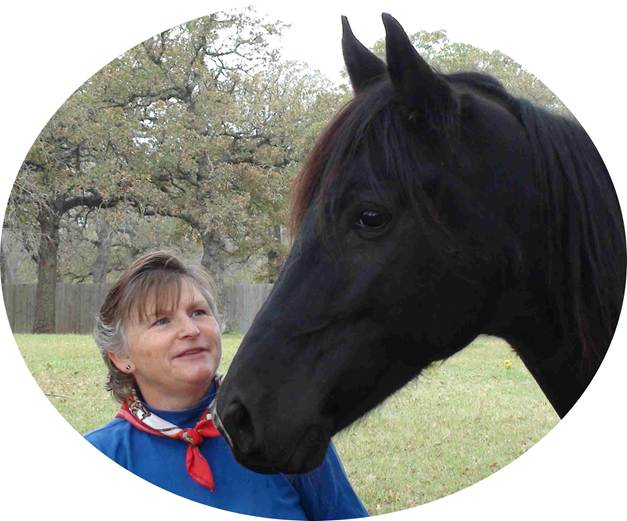
Figure 116 Partners at last
Rocky is half of our horse and human partnership. I learned volumes about him on our natural
horsemanship journey. Rocky has a huge
heart full of hope and forgiveness. He
naturally forgave all my mistakes along the way. After we got over our initial “rocky”
relationship, Rocky was a different horse.
He seemed to have lost a lot of old emotional baggage and now starts
each day as a new beginning without any animosity about past human mistakes. Instead of waiting for me with his “I am
ready to beat you in the dominance games” full face stare, he eagerly runs to
greet me to see what the new day has to offer us. This one change has made all
of the sweat and tears worthwhile.
Rocky is proud and rightly so. He knows his jobs with the games we play and
the tasks we do around the ranch. He
hates being asked with too much pressure or nagged. He wants me to be direct when I ask him and
then let him do his job. Rocky has a well developed sense of justice and fairness. If I ask him with too much pressure, he gives
me a look that lets me know that I was unfair.
If I use poor communication and he isn’t sure what I want, he has a
quizzical look that lets me know he doesn’t understand.
Rocky is obviously the undisputed alpha of our small horse
herd and the pasture. He is a gentle and
dedicated alpha protecting his herd against all of the
local predators. We have coyotes,
bobcats, and mountain lions that move through our pasture to get to the
wildlife management area adjacent to our property. Rocky protects “his partner” as we calmly
ride bareback in the pasture that is his domain. Rocky is happy living the life of a horse.
Rocky enjoys life and is finally happy. The following Parelli Horsenality Positive
Attributes chart shows where I would rate Rocky today. Red checkmarks denote Rocky’s
characteristics. I rated him moderate
for athletic instead of extreme to indicate that he wants to know what is in it
for him before he expends the energy. He
can still be a GO horse that doesn’t tire easily but he is a slow horse when I
ask him to be a slow horse. Rocky is so
willing to do whatever I ask that I believe Rocky has become an “all-round”
horse in our partnership.

Figure 117 Parelli Horsenality Positive Attributes Chart
We attended a “Dancing with Horses” clinic with the Equus
Projects dancers (http://www.dancingwithhorses.org/)
in 2009. Rocky and I both had a lot of
fun. It was a very different experience
for both of us. We did a lot of
simulations and activities on the ground to develop and improve our sense of
balance and rhythm. I learned a lot
about my posture and flowing with Rocky while we ride.
“Eyes, belly button, legs, and finally the reins” is the Parelli
approach to using our body to let the horse know where we want to go. I developed a better understanding of my own
body and areas where I needed to improve my flexibility so I could improve my
communications with Rocky.
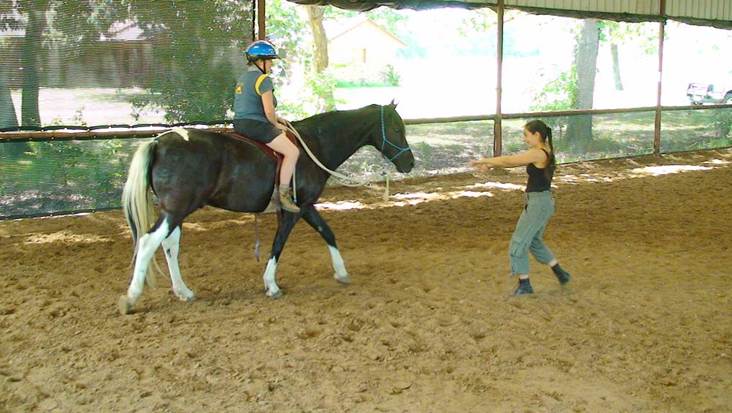
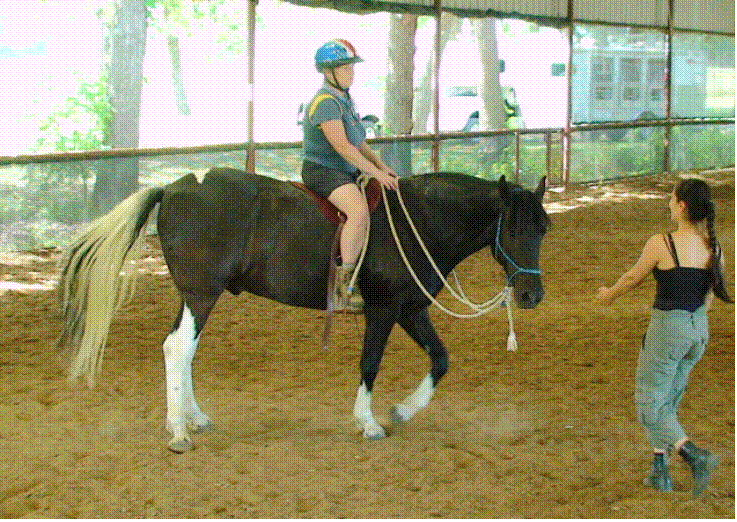
Figure 118 Mirroring with a Dancer
The dancers helped us learn to listen to our horse’s rhythm
and develop ways to naturally flow with our horse. The dancers use mirroring and other natural
horsemanship techniques to help us improve our human communication with horses. We practiced a new kind of mirroring. We (Rocky and I) learned to mirror the
dancers instead of one another during the clinic. It was a unique and rewarding experience.
Rocky had a lot of fun!
As a left brained introvert who is easily
bored, it was a totally different experience for Rocky. He is quite happy and intrigued in these photos.
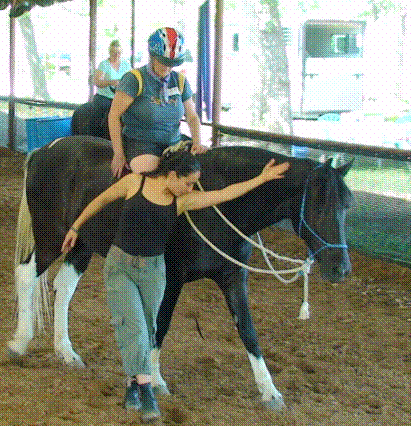
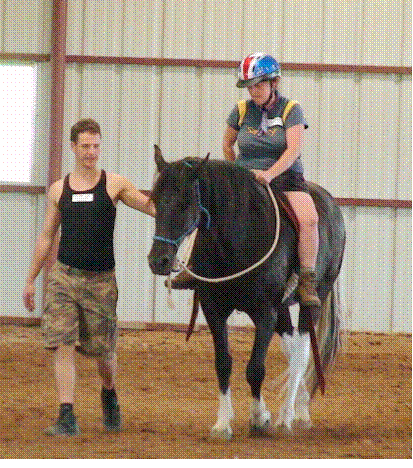
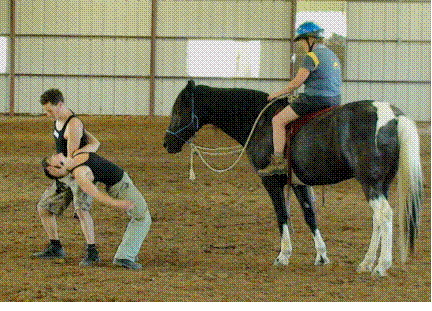
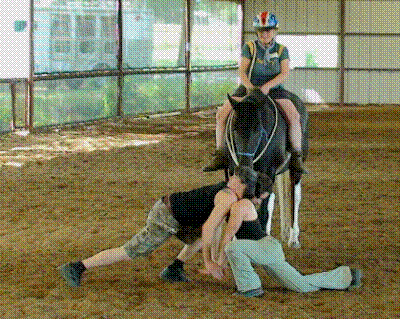
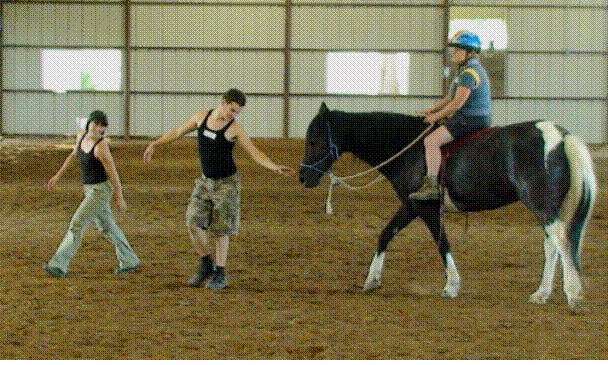
Figure 119 The Equus Projects Experience
The following photos show Rocky just enjoying himself. Rocky is finally a happy horse.
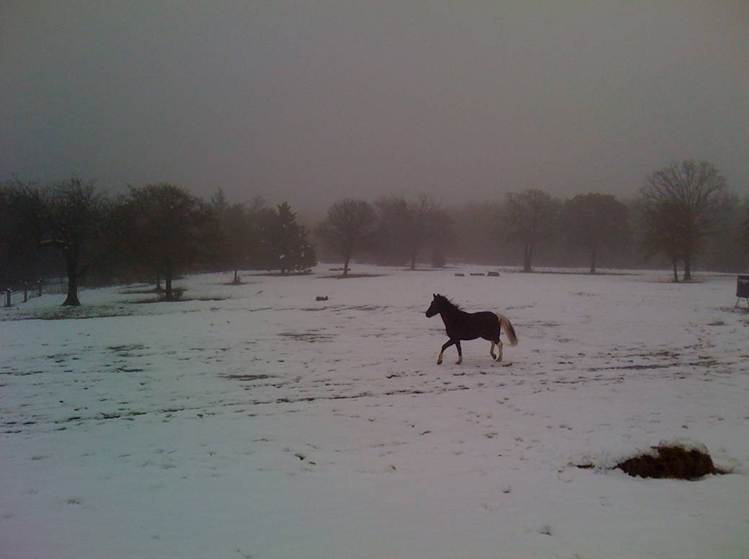
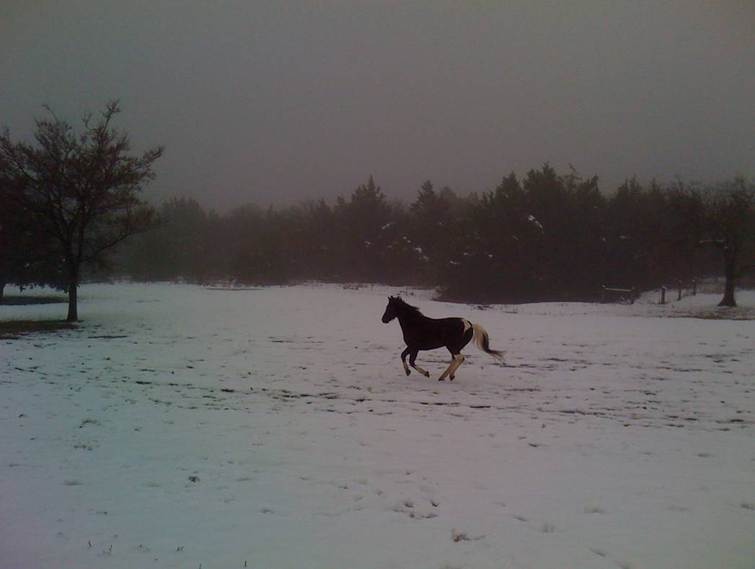
Figure 120 Freedom in the Snow
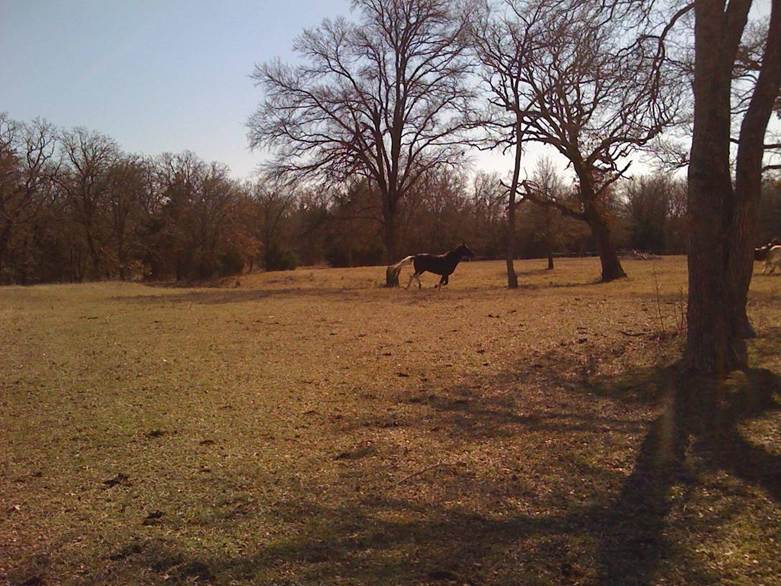
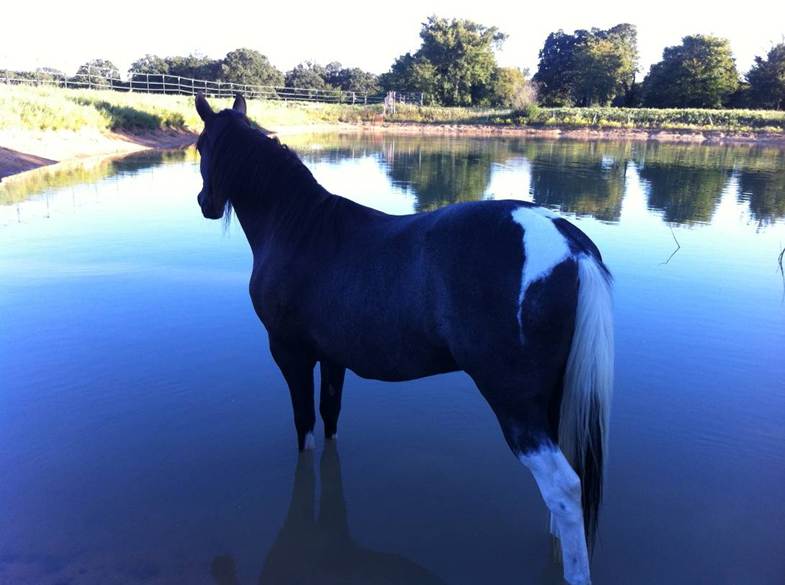
Figure 121 Freedom in the Pasture
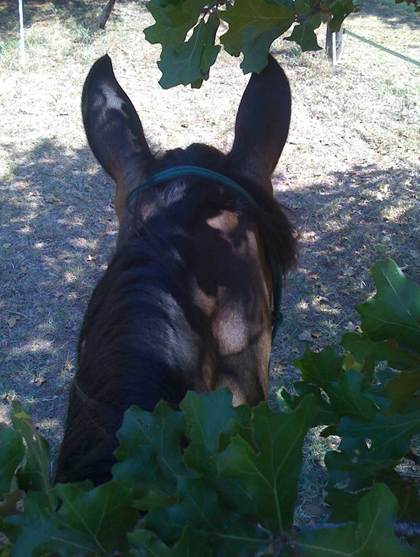
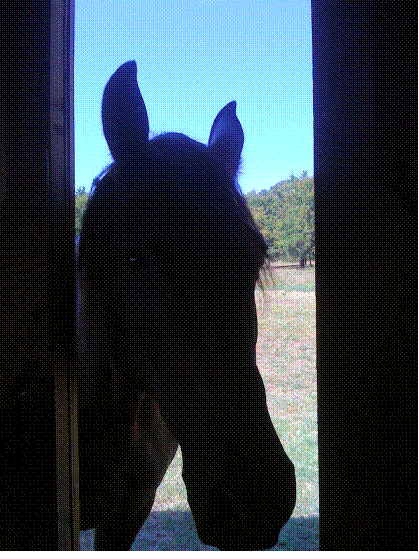
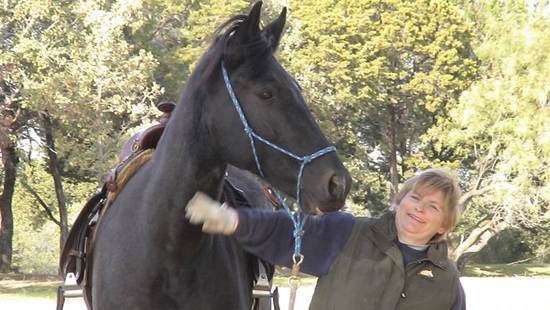
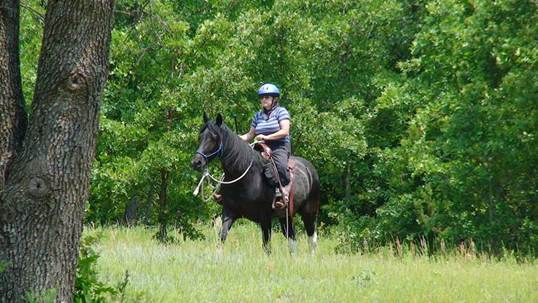
Figure 122 Happy Ears Say it ALL
Figure 123 Enjoying a Moonlit Ride behind our House
I enjoy stargazing and spend a lot
of time just hanging out with Rocky at night so we can both enjoy the night
sky. Sometimes I saddle him with the
bareback pad and just spend quiet time sitting with him.
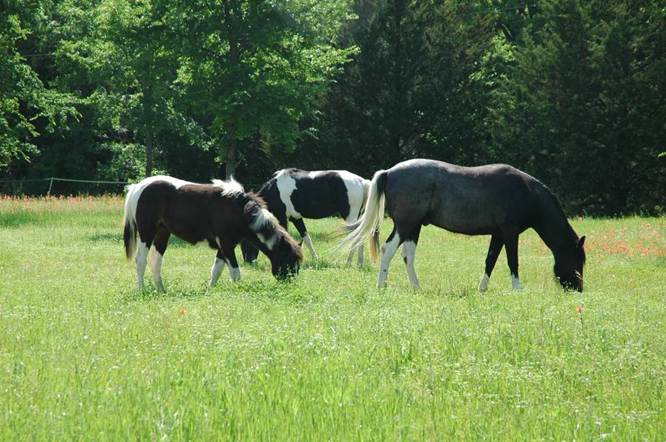
Figure 124 Rocky with his Herd
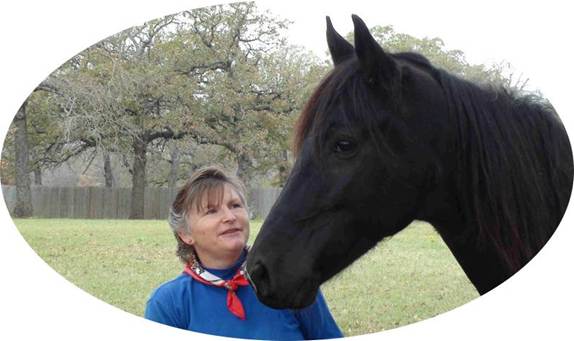
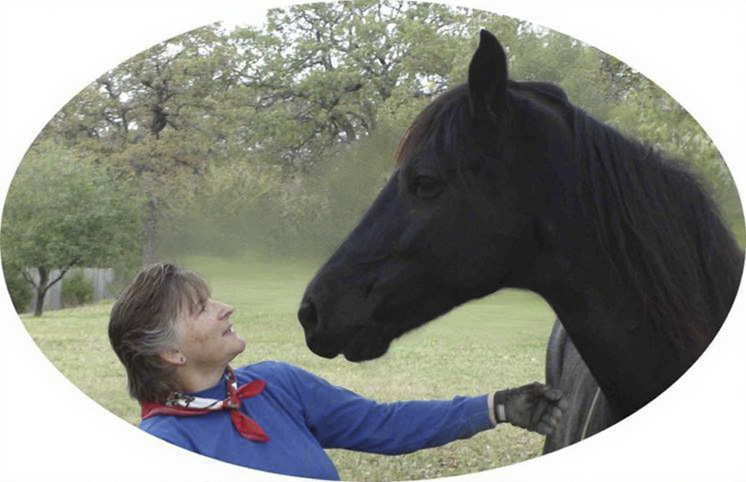
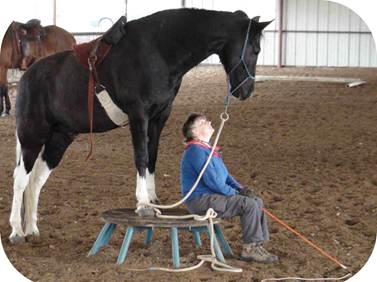
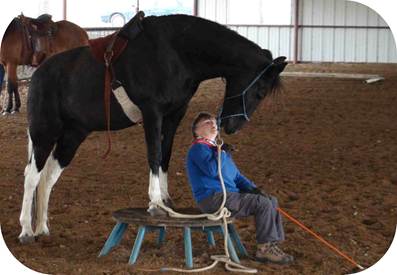
Figure 125 Portrait of Partners
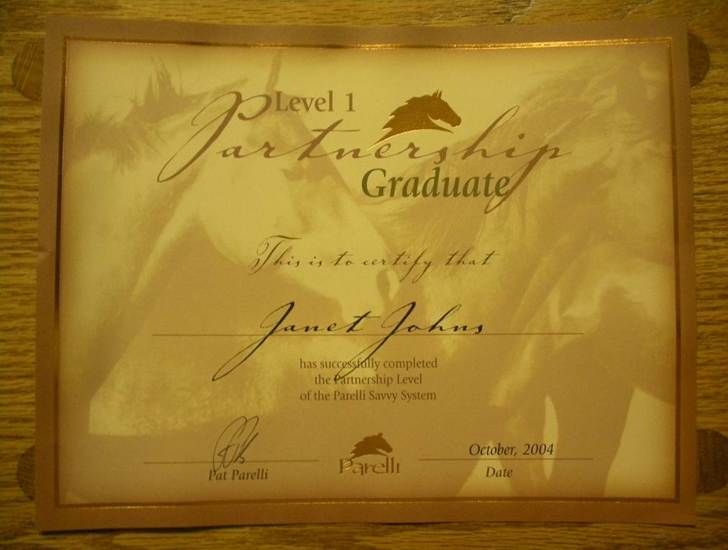
Figure 126 Parelli Level 1 Certificate
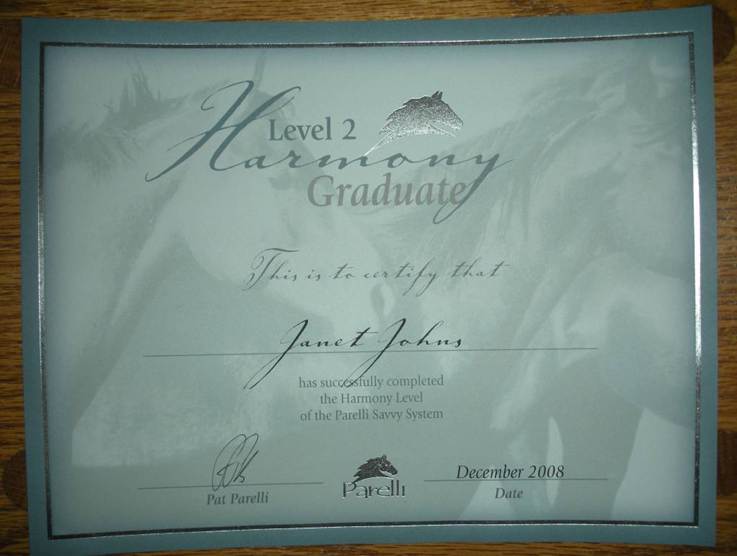
Figure 127 Parelli Level 2 Certificate
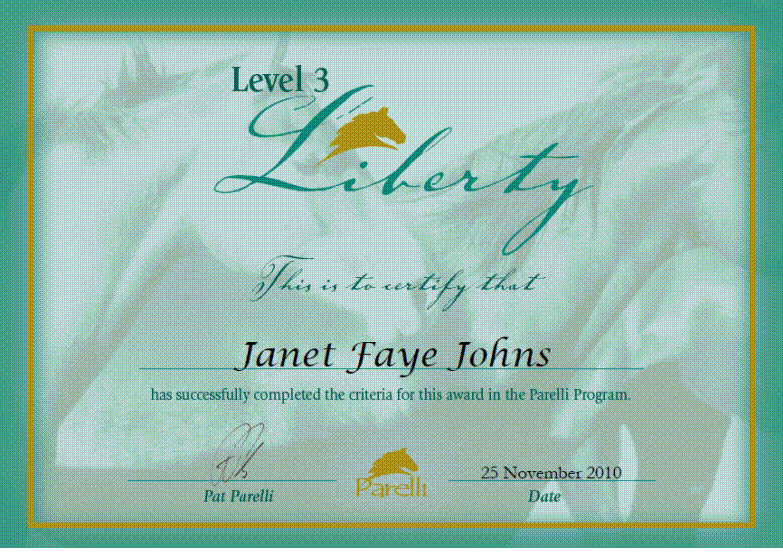
Figure 128 Parelli Level 3 Liberty Certificate
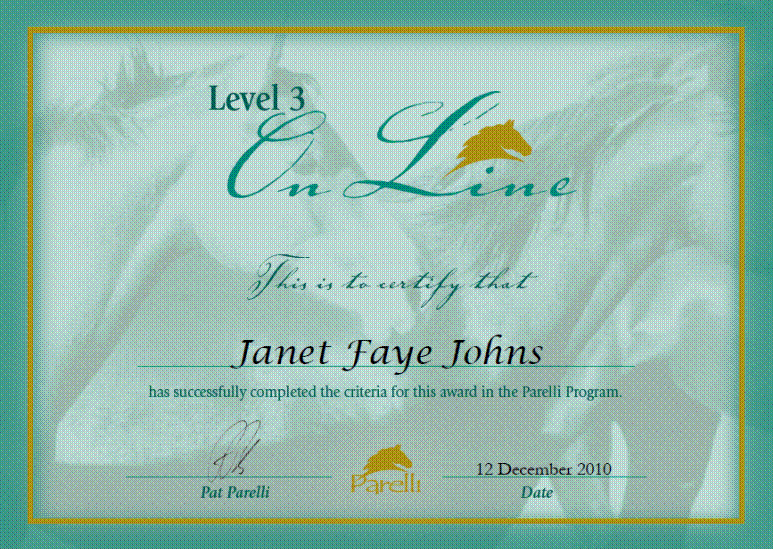
Figure 129 Parelli Level 3 Online Certificate
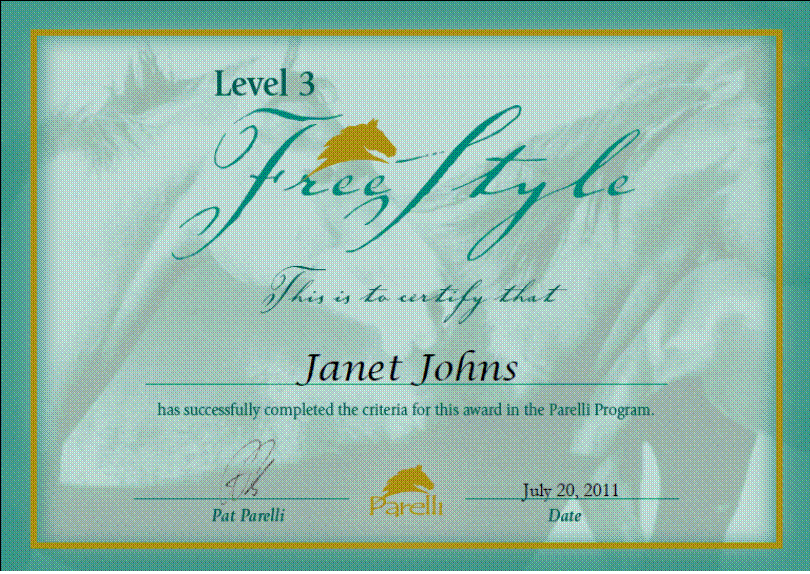
Figure 130 Parelli Level 3 Freestyle Certificate